
Analysing a Primary Source: Faxian’s Travelogue
Aim
To read a traveller’s account of the Gupta period, tell what he saw apart from what he thought, and see why historians cross-check sources.
Apparatus
- Two passages from Faxian’s travelogue (James Legge’s 1886 translation, in place of the textbook excerpt)
- Two highlighters of different colours (yellow and pink)
- A notebook with the observation table, a pencil
Procedure
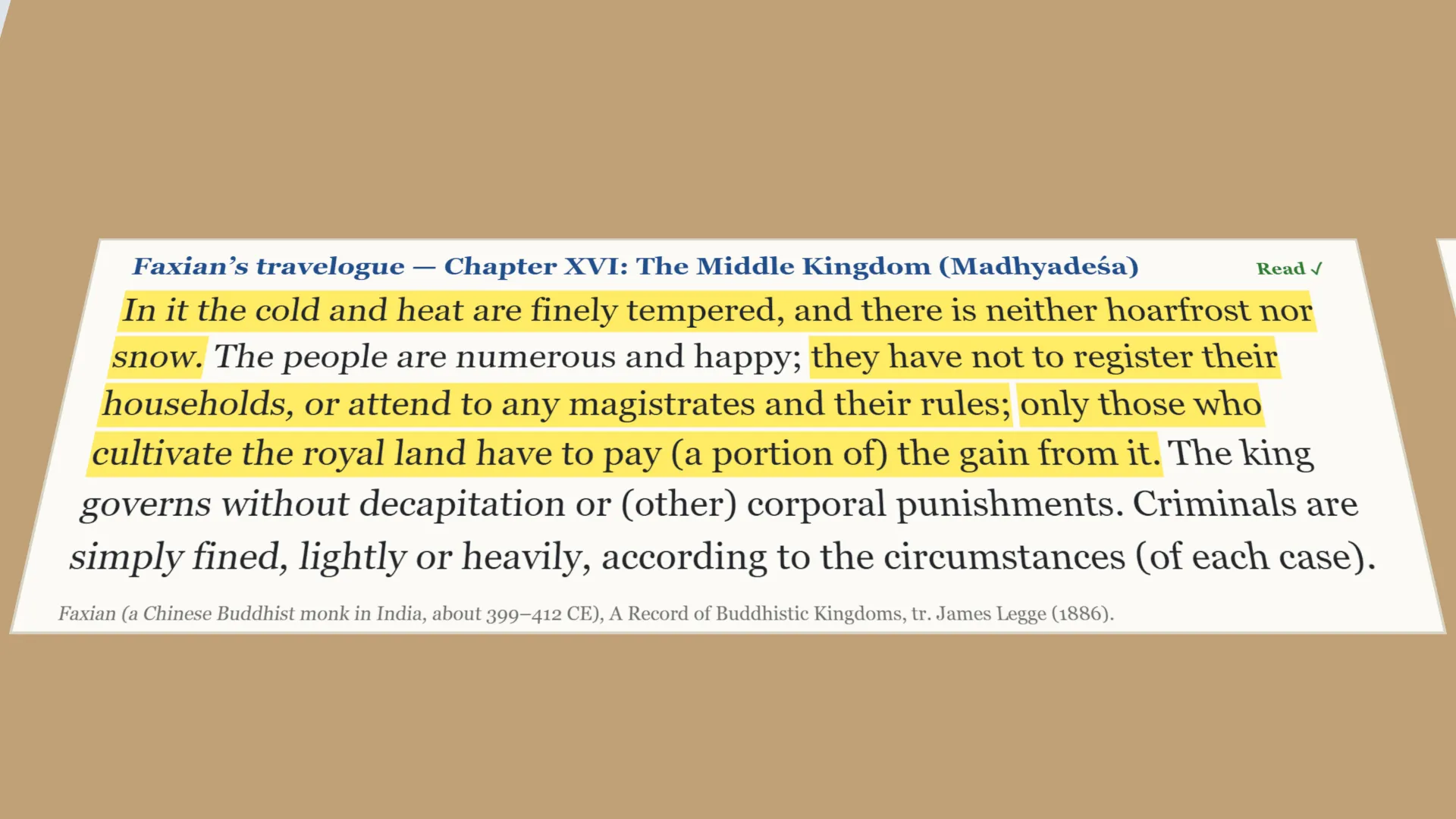
- Read the two passages from Faxian’s travelogue carefully, twice. Tap each passage.
- With the yellow highlighter, mark what Faxian directly observed, such as who gave medicine.
- With the pink highlighter, mark Faxian’s own opinions, such as calling people ‘happy’.
- List five features of Gupta-era society in the table, each as an observation or an opinion.
- Faxian also wrote about the harsh treatment of the chaṇḍālas. Discuss why historians must consider this too.
- Note one limitation of relying on a single traveller’s account.
Interactive 3D Experiment
Loading simulation…
What to observe
- An observation says what Faxian saw or was told, such as fines instead of harsh punishments or free houses of medicine.
- An opinion is his own judgement, such as calling the people ‘happy’ or ‘righteous’.
- The chaṇḍālas were kept apart and avoided, so the happy picture was not true for everyone.
- One visitor saw only some places at one time. Historians check his account against inscriptions and coins.
Notes
- A primary source like Faxian’s travelogue tells us what one traveller saw and thought at one point in time. Historians compare such accounts with inscriptions, coins and other sources to build a fuller and fairer picture of the past — this is called corroboration.
- Read the passage carefully before highlighting. Do not assume that one account describes all sections of society equally.
- The passages are Faxian’s own words in James Legge’s translation, ‘A Record of Buddhistic Kingdoms’ (1886).