
Constructing a Family Tree and Mapping Roles
Aim
To construct a simple family tree of one’s own family, identify the roles and responsibilities of its members, and classify the family as joint or nuclear.
Apparatus
- A4 sheet or notebook
- Pencil and ruler
- Colour pencils or sketch pens
Procedure
- Draw a family tree starting with your grandparents (if any) and working down to yourself, using boxes joined by lines.
- Write the name and relationship of each member inside their box, for example Father, Chittappa, Mausi.
- Ask your family members about the role or responsibility each person has at home, such as cooking or helping with homework.
- Record this in the observation table.
- Look at the generations and relatives living together, and classify your family as joint or nuclear.
- Exchange your family tree with a partner and discuss one similarity and one difference between your families.
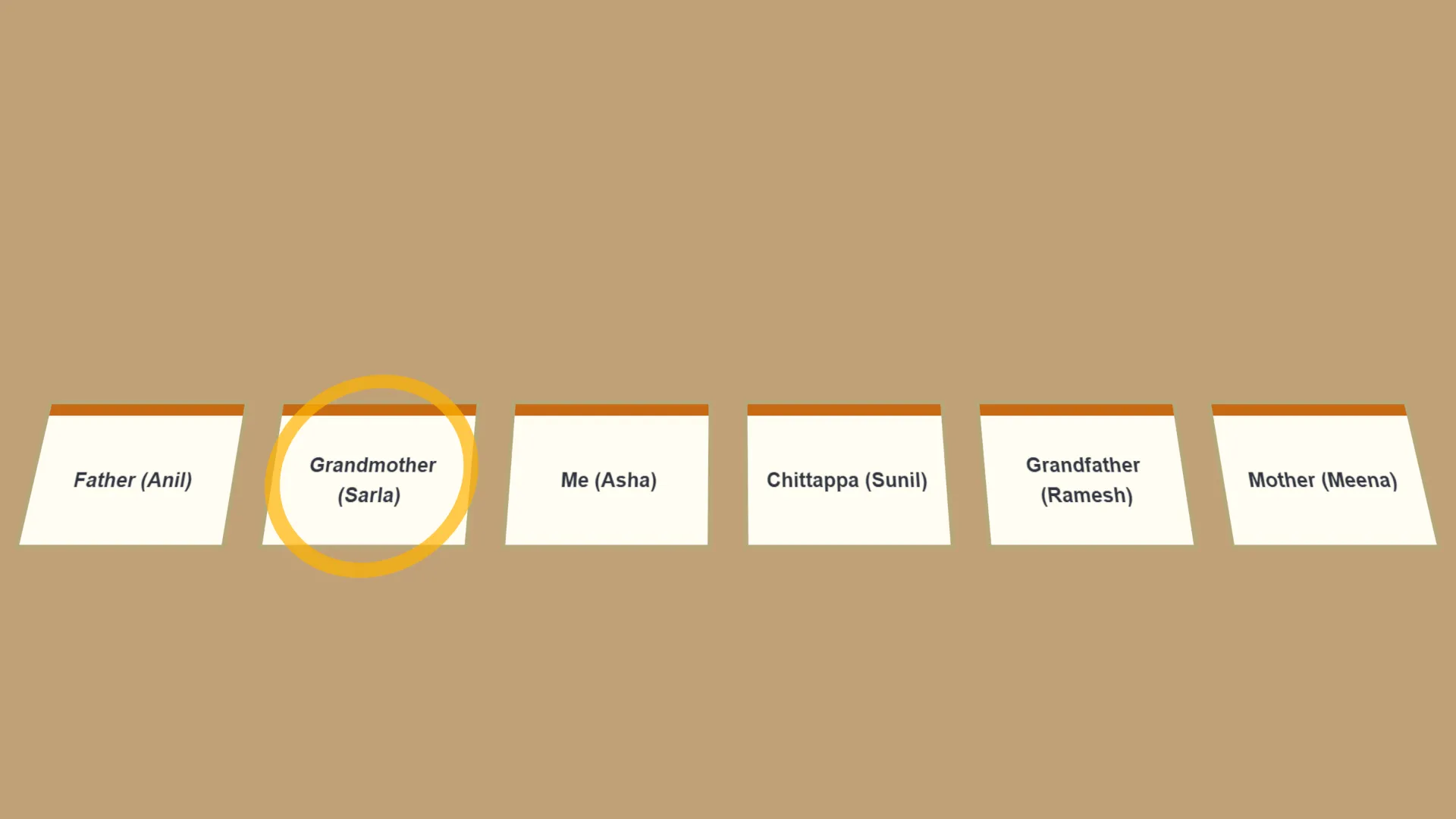
Interactive 3D Experiment
Loading simulation…
What to observe
- Every member of a family has a role, and the members depend on one another.
- A joint family has several generations living together; a nuclear family is a couple and their children.
Safety
- Use respectful language while asking family members about their roles.
- Make sure the family tree is neatly and clearly labelled.
Notes
- A joint family has several generations living together, while a nuclear family is limited to a couple and their children. In some Indian languages, cousins may be addressed using kinship terms such as brother or sister, reflecting the importance of extended family relationships.