
Analysing Primary Sources: Fact, Opinion, and Inference
Aim
To analyse statements from primary sources — Babur's Baburnama, Domingo Paes's travel account and Timur's memoirs — and to classify each one as a Fact, an Opinion or an Inference.
Apparatus
- Printed statement cards made from the source excerpts
- Worksheet (observation table)
- Pencil
- A small box or envelope to hold the cards
Procedure
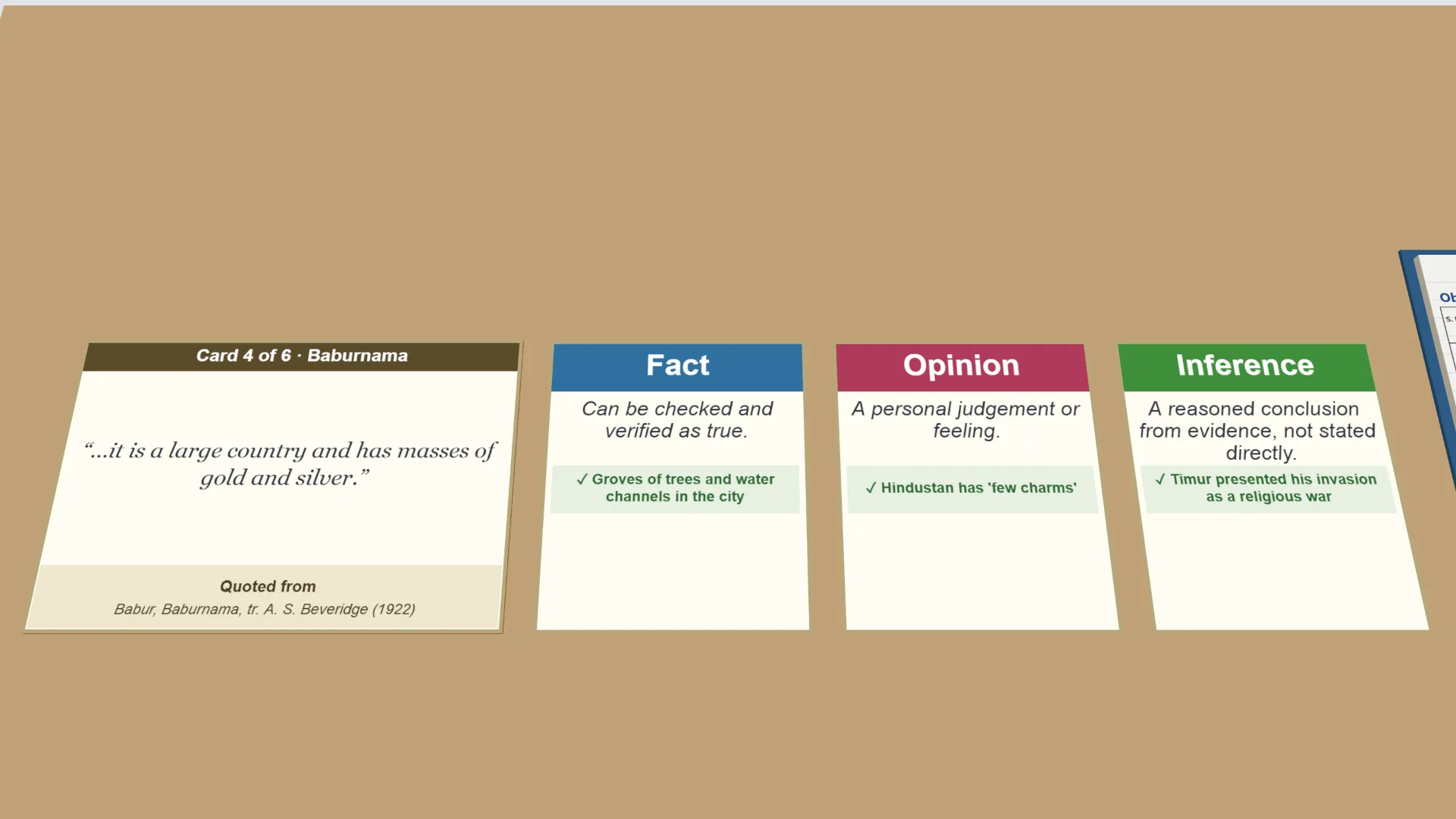
- Recall: a Fact can be checked; an Opinion is a feeling; an Inference is concluded from evidence.
- Take the statement cards out of the envelope one at a time.
- Read each card and decide whether it is a Fact, an Opinion or an Inference, with a reason.
- Sort the cards into the three piles and record them in the observation table.
- Discuss: does knowing who wrote a source change how you judge its statements?
Interactive 3D Experiment
Loading simulation…
What to observe
- A fact can be checked against other evidence, such as the ruins of Vijayanagara.
- Words like "seemed to me", "few charms" and "very beautiful" show an opinion.
- An inference is not written in the source; a reader concludes it from what is written.
- A conqueror, a foreign traveller and a court chronicler each write from their own point of view.
Notes
- Social Science Spark: a primary source is an account by someone who saw or took part in the events. Babur's Baburnama and Paes's account are primary sources, but they show their authors' views, so historians cross-check their facts.
- Precautions: handle the cards carefully so they can be reused; discuss reasons respectfully when classmates disagree.
- The quotes are from old public-domain English translations: Domingo Paes, tr. Robert Sewell, A Forgotten Empire (1900); Babur, tr. Annette S. Beveridge, The Babur-nama in English (1922). Timur's aim is in the lab manual's own words.