
Exploring Two Habitats — Biotic and Abiotic Components
Aim
Explore two nearby habitats and find the biotic (living) and abiotic (non-living) components in each.
Apparatus
- Science notebook (lab record) and pencil
- A magnifying (hand) lens, to look closely at small organisms
- A measuring tape or metre scale
- A camera or phone to take photos (optional)
- Two safe, nearby habitats, for example a pond and a large tree
Procedure
- With your teacher, choose two nearby habitats — here, a pond and a large tree.
- Observe the first habitat quietly. Look closely at the leaves, soil and water with the lens.
- List every living being you can see — plants, animals, insects, birds and tiny organisms.
- List the non-living things — water, soil, air, sunlight, temperature, stones.
- Repeat steps 2 to 4 for the second habitat.
- Record your lists in the table, living and non-living things in separate columns.
- Compare the two habitats. How are their components different?
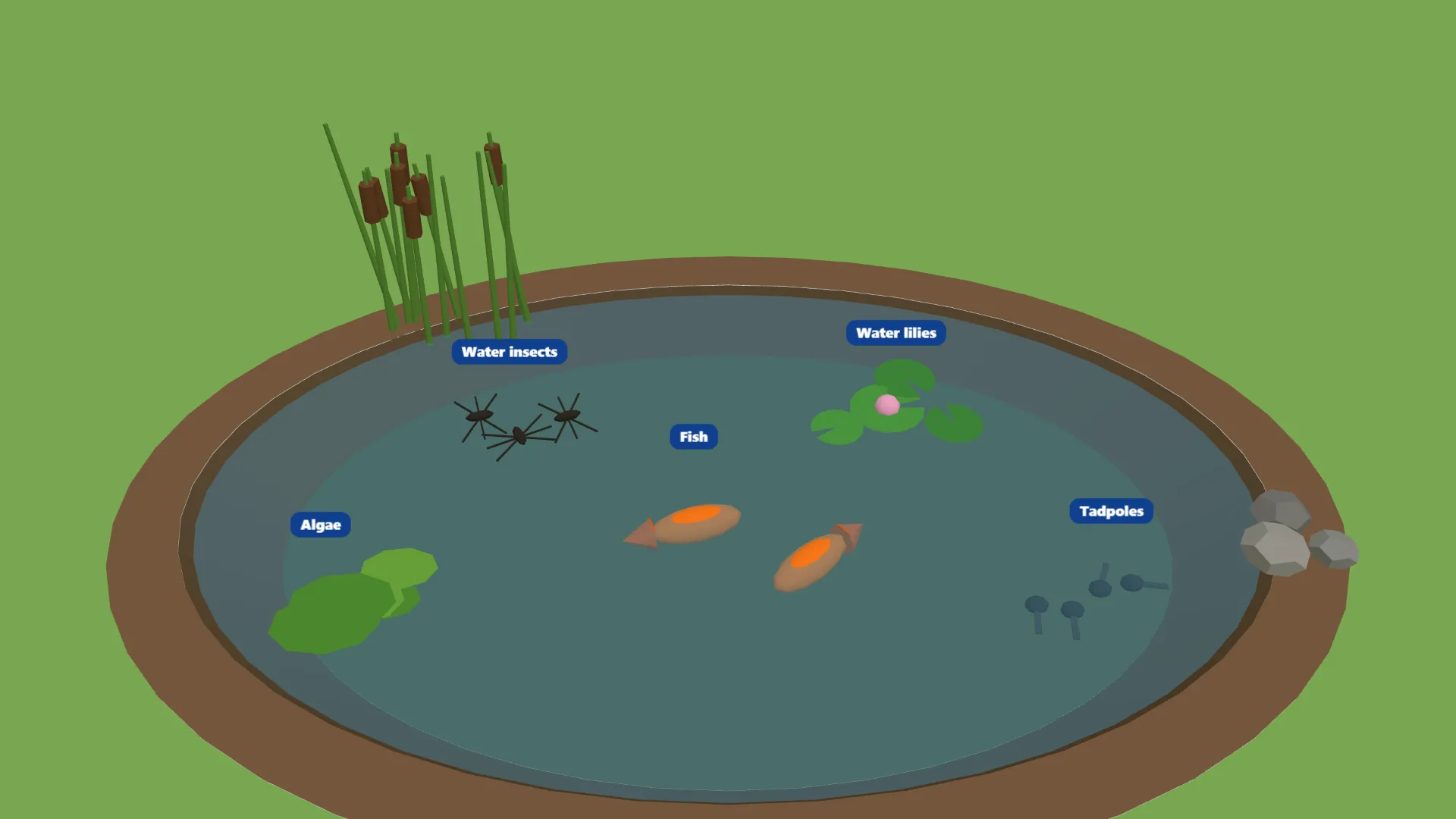
Interactive 3D Experiment
Loading simulation…
What to observe
- Which living beings live in the pond but not under the tree? Which live under the tree but not in the pond?
- Which non-living things are found in both habitats? Which one does the pond have plenty of?
- Why does each habitat have its own living beings? Think of water, sunlight and soil.
Safety
- Explore only in groups and always with your teacher; never wander off alone.
- Do not go close to the edge of a pond, well, drain or any deep water.
- Observe quietly from a distance. Do not touch, chase or catch any animal, and never disturb a nest, hive or anthill.
- Do not pluck leaves, flowers or plants; sketch or photograph them instead.
- Do not touch unfamiliar plants, and wash your hands well after the visit.
- Wear full sleeves and closed shoes, and use insect repellent if your teacher advises it.
- Never use the magnifying lens to focus sunlight onto leaves, paper or skin.
- Leave the habitat as you found it, and carry back all your litter.
- Write down living and non-living things in separate columns as you observe, not from memory later.
Notes
- The word "ecosystem" was coined in 1935 by the British botanist Sir Arthur Tansley — one word for the living community and its physical surroundings working together as a single unit.