
Exploring Number Sequences
Aim
Build the counting, odd, even, triangular, square and cube number sequences with counters, dot patterns and cubes, and find the rule that gives the next term of each.
Apparatus
- Dot grid or graph paper notebook
- Coloured pencils or sketch pens (at least 4 colours)
- Ruler and pencil
- 32 counters, beads or bottle caps
- Small cubes (sugar cubes, dice or unit blocks)
Procedure
- Place counters in one row, one at a time, and record the count each time — 1, 2, 3, 4.
- Make the odd numbers (1, 3, 5, 7) and the even numbers (2, 4, 6, 8) as separate rows of counters.
- On dot paper, draw 1 dot, then a row of 2 below it, then a row of 3, and so on. Count the dots after each row.
- Draw square arrangements of dots — 1 × 1, 2 × 2, 3 × 3, 4 × 4 and 5 × 5 — and record each total.
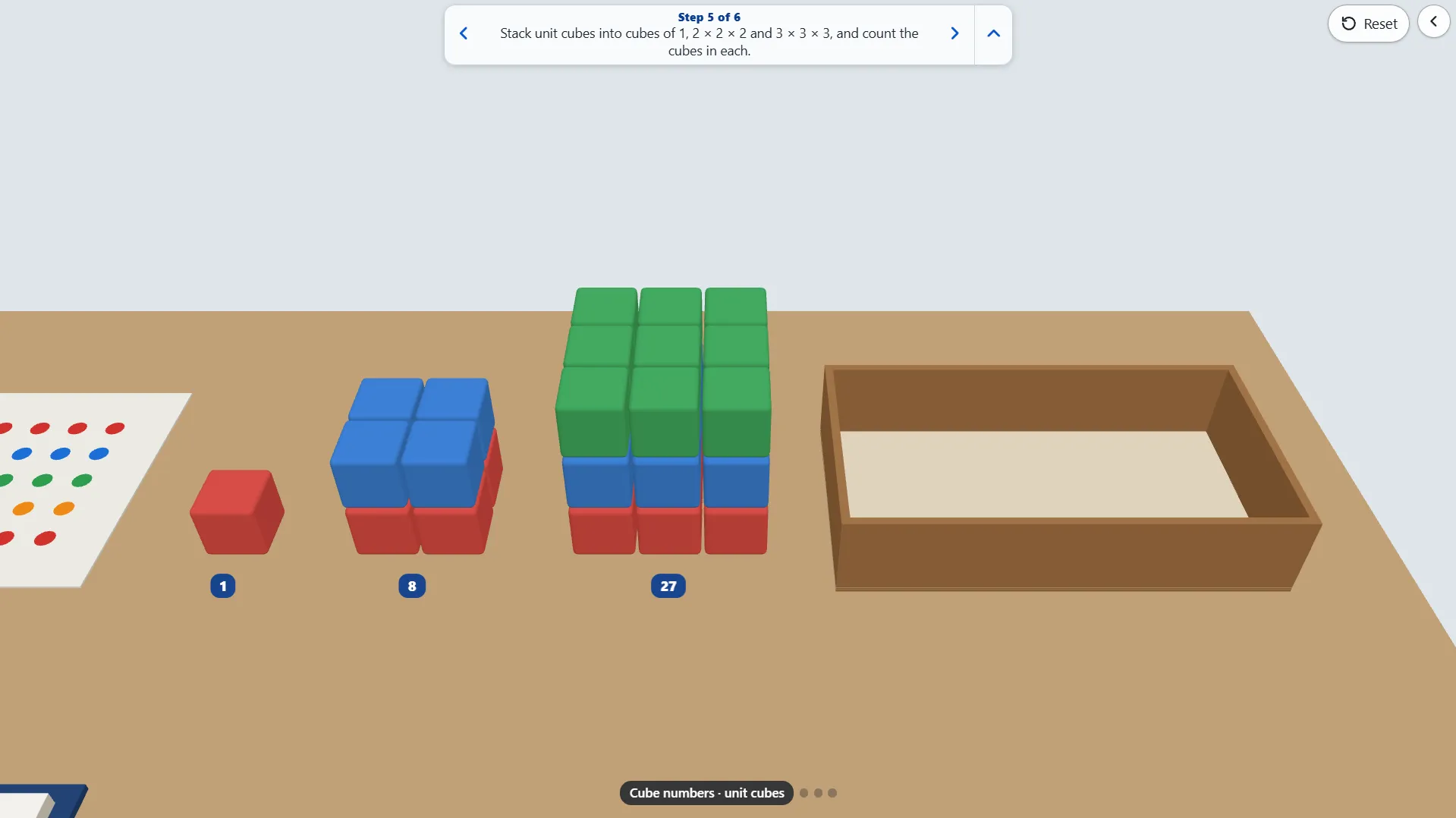
- Stack unit cubes into cubes of 1, 2 × 2 × 2 and 3 × 3 × 3, and count the cubes in each.
- For each sequence, write the rule for the next term and use it to complete the first six terms.
Interactive 3D Experiment
Loading simulation…
What to observe
- By how much does each sequence grow from one term to the next?
- Which sequences grow by the same amount every time, and which grow faster and faster?
- Which number belongs to two of the sequences at once?
Notes
- At the age of 10, Carl Friedrich Gauss added all the numbers from 1 to 100 in an instant. He paired 1 + 100, 2 + 99 and so on to get 50 pairs of 101, which makes 5050 — the same idea as the triangular numbers.
- If every person in a room shakes hands with every other person once, the number of handshakes is always a triangular number.
- Arrange the counters in straight, evenly spaced rows so the shape of each pattern is clear.
- Start every dot pattern from the same corner of the grid so the rows line up neatly.
- Count and record the total after each new row or layer, not only at the end.
- Use a different colour for each new row so you can see how the pattern grows.
- Do not disturb an arrangement before its count is recorded in the observation table.
- Use a sharp pencil and a ruler so the dots stay small and the grid does not get smudged.