
Exploring Lines of Symmetry
Aim
To find, make and check the lines of symmetry of shapes by folding paper, with a mirror, with ink blots, by cutting and by punching holes — and to count how many lines of symmetry different figures have.
Apparatus
- Plain paper, square sheets and rectangular coloured paper
- A pair of scissors and a hole punch
- Ink or poster paint, and a small brush
- A small plane mirror, ruler and pencil
- Tracing paper and cut-outs of common shapes
Procedure
- Fold the square so the two halves overlap exactly. Open it and draw the crease. Find all such folds.
- Do the folding test with a rectangle, an equilateral triangle and a circle. Record the folds that work.
- Stand a mirror on a drawn line. If the reflection completes the shape, it is a line of symmetry.
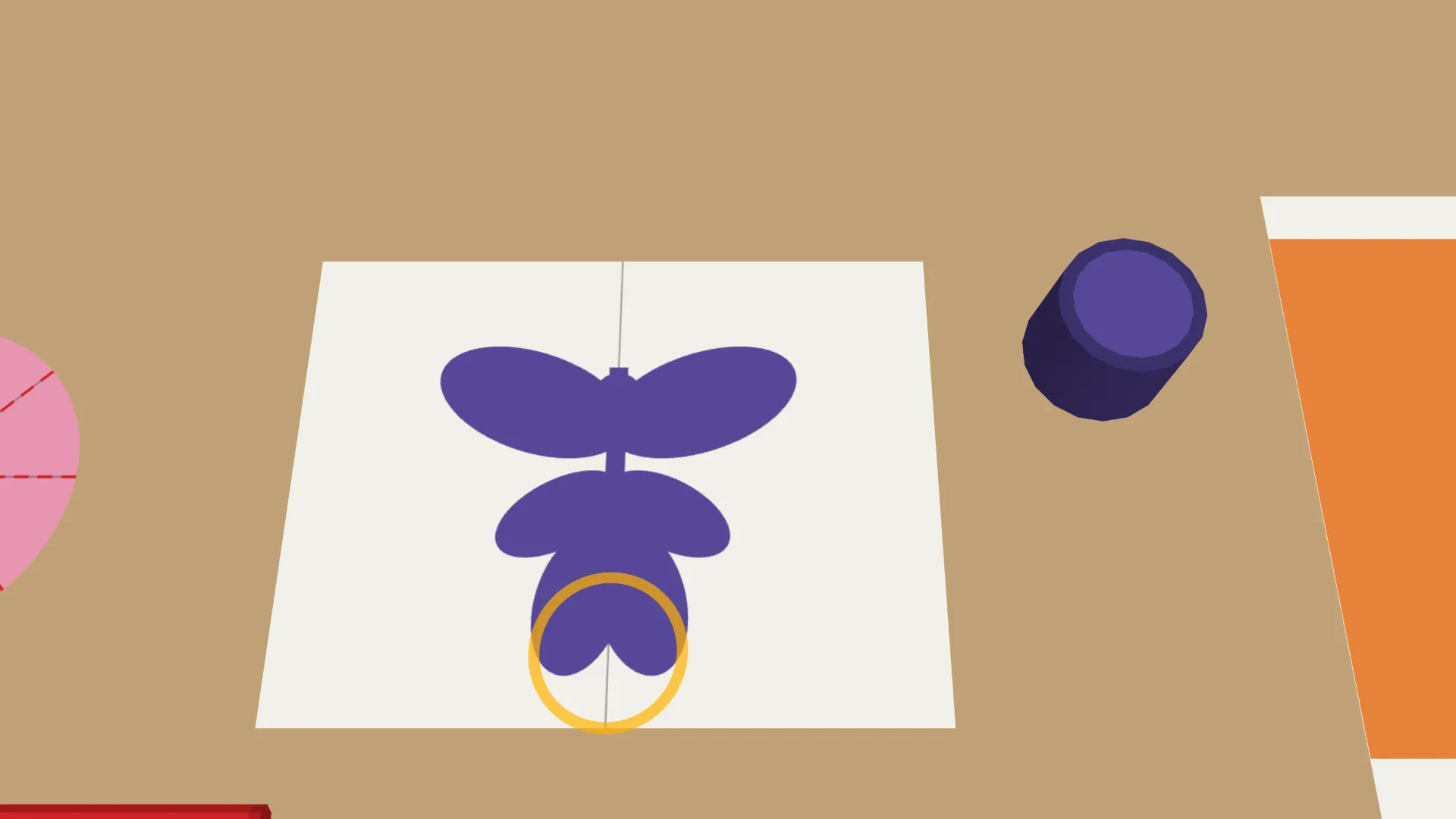
- Ink blot: fold a paper, open it, drop ink on one half, press the halves together and open it again.
- Fold a sheet and cut a shape along the fold. Predict the shape before opening it, then check.
- Punching game: fold a square sheet once or twice, punch, then open it. Look at the holes.
- For each figure, draw all its lines of symmetry and record the total number.
Interactive 3D Experiment
Loading simulation…
What to observe
- Lines of symmetry: isosceles triangle 1, equilateral triangle 3, square 4, rectangle 2, pentagon 5, hexagon 6.
- A letter H has 2 lines of symmetry; a circle has infinitely many (every line through its centre).
- A regular polygon has as many lines of symmetry as it has sides.
- The diagonal of a rectangle is not a line of symmetry — the halves do not overlap when folded.
- The ink blot, the cut-out and the punched holes are all symmetric about the fold.
Notes
- The Taj Mahal is laid out so that its left and right halves are almost perfect mirror images.
- Butterflies, leaves and the human face are roughly symmetric too.
- Fold so the two halves overlap exactly, then crease; a slanting fold gives a false line of symmetry.
- Test every possible fold before deciding the number of lines — some lines that look symmetric are not.
- Hold the mirror upright, exactly along the drawn line.
- Use only a little ink and press gently. Predict the shape before you open the folded paper.
- Cut and punch away from your fingers.