
Exploring Area with Square Grids
Aim
Understand area as the region inside a figure, build the area rule for a rectangle and a square from unit squares, and estimate the area of irregular figures by counting squares on a grid.
Apparatus
- Square grid or graph paper (1 square = 1 square unit)
- Tracing paper or a transparent sheet
- Coloured pencils and a ruler
- A few irregular cut-outs (a leaf, a hand outline, a random blob)
Procedure
- Draw a rectangle 5 units long and 3 units wide. Colour and count its squares. Is it 5 × 3?
- Draw a square of side 4 units. Count its squares. Is the area side × side?
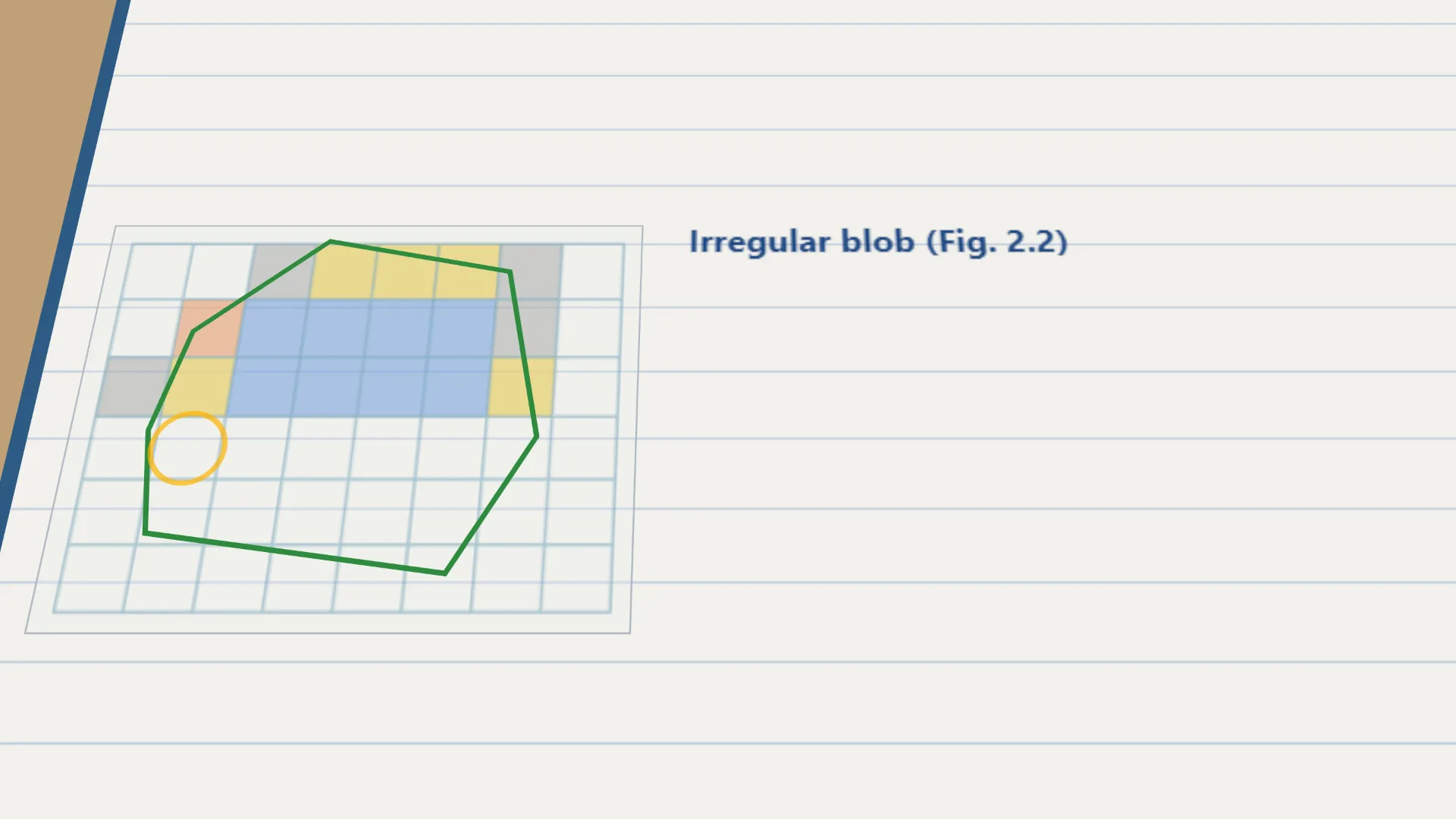
- Trace the blob onto tracing paper and place the tracing over the grid.
- Count the squares. Full = 1, more than half = 1, exactly half = ½, less than half = 0. Add them.
- Do the same for the leaf outline.
- Compare the rectangle and the square. Which looks bigger? Which has more squares?
- Fill in the observation table.
Interactive 3D Experiment
Loading simulation…
What to observe
- Is the count of unit squares the same as length × breadth? As side × side?
- Does the figure that looks bigger always have the larger area?
- Why is the area of an irregular figure only an estimate?
- Why is a square the best unit of area? (No gaps, no overlaps.)
Notes
- Area is measured in square units because squares fit together with no gaps and no overlaps. Circles leave gaps.
- A tray can hold 42 or 44 round bottle caps, depending on how they are packed. Its area never changes.
- Surveyors still estimate the area of an odd-shaped field by splitting it into rectangles and triangles.
- Trace the outline carefully and hold the tracing firmly so that it does not slide over the grid.
- Fix the rule for part-squares before you start, and use the same rule for the whole figure.
- Count each square only once. Shade or tick it lightly as you count it.
- Use squares of the same size throughout, and always write the unit of area.
- The area of an irregular figure is only an estimate. A finer grid gives a closer estimate.
- Do not mix up area and perimeter. Area is the region inside; perimeter is the boundary.