
Charting the Structure of the Election Commission of India
Aim
To draw and read an organisational chart of the Election Commission of India (ECI), showing its structure and main officers at the national, state and district levels.
Apparatus
- Chart paper or an A4 sheet and a ruler
- Sketch pens or coloured pencils
- The textbook's Fig. 5.11, Structure of the Election Commission of India
Procedure
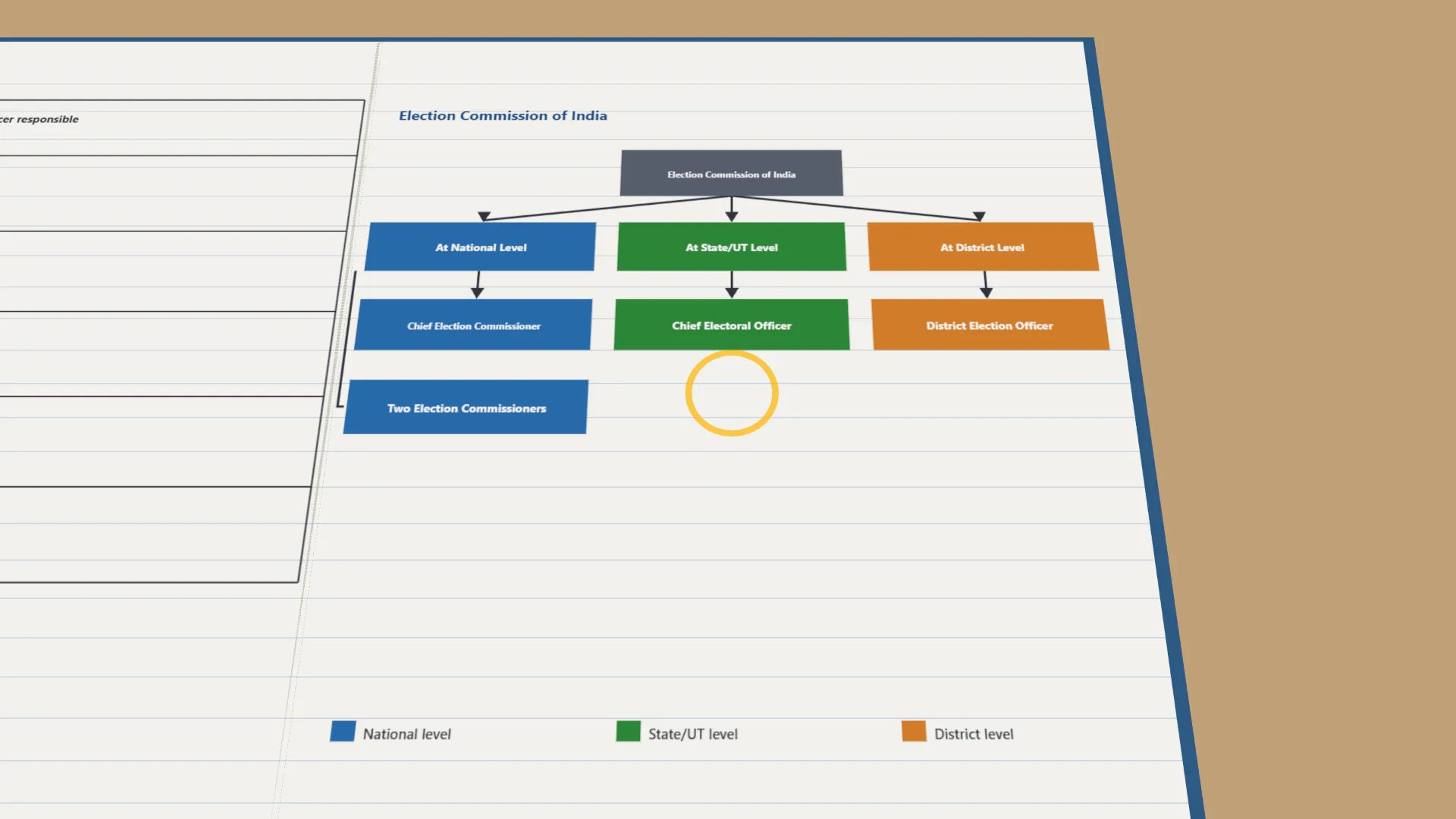
- Draw a box at the top centre and label it Election Commission of India.
- Below it draw three boxes, At National Level, At State/UT Level and At District Level, joined to the top box by arrows.
- Under the national level add Chief Election Commissioner and Two Election Commissioners.
- Under the state/UT level add Chief Electoral Officer.
- Under the district level add District Election Officer, branching into the Returning Officer (RO) and the Electoral Registration Officer (ERO).
- Beside them write what each does. The RO conducts elections and the ERO manages the voter list.
- Colour each level differently and add a key at the bottom.
- Use the chart to match each ECI task in the table to the level or officer responsible.
Interactive 3D Experiment
Loading simulation…
What to observe
- Authority flows from the Election Commission down to the state and district levels.
- The national level sets the election dates, registers parties and enforces the Model Code of Conduct.
- In a district, the ERO manages the voter list and the RO conducts the election in a constituency.
Notes
- Social Science Spark: the Election Commission of India was set up in 1950. The State Election Commissions, which manage elections to gram panchayats, municipalities and other urban local bodies, are separate constitutional bodies that work in consultation with the ECI.
- Use the exact official titles from the textbook. Draw the arrows downward to show that authority flows from the national level to the state and district levels.