
Classifying Economic Activities into Sectors
Aim
To observe a set of economic activities and classify them into the primary, secondary and tertiary sectors.
Apparatus
- Picture cards or name-cards of economic activities
- Chart paper
- Sketch pens
- A glue stick
- Scissors
Procedure
- Collect at least twelve cards of economic activities, such as farming, mining, teaching and banking.
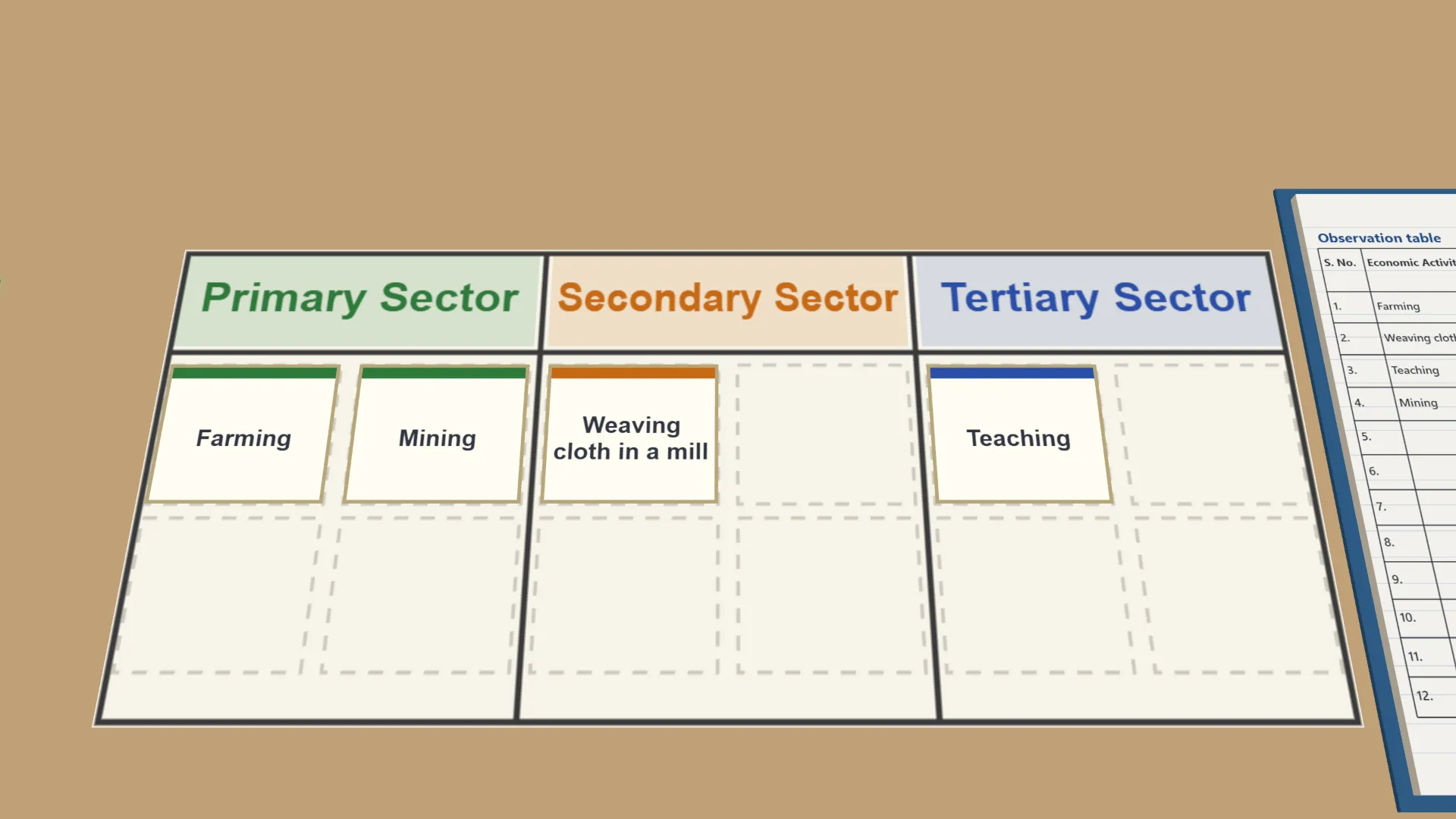
- Draw three columns on chart paper - Primary Sector, Secondary Sector and Tertiary Sector.
- Examine each card - does it take raw material from nature, make it into a product, or give a service?
- Paste or write each activity under the correct column.
- Record each activity in the table, then count the activities in each sector and record the totals.
- Exchange charts with a partner and discuss any activities you classified differently.
Interactive 3D Experiment
Loading simulation…
What to observe
- Activities that take raw material from nature, like farming, mining and fishing, are in the primary sector.
- Activities that make raw material into a product, like weaving cloth in a mill and construction, are in the secondary sector.
- Activities that give a service, like teaching, banking and driving a truck, are in the tertiary sector.
Notes
- The word 'agriculture' comes from the Latin ager (field) and cultura (cultivation). Farming is the largest primary sector activity in India, giving a livelihood to nearly half of its workforce.
- Handle chart paper and cards carefully, use glue sparingly, and discuss disagreements respectfully before you finalise the chart.