
Doubling and Halving a Square
Aim
Construct, by paper folding and drawing, a square with double the area of a given square and a square with half its area, following Baudhayana's Sulba-Sutra, and justify both constructions using congruent triangles.
Apparatus
- Four square sheets of coloured paper, 12 cm × 12 cm (two of each colour)
- A pair of scissors, glue stick and a hard board or file for pasting
- Ruler, sharp pencil and a set square
- Graph paper or dot-grid sheet
- Sketch pens (at least two colours)
Procedure
- Cut two identical 12 cm squares. Label one Square 1 and keep it aside.
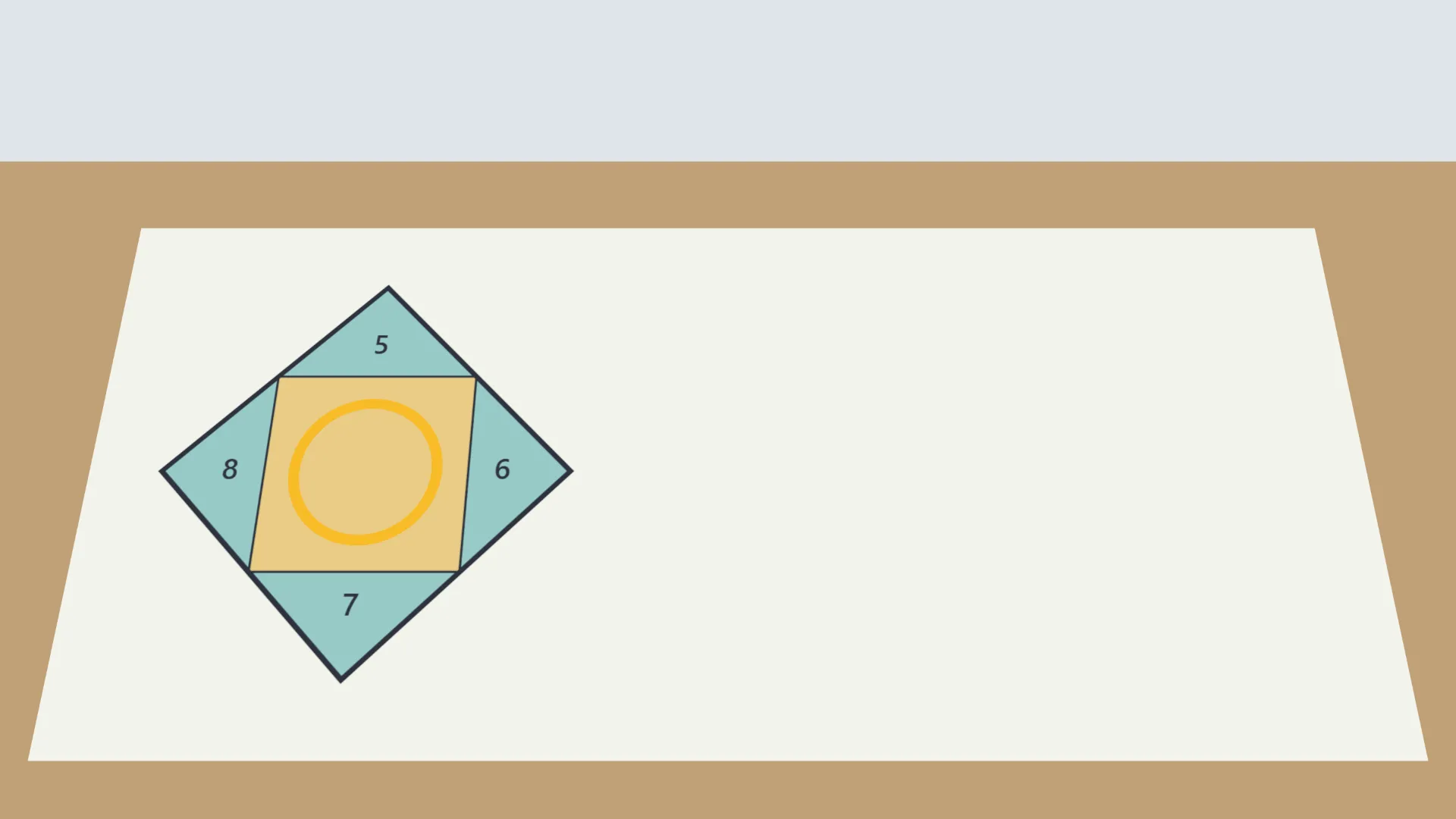
- Fold the second square along both diagonals and cut the creases to get four right triangles, 5 to 8.
- Place the four triangles round Square 1, each hypotenuse along a side of Square 1, and paste.
- Check with a set square that all angles are right angles, and with a ruler that all sides are equal.
- Count the small triangles: Square 1 has 2, the new square has 4, so its area is double.
- Measure the side of the new square (the diagonal of Square 1), find its area and compare it with 2 × 144.
- For halving, take a fresh square and fold each corner inwards, the creases passing through the midpoints. Name it PQRS.
- Measure a side of PQRS, find its area and compare it with half the area of the original.
- Discuss: does a square with half the side have half the area? How many such squares fill the original?
Interactive 3D Experiment
Loading simulation…
What to observe
- The square on the diagonal is made of 4 congruent triangles, Square 1 of 2, so its area is double (about 288 cm²).
- The folded square PQRS has half the area of the original (about 72 cm²).
- The diagonal of a 12 cm square is about 17 cm, close to 12√2; it is not an exact decimal.
- A square with half the side has only a quarter of the area. Four of them fill the original.
Notes
- Math Spark: Baudhayana composed the Sulba-Sutra around 800 BCE, nearly three centuries before Pythagoras. Sulba means ‘cord’: the geometry was done with a stretched rope and pegs, to build fire altars. Verse 1.9 says the diagonal of a square produces a square of double the area.
- Cut the paper squares accurately and check with a set square that all four angles are right angles.
- Fold corner to corner exactly and press a sharp crease; draw along the crease with a sharp pencil before cutting.
- Use squares of exactly the same size when two figures are to be compared.
- Keep the four triangles congruent: check by placing one over another before pasting.
- Paste the pieces without overlap and without gaps, and press flat until dry.
- The diagonal is an irrational length: record the measurement as an approximation, not an exact decimal.
- Use the scissors carefully and cut away from the body.