
Does Water Push Back? — Pressure Exerted by Liquids
Aim
Show that a liquid exerts pressure on the bottom and the walls of its container, and that this pressure increases with the depth (height) of the liquid column.
Apparatus
- A used transparent plastic bottle
- A needle or a thin nail to make holes (with adult help)
- Sticky tape and water
- Two transparent pipes of different diameters, about 25 cm long
- Two good-quality rubber balloons
- A stand with a clamp
- A science notebook or lab record and a pencil
Procedure
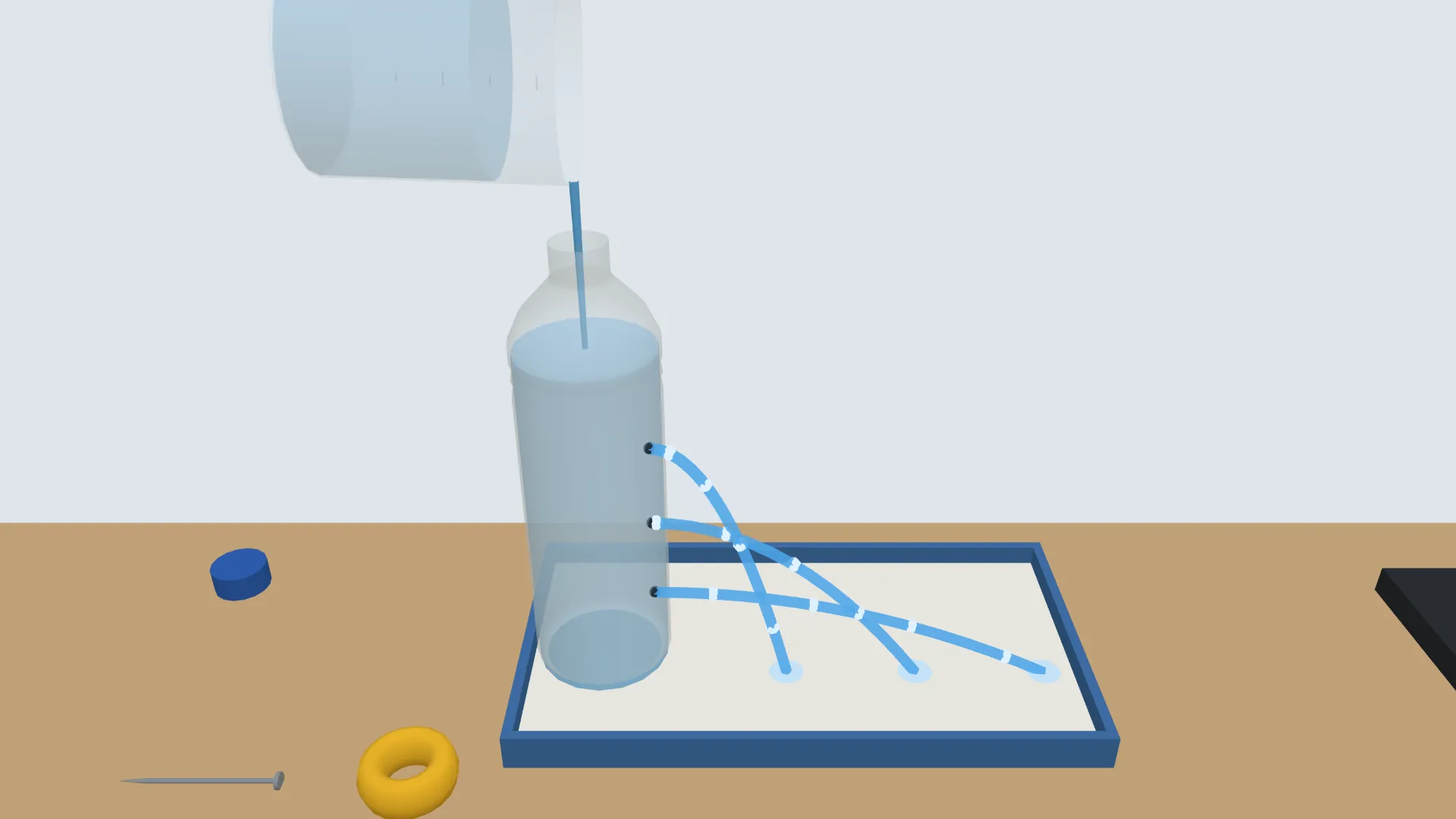
- Remove the bottle cap. With an adult's help, make three small holes, one above the other.
- Cover all the holes with tape and fill the bottle with water.
- Stand the bottle at the edge of a tray, peel off the tape and note which hole throws water farthest.
- Attach a balloon to one end of each pipe and clamp the pipes on the stand.
- Fill both pipes with water to the same level and compare the bulge of the two balloons.
- Pour more water into one pipe and watch how the bulge changes as the column rises.
- Write your conclusion about depth and pressure in the table.
Interactive 3D Experiment
Loading simulation…
What to observe
- Water spurts out sideways from all three holes, so a liquid pushes on the side walls too.
- The lowest jet goes farthest, the middle one less far and the top one the shortest distance.
- At the same level both balloons bulge equally, even though the pipes have different widths.
- When one column grows taller, its balloon bulges noticeably more.
Safety
- An adult or teacher must make the holes with a needle or thin nail. Heating the point makes this easier and safer.
- Make all three holes the same size, one exactly above the other, so that only the depth differs.
- Seal the holes with tape before filling, and peel all three off together so the jets can be compared fairly.
- Keep the bottle upright and refill it as needed, so that the water level stays the same.
- Work over a tray, sink or outdoors, and wipe up spilt water at once. A wet floor is slippery.
- Clamp the pipes firmly and vertically. Check that the balloons are tied on tightly and do not leak.
- Use balloons of the same size and quality, and fill both pipes to exactly the same level at first.
- Use only water. Never use hot water or any other liquid.
Notes
- A dam is built much thicker at the bottom than at the top, because water pressure is greatest near the bottom. Deep-sea divers wear special suits for the same reason.