
Dividing Fractions — The Reciprocal Method
Aim
To model the division of fractions with "how many fit" pieces and number lines, to discover that dividing by a fraction is the same as multiplying by its reciprocal, and to compare the size of the quotient with the dividend.
Apparatus
- Graph-paper notebook and a ruler
- Strips of paper of equal length (to make fraction strips)
- Coloured pencils or sketch pens
- A pair of scissors
Procedure
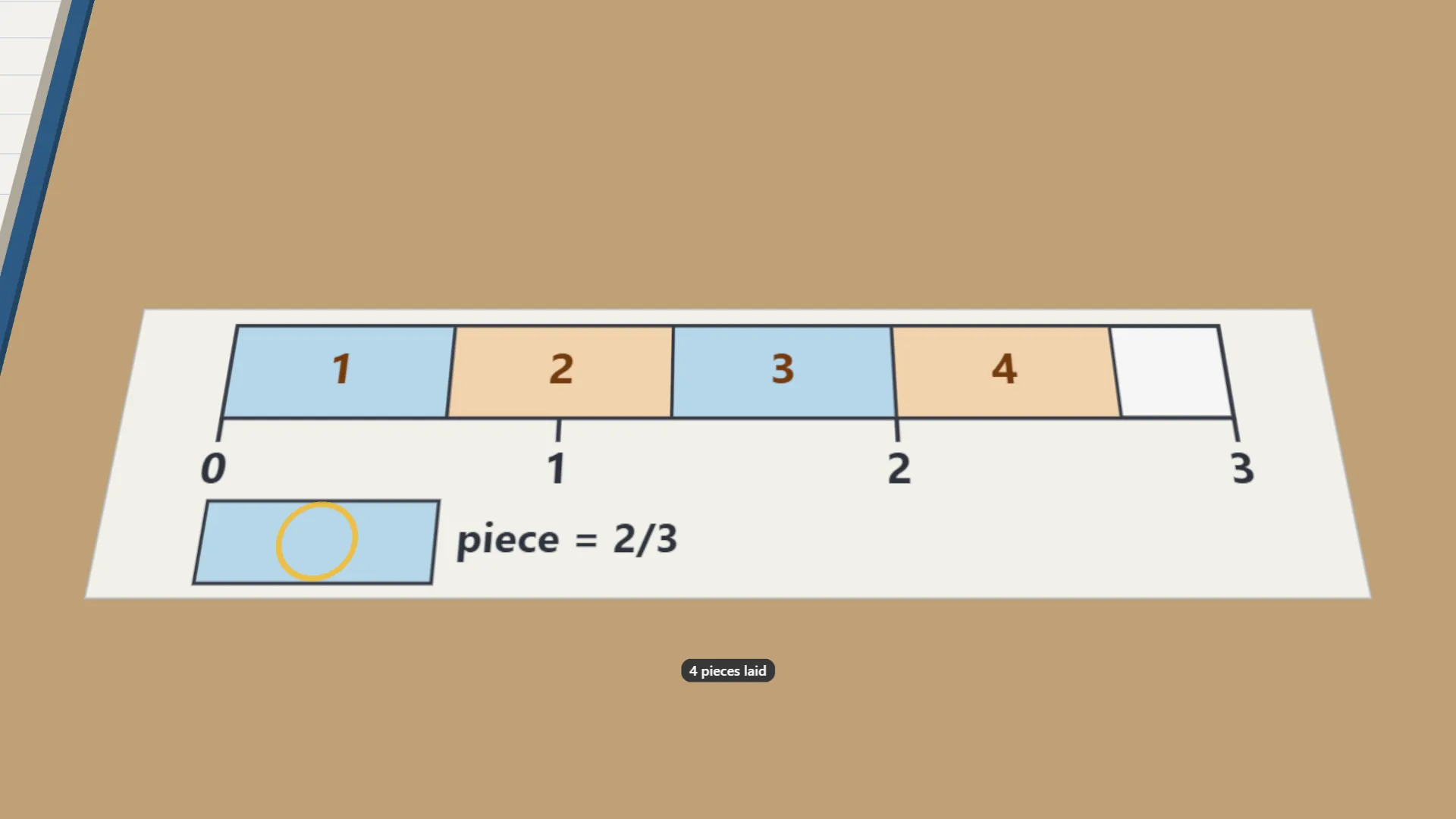
- Draw a bar for 3 whole units. Mark the points 0, 1, 2, 3.
- Cut pieces each 2/3 long. Count how many fit into 3 — 4 whole pieces and half of another, that is 9/2.
- Check by the reciprocal method: 3 ÷ 2/3 = 3 × 3/2 = 9/2. The two answers match.
- Fold a strip to show 3/5 × 5/3 = 1. A fraction times its flipped fraction (reciprocal) is always 1.
- Divide 2/3 ÷ 3/5 by multiplying 2/3 by the reciprocal 5/3: 2/3 × 5/3 = 10/9.
- Work out 6 ÷ 1/4 and 6 ÷ 3. Is the quotient larger or smaller than 6?
- For each division, write divisor × ? = dividend, then solve it with the reciprocal. Fill the table.
Interactive 3D Experiment
Loading simulation…
What to observe
- 4 whole pieces of 2/3 and half of another fit into 3, so 3 ÷ 2/3 = 9/2.
- The reciprocal method gives the same answer, 3 × 3/2 = 9/2.
- A fraction times its reciprocal is always 1 (3/5 × 5/3 = 1).
- Dividing by a number less than 1 gives a quotient larger than the dividend.
- Dividing by a number more than 1 (6 ÷ 3, 14/6 ÷ 7/3) gives a smaller quotient.
Notes
- Brahmagupta gave the rule for dividing fractions in 628 CE — flip the divisor and multiply.
- Around 1150 CE, Bhāskara II explained it in his book Līlāvatī.
- The word reciprocal comes from two numbers that "return" to 1 when multiplied, as 3/5 × 5/3 = 1.
- Mark the number line with exactly equal spacing, or the pieces will not fit correctly.
- Write the leftover piece as a fraction of the divisor, not of the whole unit.
- Flip the divisor only — the dividend is never inverted.
- Cut the fraction strips to identical lengths before folding them.
- Check that the answer is reasonable. Dividing by a fraction less than 1 must give a larger number.