
Discovering the Idea of a Base
Aim
Build a number system whose landmark numbers are powers of a fixed number (a base). Write numbers in base 5 and in the Egyptian base-10 system, and see why a base makes writing and adding numbers easier.
Apparatus
- About 150 counters (beads, seeds or bottle caps) for building groups of 125
- Small paper cut-outs of shapes (triangles, squares, hexagons, circles)
- Dot grid or plain paper notebook
- Coloured pencils or sketch pens
- Ruler and pencil
Procedure
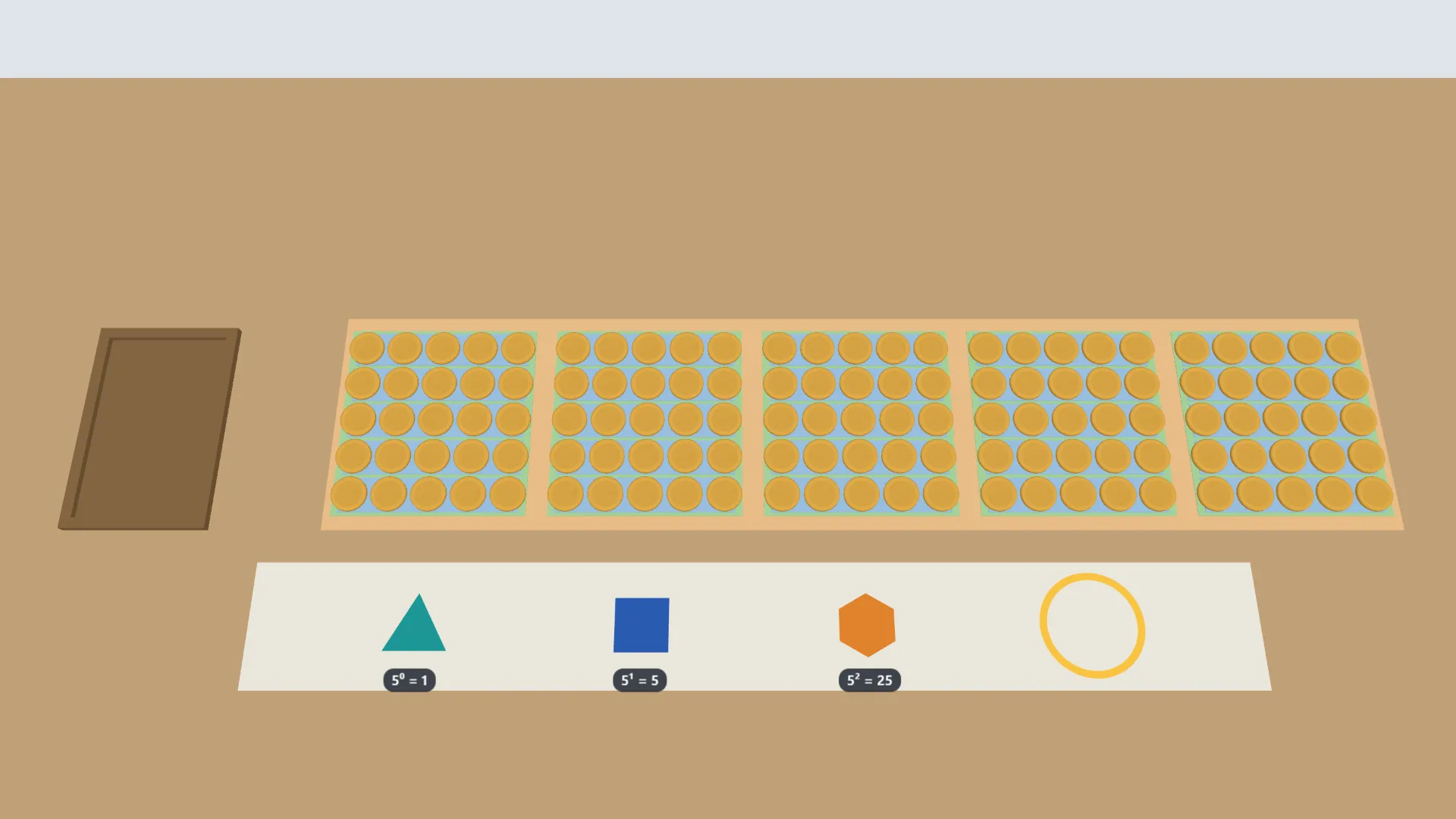
- Bundle 5 counters into a group of 5, 5 of those into a group of 25, and 5 of those into a group of 125.
- Give each landmark a shape. Triangle = 1, square = 5, hexagon = 25, circle = 125 (5⁰, 5¹, 5², 5³).
- Show 143 as 125 + 5 + 5 + 5 + 1 + 1 + 1. Lay out the matching shapes and record them.
- Repeat for 15, 50, 137 and 293. Always take as many of the largest landmark as you can first.
- Switch to the Egyptian base-10 system. Write 324 with its symbols (coils, heel bones, strokes).
- Add two Egyptian numerals. When ten of one symbol collect, exchange them for one of the next symbol.
- For each system, write in your own words how the next landmark number comes from the current one.
Interactive 3D Experiment
Loading simulation…
What to observe
- Every landmark is 5 times the one before it (1, 5, 25, 125), so every number is a few shapes of each kind.
- In base 5 every digit is 0 to 4, because five of one landmark are carried to the next. 125 becomes 1000.
- The Egyptian system does the same with powers of 10, using a new symbol for each landmark.
- A base keeps the number of symbols small and makes adding systematic, because a full group is carried to the next place.
Notes
- Math Spark: a number system whose landmark numbers are the powers of a fixed number n is called a base-n system. Our everyday system is base 10, the decimal system. The Egyptians wrote in base 10 around 3000 BCE, but with no place value and no zero, so huge numbers needed brand-new symbols for every higher power of 10.
- Form a bundle only when the group is complete. Five counters make one bundle of five, no fewer.
- Exchange upward as soon as five bundles are collected. Do not leave five bundles unexchanged.
- Read and write the places from the right. The rightmost place is the units place.
- In base 5 no digit may be 5 or more. If a place reaches 5, carry it.
- Do not read a base-5 numeral as an ordinary number. 1000 in base five is "one, zero, zero, zero", not "one thousand".
- In the Egyptian system, repeat a symbol at most nine times before using the next higher symbol.
- Keep the paper cut-outs for each place value distinct so the two systems are not mixed up.