
Discovering the Rules of Signs
Aim
To discover, describe and justify the rules for the signs of products (and quotients) of integers, by extending multiplication tables below zero and watching the patterns that appear.
Apparatus
- Squared or graph paper and a ruler
- Coloured pens (at least two colours, e.g. green and red)
- A prepared "multiplication chain" worksheet
Procedure
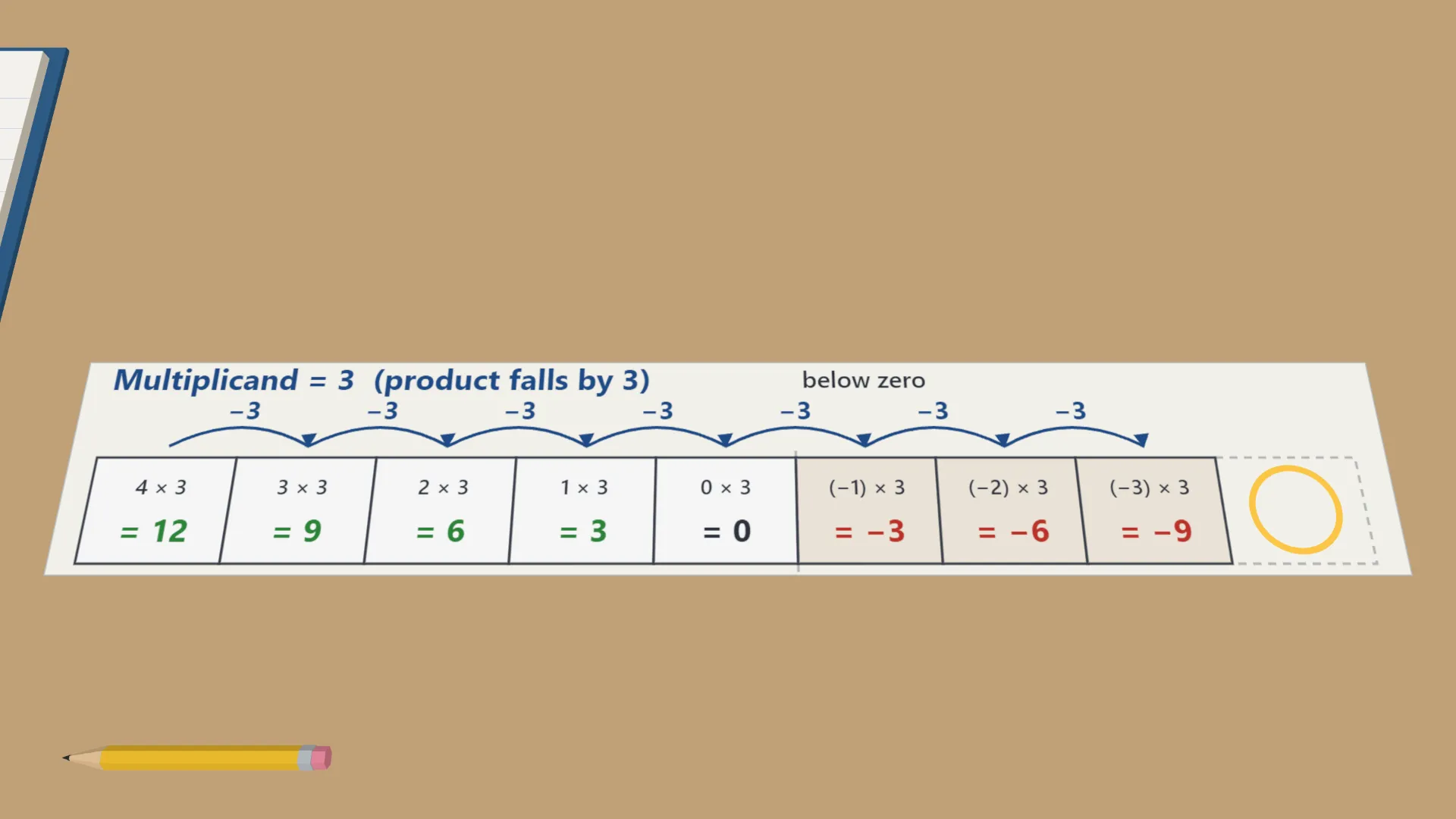
- Write the table of 3: 4 × 3, 3 × 3, 2 × 3, 1 × 3, 0 × 3. Note how the product changes as the multiplier falls by 1.
- The product falls by 3 each time. Go below zero: (−1) × 3, (−2) × 3, (−3) × 3. Which sign do they take?
- Repeat with a negative multiplicand: 4 × (−3) down to 0 × (−3), then (−1) × (−3), (−2) × (−3), (−3) × (−3).
- Arrange the results as a four-part table. Repeat with the table of 5 before you state the rule.
- From the completed table, write the rule for the sign of the product in each of the four cases.
- Test the rules on division: rewrite (−100) ÷ 25 as 25 × ? = −100 and find the missing factor.
Interactive 3D Experiment
Loading simulation…
What to observe
- Going down the table of 3, the product falls by 3 each time and goes below zero: −3, −6, −9.
- With a multiplicand of −3 the product rises by 3 each time: 0, then +3, +6, +9.
- Positive × positive and negative × negative are positive. The other two are negative.
- An even number of negative factors gives a positive product, an odd number a negative one.
- The same rules hold for division, because division undoes multiplication.
Notes
- When you multiply several negative numbers, −1 × −1 = 1, −1 × −1 × −1 = −1, and so on. Count the negatives to predict the sign.
- Decrease the multiplier by exactly 1 at each step. Skipping a step hides the pattern.
- Check that the difference between consecutive products is constant before you go below zero.
- Extend the pattern to find each new product. Do not guess the sign and then fit the number to it.
- Put negative numbers in brackets, as in (−2) × 3, so the signs are not misread.
- Repeat the investigation with a second table, such as the table of 5, before you state the rule.