
Discovering Rotational Symmetry
Aim
To explore rotational symmetry by turning figures about a fixed point (the centre of rotation), and to find the angles of symmetry and the order of rotational symmetry of different figures.
Apparatus
- Tracing paper and thick paper or cardboard
- A sharp pin or drawing pin (to fix the centre of rotation)
- A protractor, ruler and pencil
- Cut-outs with 3, 4 and 5 radial arms
- A paper windmill and pictures of a fan, flower and wheel
Procedure
- Pin the paper windmill at its centre. Turn it and note each turn after which it looks the same.
- Trace a figure. Pin the tracing at the centre, turn it and mark each angle where the two overlap.
- Figure with 4 radial arms: check the overlaps at 90°, 180°, 270° and 360°.
- Do the same with 3 and 5 equal arms; their arms are 120° and 72° apart.
- Count the angles of symmetry of each figure: this count is the order of rotational symmetry.
- Check that every angle is a multiple of the smallest one, and the smallest is a factor of 360°.
- Turn a traced circle by any angle. It always overlaps.
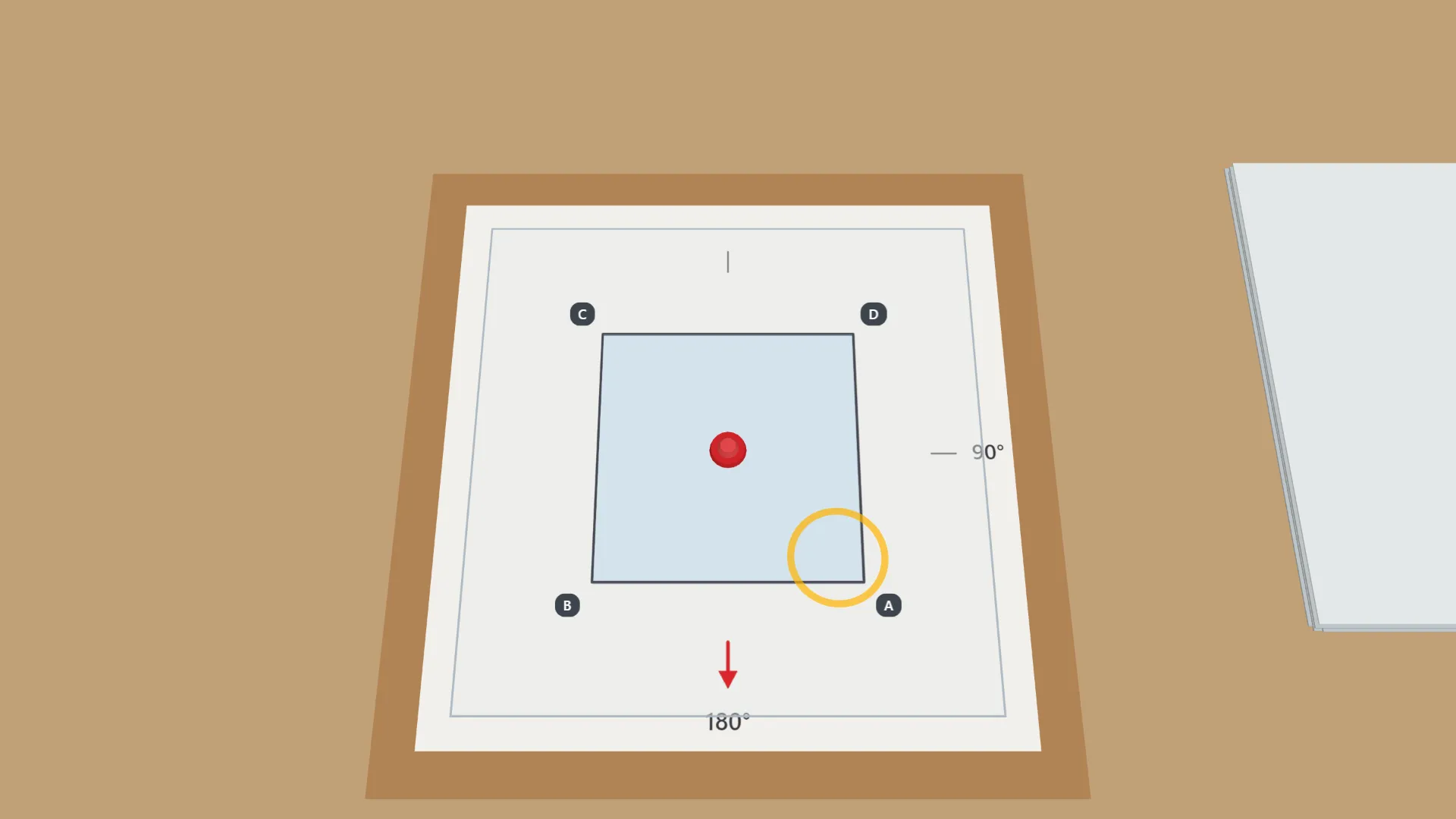
Interactive 3D Experiment
Loading simulation…
What to observe
- Order: triangle 3, square 4, rectangle 2, pentagon 5, hexagon 6, 5 arms 5, Ashoka Chakra 24.
- With n equal arms the smallest angle of symmetry is 360° ÷ n.
- Every angle of symmetry is a multiple of the smallest one; the smallest is a factor of 360°.
- A circle overlaps after a turn of any size, so it has infinitely many angles of symmetry.
Notes
- The Ashoka Chakra has 24 equal spokes. It looks the same after a turn of 360° ÷ 24 = 15°.
- Windmills, ceiling fans, flowers and bicycle wheels all show rotational symmetry.
- Fix the pin exactly at the centre; if it is even slightly off-centre, the tracing never overlaps.
- Trace the figure accurately. Turn only the tracing, always in the same direction.
- Count each angle of overlap once, and include the full turn of 360°.
- Measure the angles from the same arm every time. Handle the sharp pin carefully.