
Detecting Starch, Fats and Proteins in Food
Aim
To test everyday food items for starch, fats and proteins using simple chemical tests.
Apparatus
- Small samples of potato, cucumber, boiled rice, boiled gram, crushed peanuts, bread or chapati, butter and crushed coconut
- Dropper and diluted iodine solution
- Plain white sheets of paper
- Clean test tubes, pestle and mortar
- Copper sulphate solution and caustic soda (sodium hydroxide) solution
- Water and a science notebook
Procedure
- Part A, starch. Place a small piece of each food on a separate dish.
- Put 2–3 drops of diluted iodine solution on each food.
- Blue-black means starch is present.
- Part B, fat. Wrap a small piece of each food in white paper and press gently. Let watery foods dry.
- Hold the paper up to the light. An oily patch that lets light through faintly means fat is present.
- Part C, protein. Make a paste of each food in a mortar. Put half a teaspoon in a clean test tube.
- Add 2–3 teaspoons of water and shake well.
- Add two drops of copper sulphate solution, then 10 drops of caustic soda solution.
- Shake well and leave for a few minutes. Violet means protein is present.
- Write the results in the observation table.
- List the foods with more than one nutrient. Why is one food not enough?
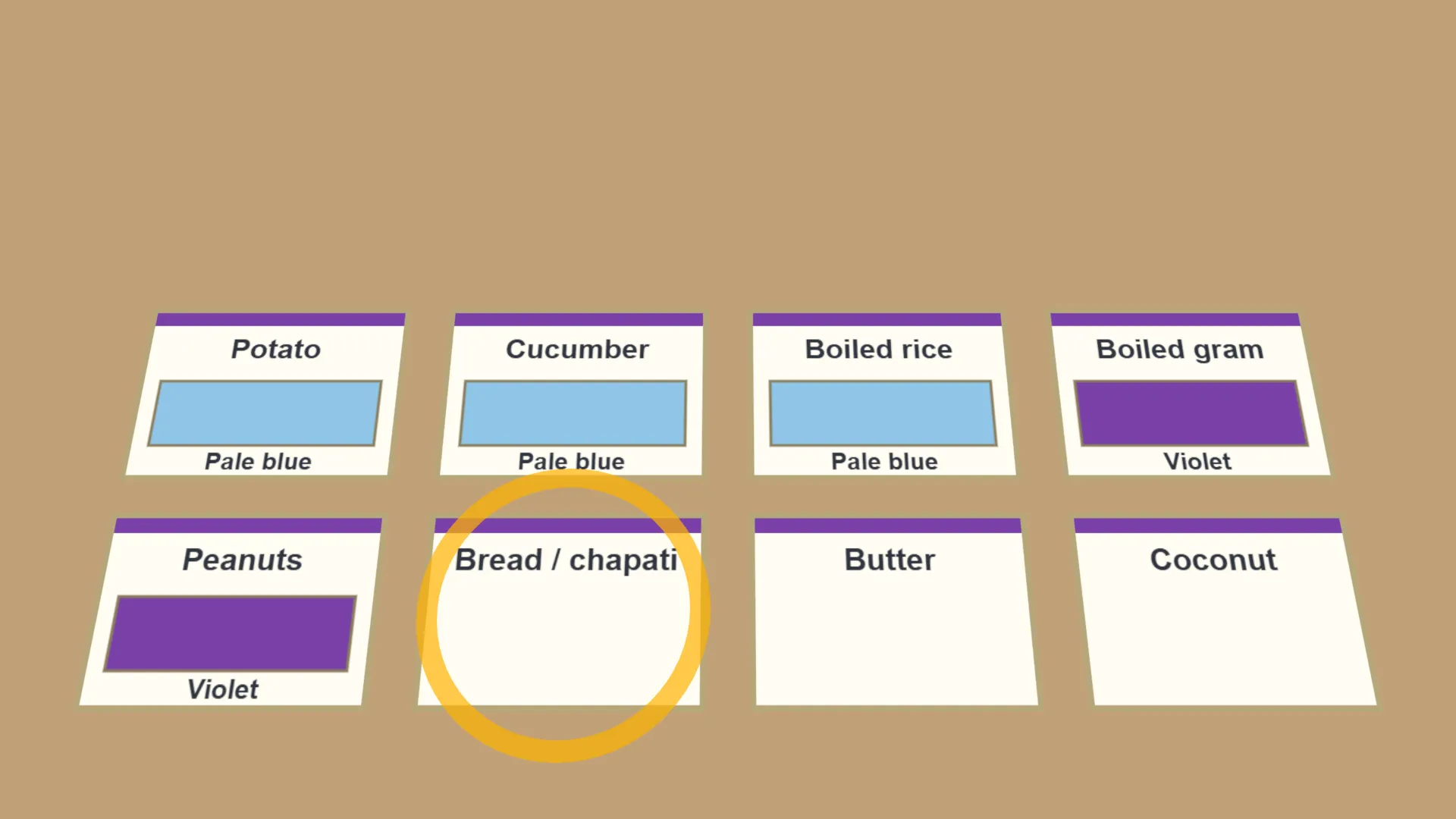
Interactive 3D Experiment
Loading simulation…
What to observe
- Foods with starch turn blue-black with iodine.
- Foods with fat leave an oily patch on paper.
- Foods with protein turn violet in the protein test.
- Some foods, such as boiled gram, peanuts and bread, contain more than one nutrient.
Notes
- Science Spark: the violet colour in the protein test is the Biuret reaction. Copper ions bind to the protein's chemical backbone. Laboratories use it to estimate protein in foods and blood.
- Copper sulphate and caustic soda are harmful and corrosive. Use them only when your teacher tells you to, with an apron on and long hair tied back.
- If a chemical touches your skin or eyes, wash with plenty of clean water and tell your teacher at once.
- Never put a chemical in your mouth or smell it directly. Do not eat a food after it has been tested.
- Add caustic soda drop by drop down the inner side of the tilted tube, pointed away from everyone. Use a clean tube and dropper for each sample.
- Anyone with a peanut or nut allergy must not handle the peanuts. Wash your hands with soap at the end.