
Is Sugar an Element? — Decomposing Sugar by Heating
Aim
To show, by heating, that sugar is a compound which can be broken down into simpler substances — carbon and water.
Apparatus
- Sugar (about a teaspoonful)
- Boiling tube and test-tube holder
- Spirit lamp (or burner)
- Watch glass
- Science notebook and pencil
Procedure
- Put a teaspoon of sugar into a dry boiling tube.
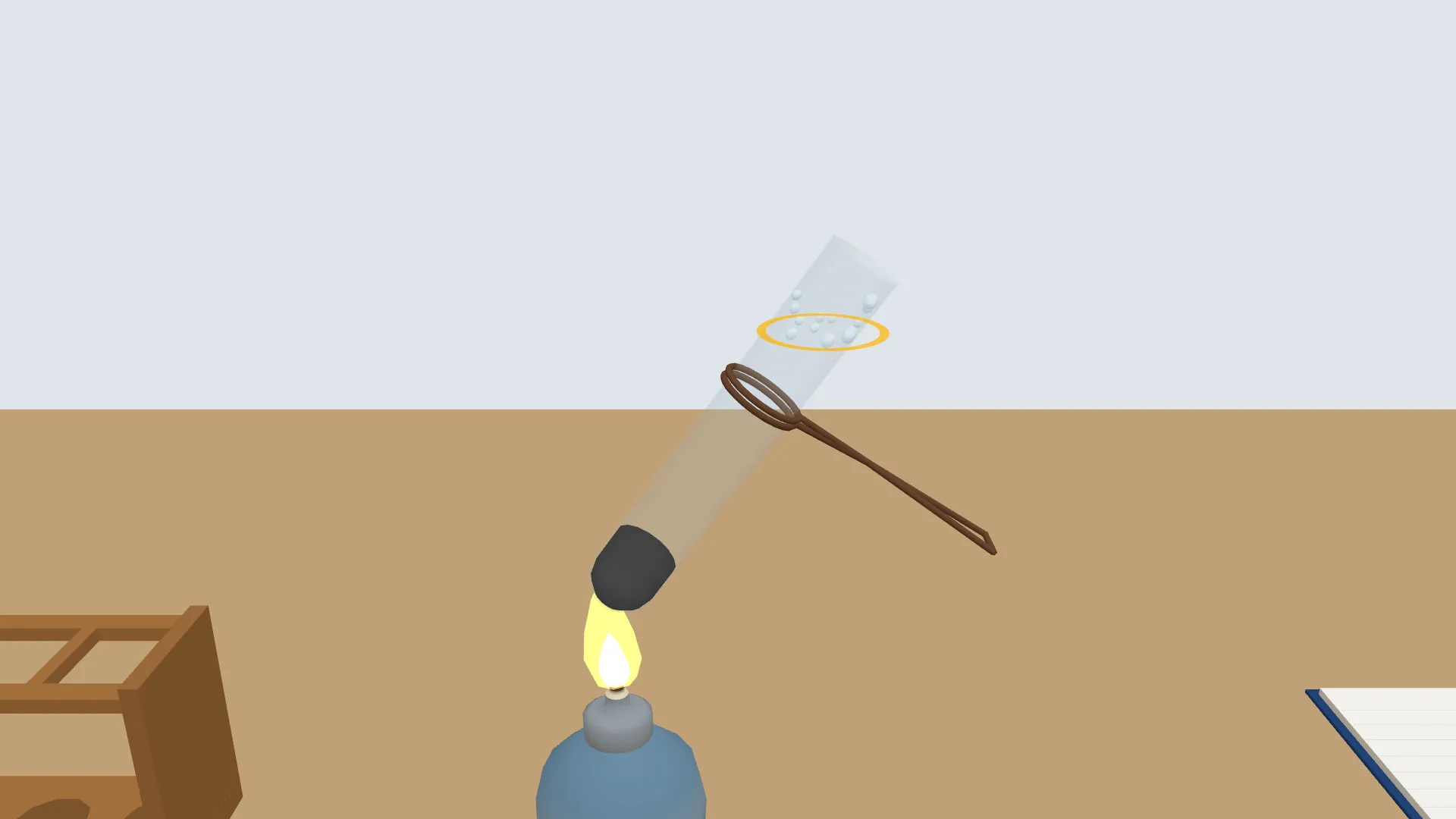
- Hold the tube with a test-tube holder and heat it gently, its mouth pointed away from everyone.
- Watch the colour of the sugar. Note when it turns brown and then blackish.
- Look at the cooler upper part of the tube, near its mouth. Record what collects there.
- Heat until nothing more changes. Let the tube cool, then scoop the black solid onto a watch glass.
- Record all your observations in the table.
Interactive 3D Experiment
Loading simulation…
What to observe
- The white sugar first melts, then turns brown and finally leaves a black, porous, spongy solid. This is carbon.
- Colourless droplets of water collect on the cool upper wall of the tube, near its mouth.
- The tube was dry at the start, so the water came from the sugar itself.
- One substance broke down into two simpler ones, so sugar is not an element. It is a compound of carbon, hydrogen and oxygen.
- Word equation: Sugar → (on heating) → Carbon + Water
Safety
- Do this activity only in the presence of a teacher.
- The boiling tube must be completely dry before the sugar goes in.
- Take only about a teaspoonful of sugar. Never fill the tube more than about a quarter.
- Hold the tube with a test-tube holder, never with bare fingers or a cloth.
- Keep the mouth of the tube pointed away from yourself and everyone else.
- Heat gently and keep moving the tube through the flame. Strong heating in one place cracks the glass and makes the sugar spurt.
- Molten sugar is very hot and sticky. Never touch it or smell the tube closely.
- Let the tube cool fully on a stand before you examine the black solid. Never put a hot tube on a cold surface or into water.
- Tie back long hair, keep the flame away from books and clothes, and put the lamp out with its cap, never by blowing.
Notes
- Science Spark: The black solid left when sugar is heated is almost pure carbon, the same element found in charcoal, pencil graphite and diamond. Sugar is C₁₂H₂₂O₁₁: twelve carbons, with hydrogen and oxygen in the 2 : 1 ratio found in water.