
Day and Night — Modelling the Rotation of the Earth
Aim
To model the rotation of the Earth with a globe and a torch, and to show that the Earth turning from West to East causes day and night and makes the Sun appear to travel across the sky from East to West.
Apparatus
- A globe on a stand, with the North Pole, the South Pole and the Equator marked
- A torch with fresh cells (to represent the Sun)
- Two or three small stickers or bindis
- A metre scale or a measuring tape
- A room that can be darkened by drawing the curtains
- Science notebook / lab record and pencil
Procedure
- Find the North Pole, the South Pole and the Equator on the globe, then locate India.
- Fix a sticker on your own town, and a second sticker far to its east, such as Dibrugarh.
- Look from above the North Pole. Turn the globe anti-clockwise until your sticker comes back.
- Darken the room. Place the lit torch about 1.5 m away. See how much of the globe is lit.
- Write the question: In which direction must the Earth turn so that the Sun rises in the East?
- Write down your guess before you test it.
- Watch eastern India. Turn the globe one way, then the other. Which way lights the east first?
- Turn the globe that way only. Follow your sticker through sunrise, noon, sunset and night.
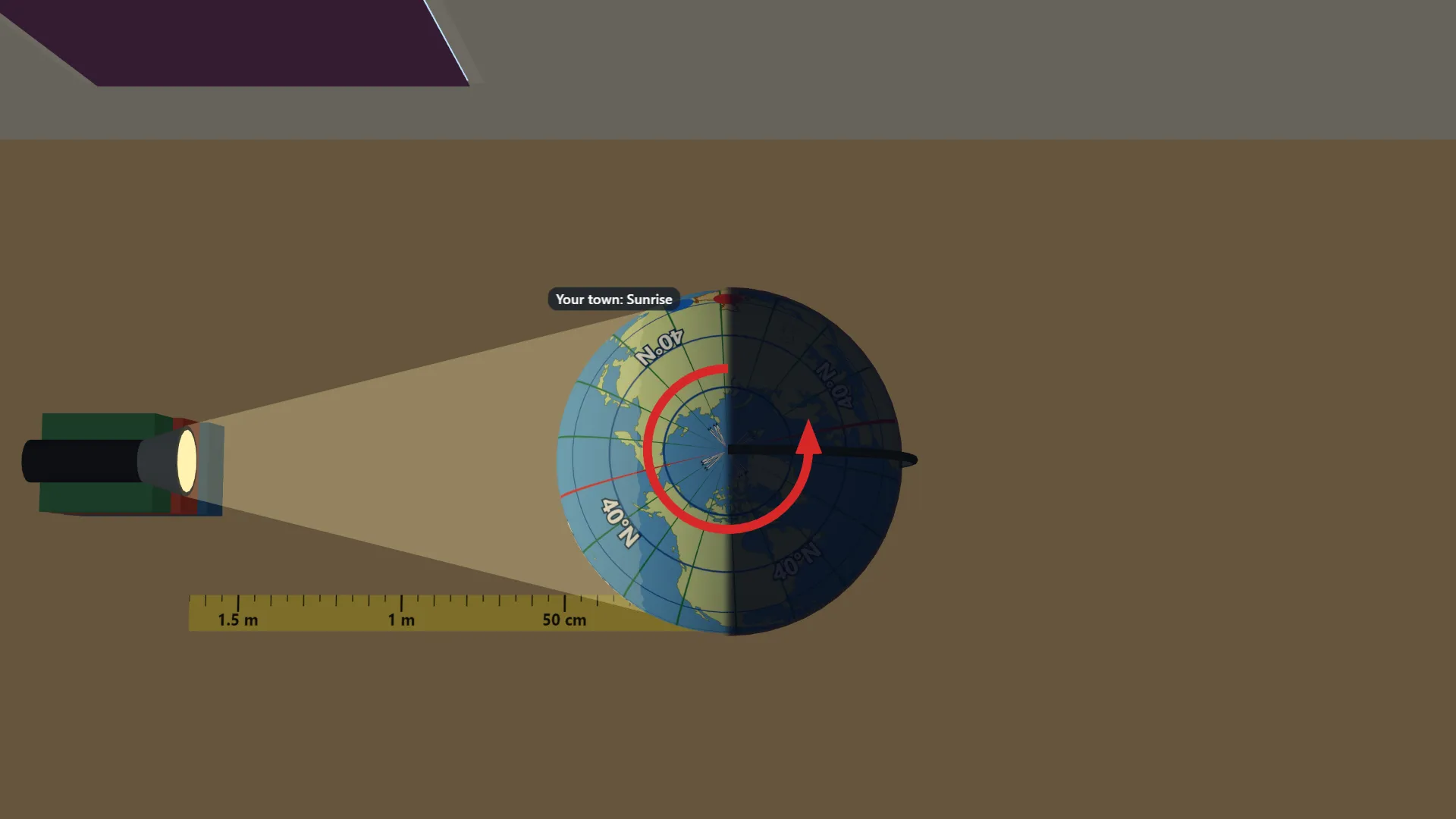
Interactive 3D Experiment
Loading simulation…
What to observe
- The torch lights only one half of the globe. One half has day while the other half has night.
- Seen from above the North Pole, the Earth turns anti-clockwise, that is, from West to East.
- Turning West to East brings the light to eastern India first, so the Sun rises in the East and sets in the West.
- One complete rotation, about 24 hours, gives one day and one night.
- The Sun only appears to travel across the sky. It is the Earth that is turning beneath it.
Safety
- Darken the room with the curtains only. Keep enough light to walk safely and keep the aisle clear.
- Do not shine the torch into anybody's eyes, never use a laser pointer, and switch the torch off between observations.
- Stand the globe on a firm, level table, well away from the edge.
- Turn the globe slowly and gently. Do not spin it fast, lift it off its axis or lean on it.
- Do not look at the Sun through a window, a tube or any instrument. It can damage the eye permanently.
Notes
- In 1851 Leon Foucault hung a long pendulum from a high ceiling. The direction of its swing slowly turned through the day, the first simple demonstration that the Earth is turning. A 22-metre Foucault pendulum now hangs in the Constitution Hall of the new Parliament building in New Delhi.