
The Magnetic Effect of an Electric Current
Aim
To show that an electric current flowing through a wire produces a magnetic effect, seen as the deflection of a nearby compass needle.
Apparatus
- Science notebook / lab record and pencil
- A magnetic compass
- An electric cell and a cell holder
- A simple switch (two drawing pins, a safety pin and a small cardboard piece)
- Two iron nails and two small pieces of cardboard
- Two connecting wires (one longer and one shorter)
Procedure
- Make a simple switch with two drawing pins and a safety pin. Keep it OFF.
- Place the electric cell in the cell holder.
- Fix two nails to a cardboard piece. Stretch the long wire between them, a little above it.
- Join the long wire to the cell holder and the switch. Join the short wire from holder to switch.
- Place the compass just beneath the wire, between the nails. Note where the needle points.
- Turn the switch ON so that current flows. Watch the compass needle.
- Turn the switch OFF, then ON and OFF a few more times. Watch the needle each time.
- Record what the needle does when the current flows and when it stops.
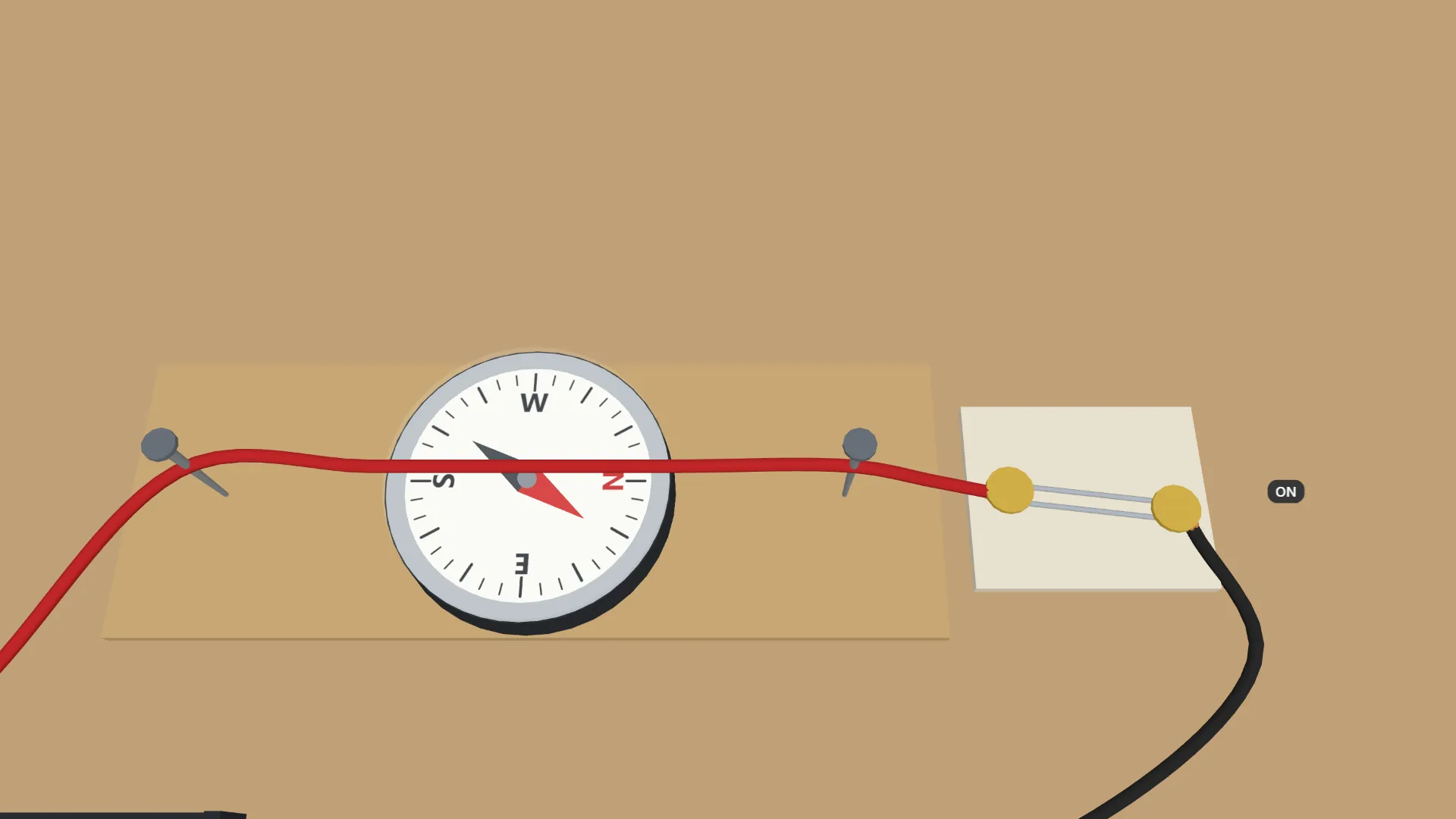
Interactive 3D Experiment
Loading simulation…
What to observe
- Switch OFF — the needle rests along north–south.
- Switch ON — the needle swings away from north–south.
- Switch OFF again — the needle returns to north–south. It is the same every time.
- A wire carrying a current acts like a magnet. This is the magnetic effect of electric current.
Safety
- Keep the switch OFF while you set up. Switch on only when you are ready to observe.
- Close the circuit for a few seconds at a time. A long time heats the wire and drains the cell.
- Keep connections clean and tight. Scrape the insulation off the wire ends.
- Never join the two terminals of the cell directly. A short circuit makes the wire dangerously hot.
- Place the compass right below the wire and close to it.
- Keep magnets, iron objects, phones and other circuits away from the compass.
- Note where the needle rests before you switch on.
- Use a fresh cell. Never use a damaged or leaking one.
Notes
- In 1820 the Danish scientist Hans Christian Oersted saw a compass needle twitch near a current-carrying wire during a class demonstration. It was the first clear proof that electricity and magnetism are connected.
- In the simulation the wire runs north–south, along the needle, so that the turn is easy to see.