
Cracking ‘Think of a Number’ Tricks
Aim
Perform, generalise and justify ‘Think of a Number’ tricks by replacing the secret number with a letter-number, and design a new trick whose final answer is fixed in advance.
Apparatus
- Slips of paper and pencils (one set per pair)
- A pack of digit cards 0 to 9, or two dice, to generate starting numbers
- Chart paper and coloured sketch pens (at least 3 colours)
- A calculator, only for checking large starting numbers
Procedure
- Work in pairs. Partner A reads: think of a number, double it, add 4, divide by 2, subtract the number. Partner B works silently.
- Partner A announces the answer before Partner B speaks. Swap roles and repeat.
- Try at least five starting numbers, including a two-digit number, a three-digit number, 0 and 1/2. Record every stage.
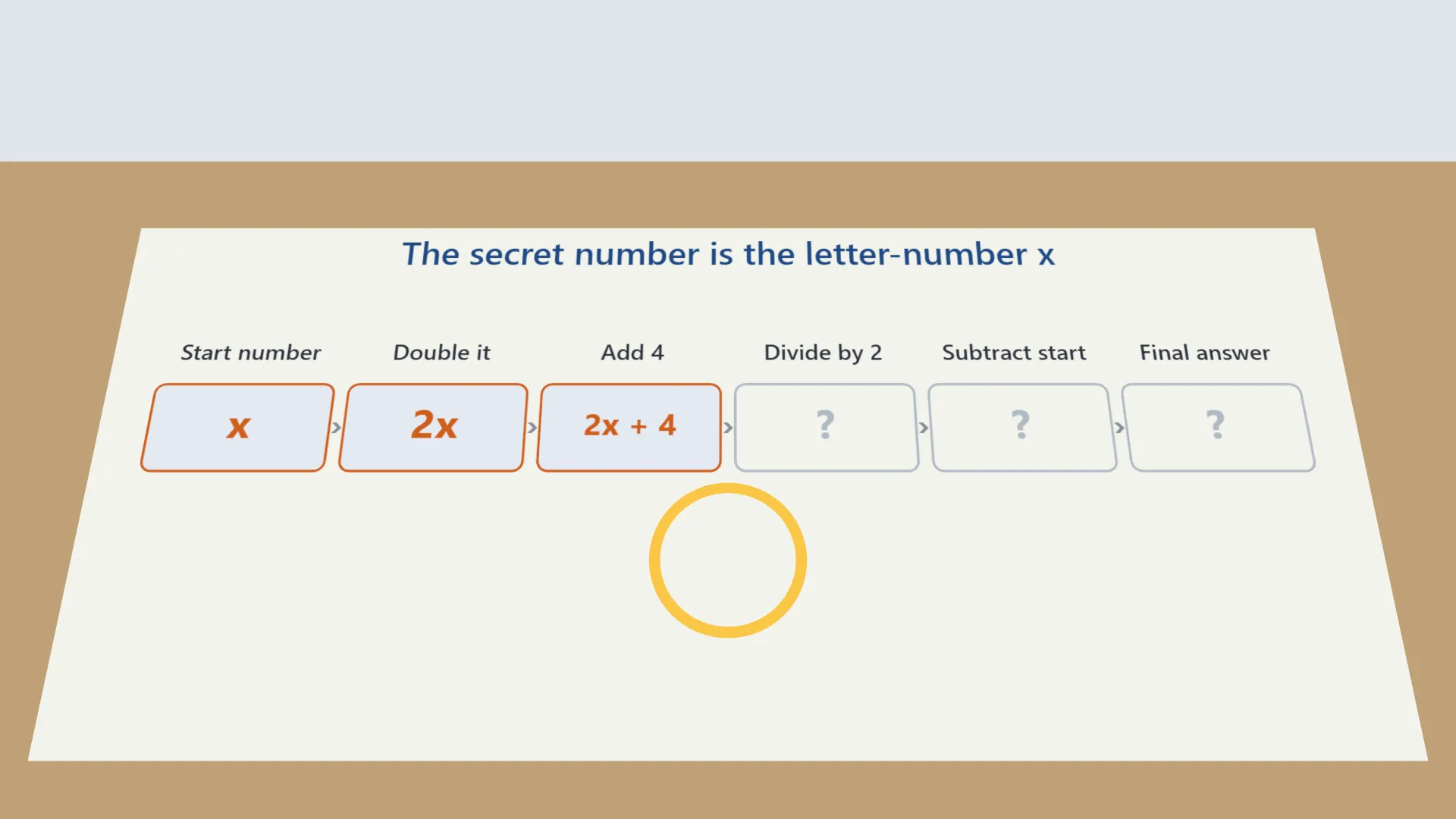
- Let the secret number be the letter-number x. Write the expression after each step, one below the other.
- Simplify the last expression. Why does the starting number disappear?
- Change exactly one instruction, for example ‘Add 4’ to ‘Add 10’. Predict the new answer with algebra, then test it.
- Design your own trick of at least six steps whose answer is always 5. Try it on three classmates.
Interactive 3D Experiment
Loading simulation…
What to observe
- Whatever starting number is chosen, the final answer is the same: 2.
- With x for the secret number, (2x + 4) ÷ 2 − x = x + 2 − x = 2: the terms in x cancel and only a constant is left.
- Changing ‘Add 4’ to ‘Add k’ makes the fixed answer k ÷ 2. Working backwards from a chosen answer designs a new trick.
Notes
- Math Spark: the word ‘algebra’ comes from al-jabr, part of the title of a book by Al-Khwarizmi in Baghdad around 820 CE; ‘algorithm’ comes from his name too. In 628 CE Brahmagupta used abbreviations of colour names (yavat tavat, kalaka, nilaka) as symbols for unknown quantities, much as we use x, y and z. Every ‘Think of a Number’ trick is an algebraic identity wearing a costume: write x instead of a number and the costume falls off.
- Carry out the instructions in the given order; changing the order changes the expression.
- Use the same letter for the secret number at every step, and write the expression after each instruction before moving on.
- Use brackets when a whole expression is doubled or halved: 2x + 8 halved is x + 4, not 2x + 4.
- Simplify fully and check that the term in the letter really cancels before claiming the answer is fixed.
- Test the trick with at least three different starting numbers, including 0 and a large number.
- When designing a new trick, work backwards from the fixed answer and then verify the algebra forwards.
- Keep the starting number secret from the partner until the trick is complete.
- Use the calculator only to check the arithmetic for large starting numbers.