
Counting Without Modern Numbers
Aim
Represent and compare quantities the way early people did, with one-to-one mapping and tally marks. Group the tallies in fives, and write the same numbers in the Roman number system.
Apparatus
- A handful of sticks, matchsticks, pebbles or bottle caps (about 30)
- A set of small objects to count (buttons, beads or beans)
- Dot grid or plain paper notebook
- Coloured pencils or sketch pens (at least 3 colours)
- Ruler and pencil
Procedure
- Put one stick beside each object. This is a one-to-one mapping, so no object shares a stick.
- Match the two stick-piles stick for stick to see which collection is larger, and by how many.
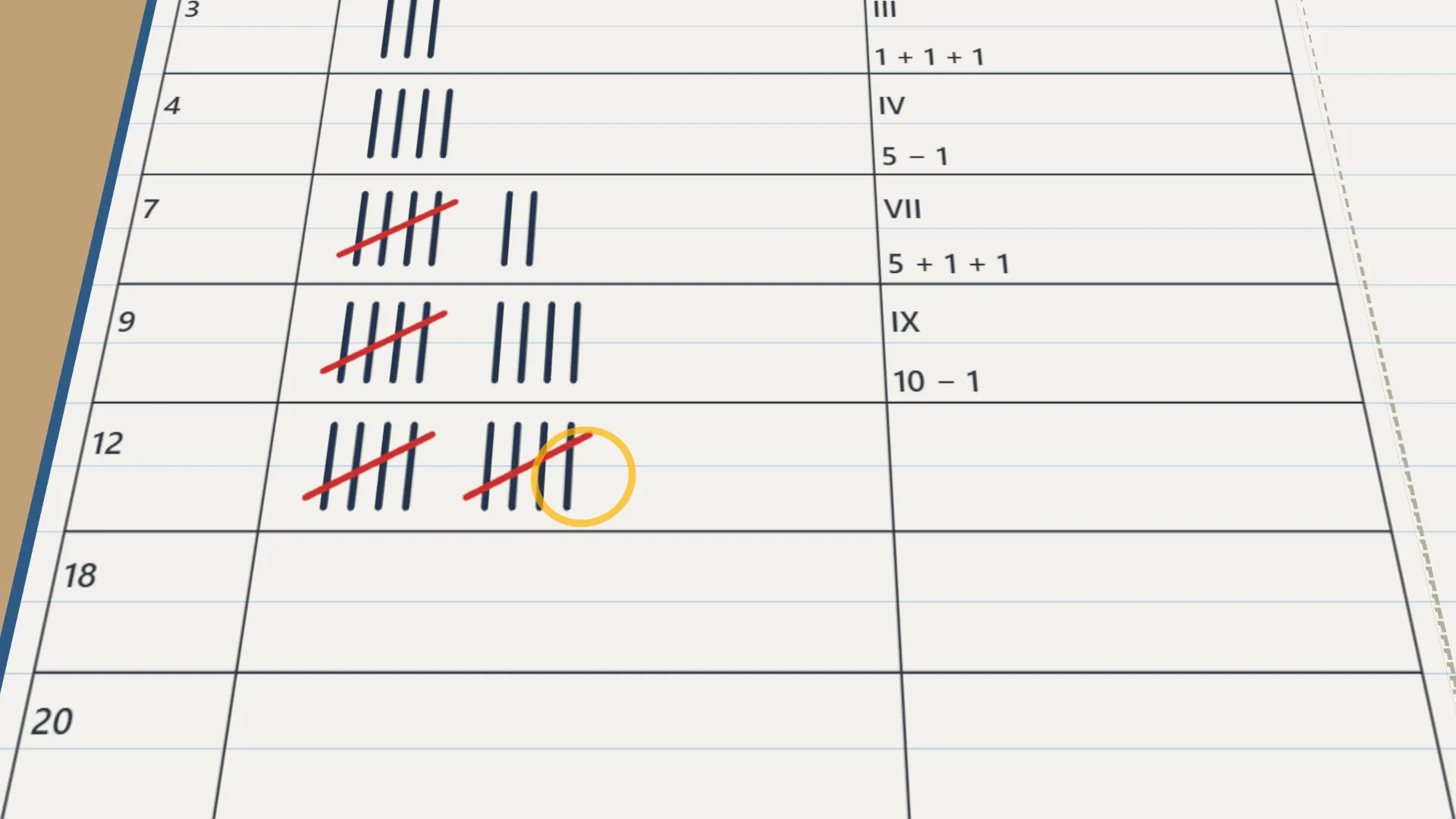
- Record numbers as tally marks, one vertical mark for each object.
- At five marks, cross the four with a diagonal "gate" line and bundle in fives, up to 20.
- Write each number in Roman numerals using I, V, X, L, C and D. Remember 4 is IV and 9 is IX.
- For every number, write in your own words the rule you used to go from tallies to the Roman numeral.
Interactive 3D Experiment
Loading simulation…
What to observe
- Matching sticks one to one shows which collection is larger, and by how many, without any number name.
- Tallies bundled in fives are far quicker to read than a long unbroken row of strokes.
- In Roman numerals 4 is IV and 9 is IX, and no symbol is written more than three times in a row.
- Grouping is what turns a record of counting into a usable number system.
Notes
- Math Spark: the Lebombo bone, found in South Africa, is a tally stick with 29 notches, about 44 000 years old. The Roman system has no zero, which makes adding and multiplying large numbers awkward, so merchants used a counting board, the abacus.
- Place exactly one stick against one object. A stick shared between two objects breaks the mapping.
- Keep the two collections and their stick-piles separate so they do not get mixed.
- Compare the piles by matching them stick for stick. Do not count them in number names.
- Draw four upright marks and cross the fifth diagonally across them. Do not draw five upright marks and then a line beside them.
- Do not write the same Roman symbol more than three times in a row. Write IV and IX, not IIII and VIIII.
- Check that each tally record and its Roman numeral stand for the same count before writing the rule.