
Why Does Smoke Rise? — Convection in Air
Aim
Investigate how heat is transferred in air, and show that air becomes lighter and rises when it is heated.
Apparatus
- Two identical paper cups
- Thread
- A wooden stick or ruler, about 30 cm long
- A hook, nail or stand to hang the stick from
- A candle and a matchbox
- An incense stick
- A notebook and pencil
Procedure
- Predict what will happen to a cup if a burning candle is placed below it.
- Light the candle at its stand.
- Place the burning candle a little below one cup and watch the cup for about a minute.
- Blow out the candle and wait for the stick to rest. Repeat below the other cup.
- Light an incense stick nearby and watch which way its smoke travels.
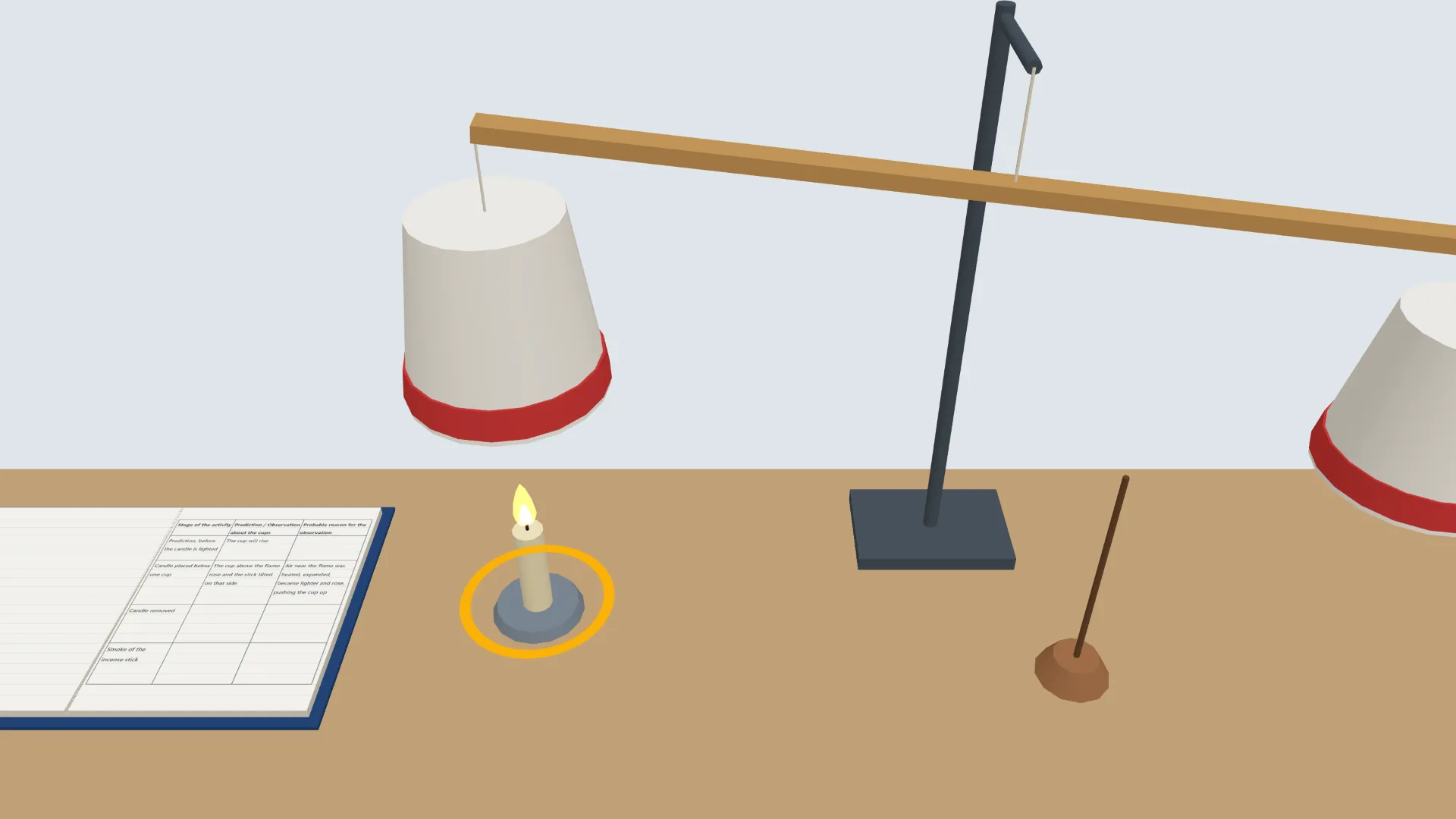
Interactive 3D Experiment
Loading simulation…
What to observe
- The cup above the flame rises and the stick tilts on that side.
- Air near the flame is heated, expands, becomes lighter and rises, pushing the cup up.
- Colder, heavier air moves in to take its place, so a continuous current of air is set up.
- This transfer of heat by the moving fluid itself is called convection. It happens in liquids and gases, not in solids.
- The rising smoke of an incense stick shows the same current.
Notes
- A hot-air balloon flies on this idea. Heating the air inside makes it lighter and lifts the balloon.
- An adult must be present. Never leave the burning candle alone below the cup.
- Keep the flame well below the cup so the paper never scorches. If it darkens, lower the candle or blow it out.
- Hang the stick from a firm hook and check it is steady before lighting the candle.
- Stand the candle in a holder, tie back long hair, and keep thread, sleeves and paper away from the flame.
- Do not put your hand or face into the hot air above the flame.