
Constructing Triangles with a Compass
Aim
Construct equilateral, isosceles and scalene triangles with a ruler and compass from given side lengths, and see why the two arcs find the third corner exactly.
Apparatus
- Ruler and a sharp pencil
- Compass
- Protractor
- Coloured pencils or sketch pens
- Plain drawing sheets / notebook
Procedure
- Draw a base AB = 4 cm with the ruler. Open the compass to 4 cm on the ruler.
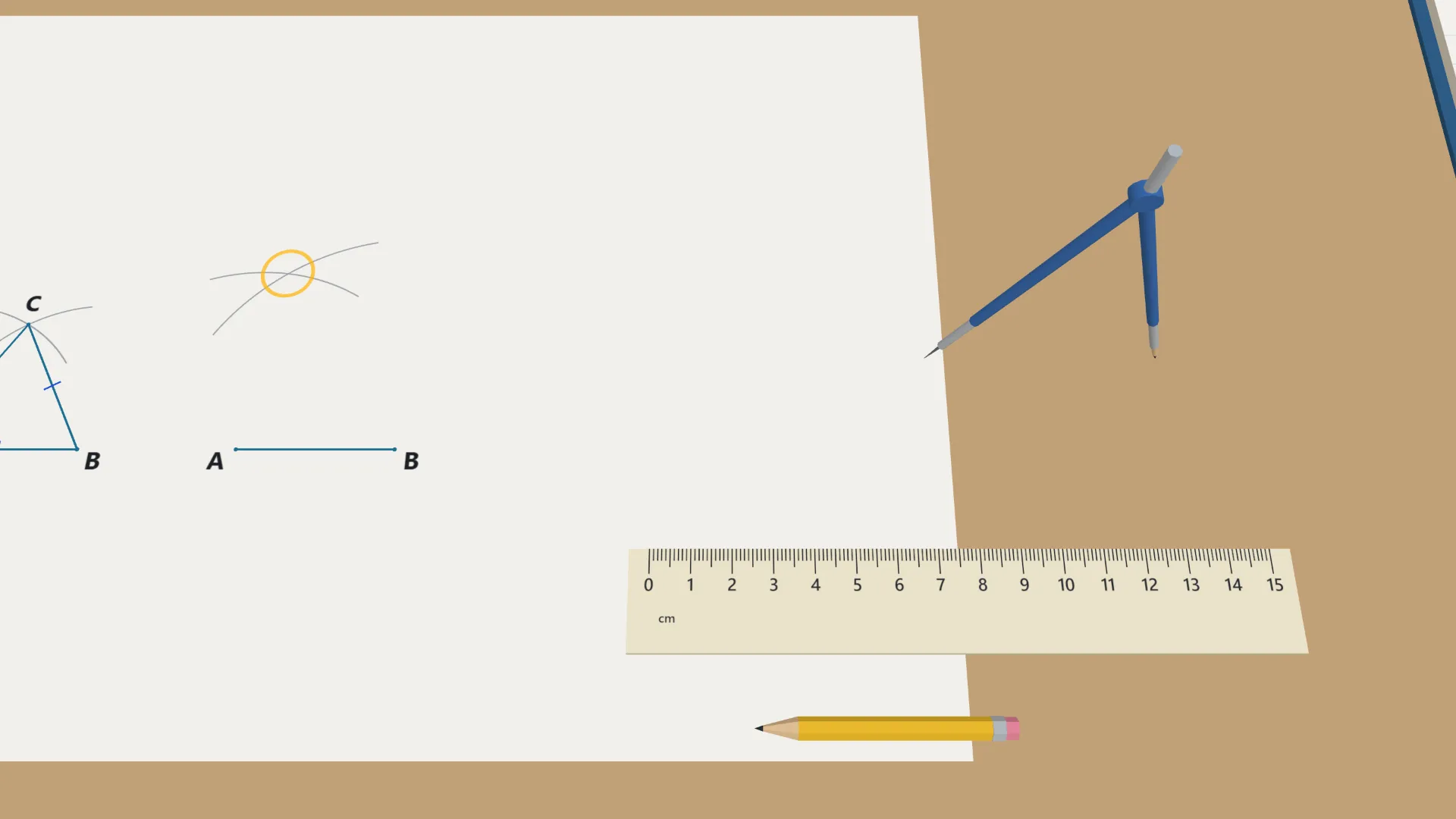
- With A as centre draw a 4 cm arc; with B as centre draw one cutting it. Mark C where they meet.
- Join AC and BC to get an equilateral triangle. Measure all three sides with the ruler.
- Scalene triangle: AB = 4 cm, a 5 cm arc from A, a 6 cm arc from B. Join C, then measure.
- Isosceles triangle 5, 5, 3: AB = 3 cm, 5 cm arcs from A and from B. Join C, then measure.
- For each triangle, write the side lengths and the type of triangle in the table.
Interactive 3D Experiment
Loading simulation…
What to observe
- The point where the arcs cross is one radius from A and the other from B.
- Does every measured side match the length you set in the compass?
- Equilateral: three equal sides. Isosceles: two. Scalene: none.
Notes
- The very first proposition in Euclid's 'Elements' (about 300 BCE) is this construction of an equilateral triangle with two arcs.
- The arcs meet at the right place because every point of an arc is the same distance from its centre.
- Tighten the compass hinge so the radius does not slip while you draw an arc.
- Set the radius against the ruler before each arc, and check it again if the compass is disturbed.
- Draw the arcs long enough to cut each other clearly; short arcs may miss.
- Mark the meeting point with a fine dot and label it before joining the sides.
- Do not erase the construction arcs; they are part of the record.
- Keep the pencil sharp and hold the compass by its handle so the needle does not slide.