
Constructing Squares and Rectangles
Aim
Construct a square and a rectangle of given sizes with a ruler, protractor and compass, and check their properties. A square has all four sides equal and all angles 90°. A rectangle has opposite sides equal and all angles 90°.
Apparatus
- Ruler
- Protractor
- Set square
- Compass
- Sharpened pencil
- Dot paper or graph paper
- Coloured pencils
- Eraser
Procedure
- Draw PQ = 6 cm with the ruler.
- Draw perpendiculars to PQ at P and at Q using the protractor.
- Use the compass to mark S and R 6 cm from P and Q, then join R to S.
- Measure all four sides and all four angles of PQRS.
- Construct a rectangle of sides 6 cm and 4 cm in the same way and measure it.
- On dot paper, draw a tilted square with its corners on dots and measure it.
- Try to draw a four-sided figure with four right angles but unequal opposite sides.
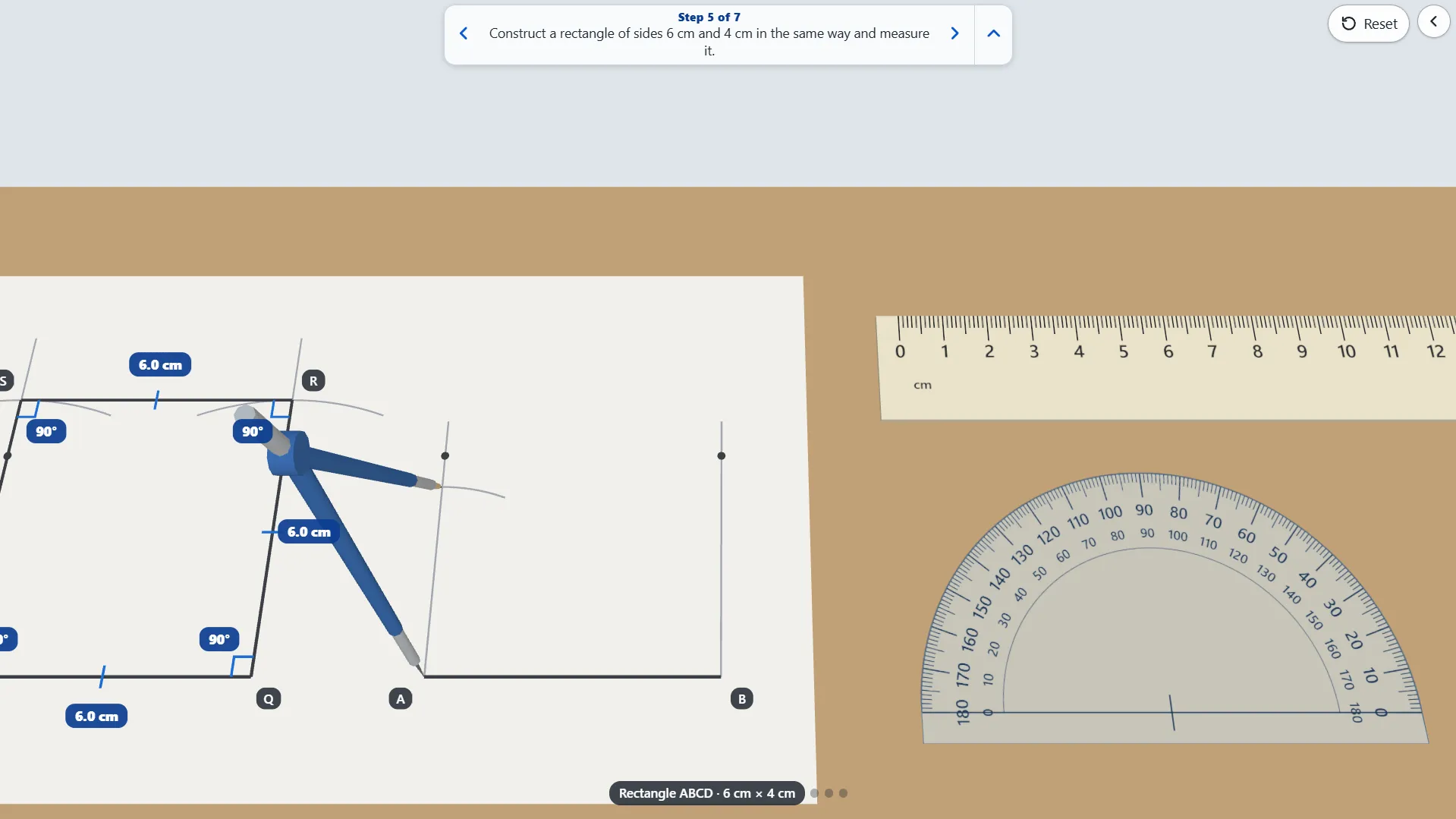
Interactive 3D Experiment
Loading simulation…
What to observe
- Are all four sides of PQRS equal, and are all its angles 90°?
- Which sides of the rectangle are equal?
- Does tilting the square change its sides or its angles?
- Can a four-sided figure have four right angles but unequal opposite sides?
Notes
- The word rectangle comes from the Latin rectangulus, meaning right-angled. A square is a rectangle whose sides are all equal.
- Builders make a right angle without a protractor using the 3–4–5 rule. A triangle with sides 3, 4 and 5 units always has a right angle.
- Turning a square does not change its sides or its angles, so a tilted square is still a square. Properties that stay the same when a shape is turned are called invariant.
- Draw a rough diagram first and mark the given measurements on it.
- Put the protractor's centre exactly on the vertex and its baseline exactly along the side.
- Transfer equal lengths with the compass instead of judging them by eye.
- Keep construction lines and arcs thin and light, and do not rub them out until the figure has been checked.
- Measure every side and angle of the finished figure instead of assuming them.