
Which Materials Let Heat and Electricity Pass Through?
Aim
To compare how a metal spoon and a wooden spoon conduct heat, and to test everyday materials for the conduction of electricity using a simple tester circuit.
Apparatus
- A glass tumbler and some hot water (not boiling)
- A metal spoon and a wooden spoon of nearly the same size and thickness
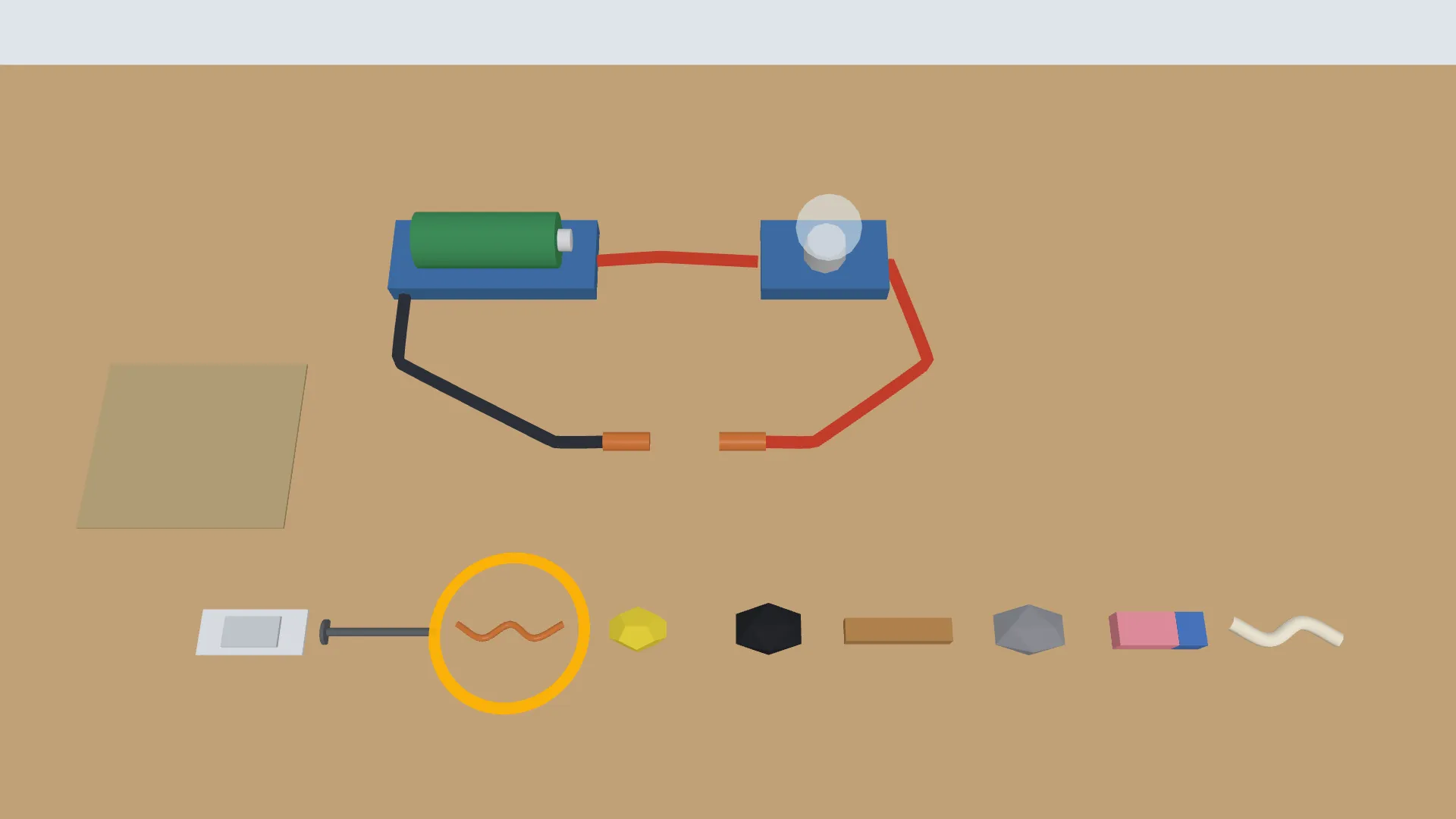
- A tester: one cell in a holder, a small torch bulb in a holder, and three connecting wires with bare ends
- Aluminium foil, an iron nail, a copper wire, a pea-sized lump of sulfur, a piece of coal, a piece of dry wood, a stone, a rubber eraser and a piece of nylon rope
- Sandpaper, a napkin for holding the hot tumbler, science notebook and pencil
Procedure
- Fill a glass tumbler about two-thirds with hot water. Your teacher pours it.
- Lower the metal spoon and the wooden spoon into the water together and leave them for two to three minutes.
- Touch the upper end of each spoon briefly. Which one feels hotter?
- Record it in Table 2A.
- Make the tester and touch its two free ends together. The bulb should glow.
- Before testing, predict for each sample whether the bulb will glow. Write it in Table 2B.
- Rub the ends of a sample with sandpaper so that the contact is clean.
- Hold the sample between the two free ends and watch the bulb.
- Write the result beside your prediction. Put a star where they do not match.
Interactive 3D Experiment
Loading simulation…
What to observe
- The upper end of the metal spoon becomes hot; the wooden spoon stays cool.
- Aluminium foil, the iron nail and the copper wire make the bulb glow.
- Sulfur, coal, wood, stone, rubber and nylon do not.
- Metals are good conductors of heat and electricity; non-metals are generally poor conductors (insulators).
Safety
- Hot water must be poured by the teacher. Use hot but not boiling water, fill the tumbler only two-thirds, and hold it with a napkin well away from the edge of the table.
- Touch the upper end of the metal spoon only for an instant with the back of a finger, and never grip it.
- Test the samples with the single-cell tester only. Never test any material at a plug point or with the mains supply, and never with wet hands or a wet sample.
- Do not touch the bare ends of the tester wires together for more than a moment, and never test the body, a plant or a water surface with the tester.
- Clean the wire ends and metal samples with sandpaper away from your face, disconnect the cell after the last sample, and let the tumbler and spoons cool before washing.
Notes
- Science Spark: Silver conducts electricity better than any other metal, yet the wiring in your home is made of copper. Copper conducts almost as well and costs a small fraction as much.