
How Does Heat Travel Through a Metal? — Conduction
Aim
Show that heat travels from the heated end of a metal strip to its colder end by conduction, and find the order in which pins fixed along the strip fall.
Apparatus
- A metal strip (aluminium or iron), about 15 cm long
- Four pins fixed with candle wax
- A candle or spirit lamp, and a matchbox
- A stand with a clamp (or two bricks)
- A wooden scale and a glass rod
- A tray, and a notebook with a pencil
Procedure
- Predict the order in which the four wax-fixed pins will fall. Tap the pins in that order.
- Light the lamp under the free end of the strip. Hold the flame steady and watch the pins.
- Put out the flame and let the strip cool completely before touching it.
- Repeat with the wooden scale, and then with the glass rod.
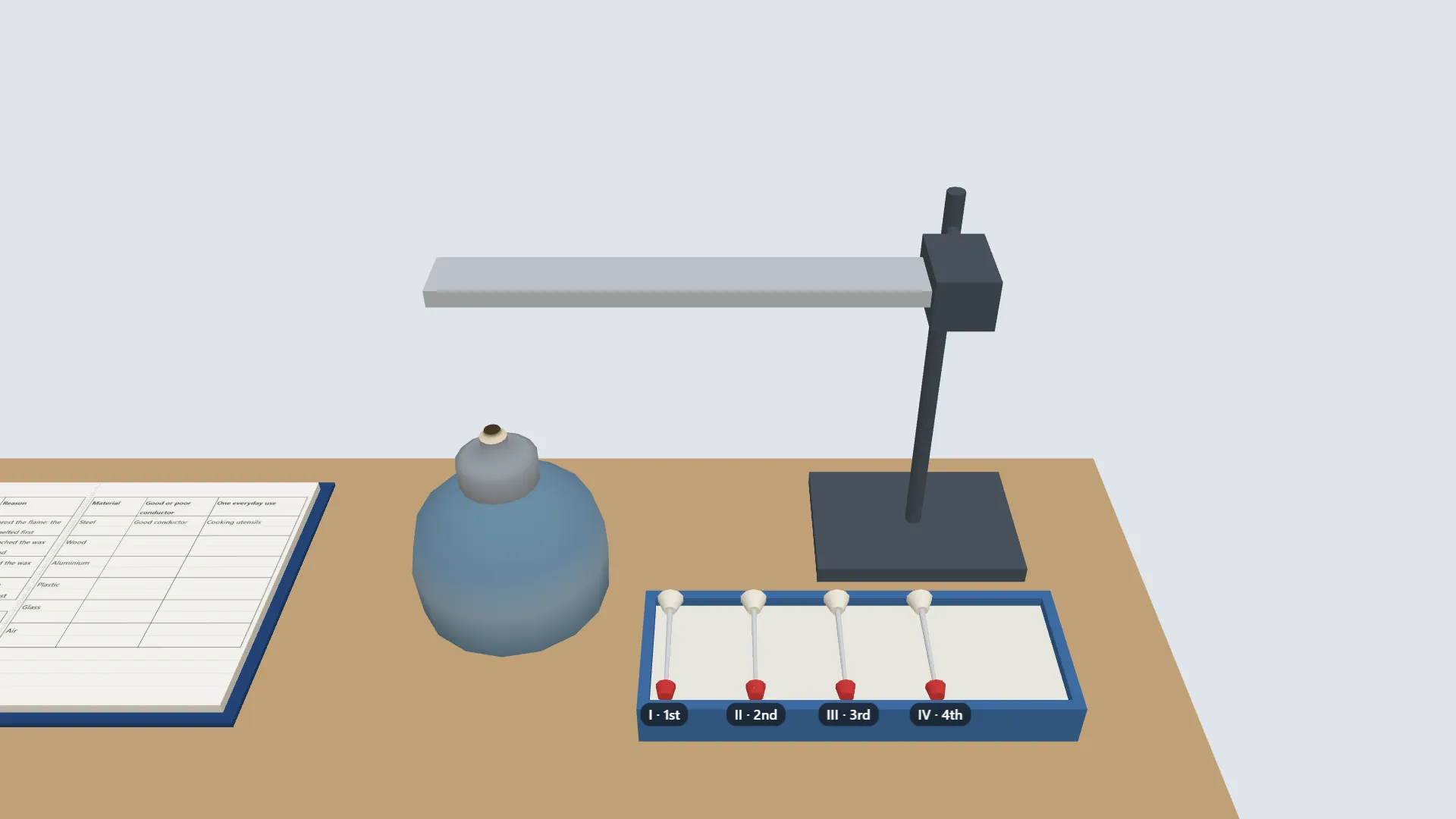
Interactive 3D Experiment
Loading simulation…
What to observe
- On the metal strip, pin I (nearest the flame) falls first, then II, III and IV.
- Heat travels from the hot end to the cold end, warming each part in turn. This is conduction.
- On the wooden scale and the glass rod the pins do not fall. Wood and glass are poor conductors.
Notes
- Diamond is the best natural conductor of heat, about five times faster than copper.
- Do this only with the teacher. Tie back long hair, roll up loose sleeves and keep paper and cloth away from the flame.
- Clamp the strip firmly and horizontally. Keep a tray under it to catch the pins.
- Hold the flame steady at the free end only. Do not touch the strip while it is hot, because a hot strip looks like a cold one.
- Put out the flame as soon as the last pin falls. Count the pins back in at the end.