
Conducting a Mock Classroom Election
Aim
To hold a mock class election by secret ballot, then count and study the results to understand the stages of India's electoral process.
Apparatus
- Plain paper strips (ballot papers)
- A small box with a lid (ballot box)
- A class roll (voter list)
- Pencils
- A tally sheet
- Chart paper for manifestos
Procedure
- Appoint an Election Officer and two Polling Officers.
- Nominate three candidates for Class Monitor; each gives a one-line manifesto.
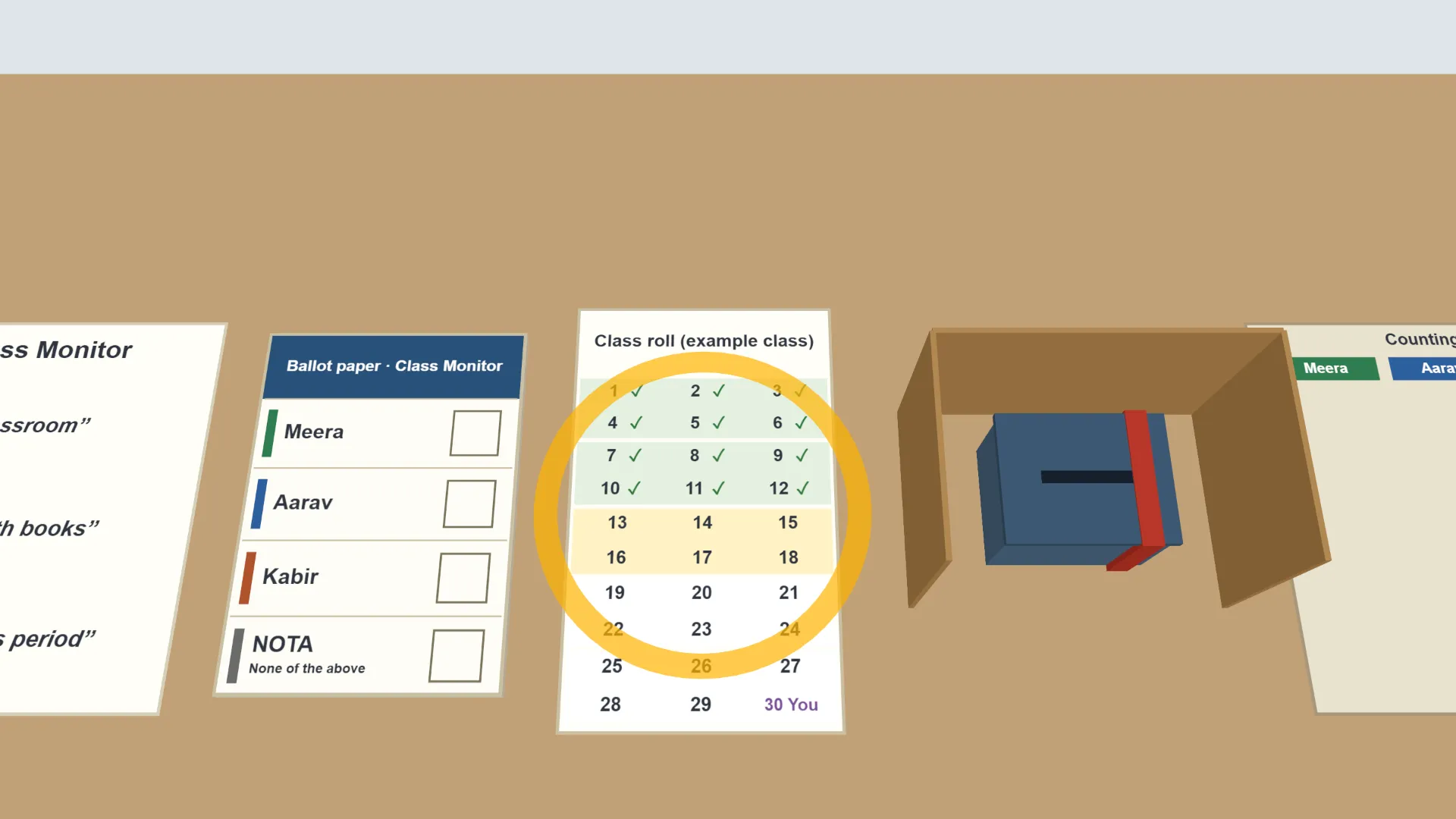
- The Election Officer prepares ballot papers with the three names and NOTA at the bottom.
- Set up a voting corner where no one can see how another student votes.
- Polling Officers check each voter's name on the class roll before giving a ballot.
- Mark an 'X' secretly against your choice, fold the ballot and drop it in the sealed box.
- Open the box before two witnesses, set aside invalid ballots and count the valid votes.
- Record the results in the table and declare the winner.
Interactive 3D Experiment
Loading simulation…
What to observe
- Every voter is checked on the roll, so no one votes twice.
- No one sees how anyone else voted — the ballot is secret.
- NOTA counts as a valid vote; blank or double-marked ballots are invalid.
- The winner has the most valid votes; the percentages of valid votes add up to 100.
Notes
- The class and its votes are an example. Hold your own election — your class's results will differ.
- A secret ballot means no voter can be pressured, bribed or punished for their choice.
- Keep the voting secret; no one should see another student's ballot.
- Keep the box sealed while voting; open it only in front of witnesses.
- Check every voter's name on the roll before giving a ballot, to stop double voting.