
Conditions for Congruent Triangles
Aim
Construct triangles from given measurements and find which sets always give congruent triangles (SSS, SAS, ASA, AAS, RHS), and show by a construction why SSA does not.
Apparatus
- Ruler, compass, protractor and a sharp pencil
- Plain paper and tracing paper
- Scissors and coloured pencils
- Cardboard for making a triangular 'frame' to copy
Procedure
- SSS: construct a triangle with sides 4 cm, 6 cm and 8 cm. Lay your partner's cut-out on it.
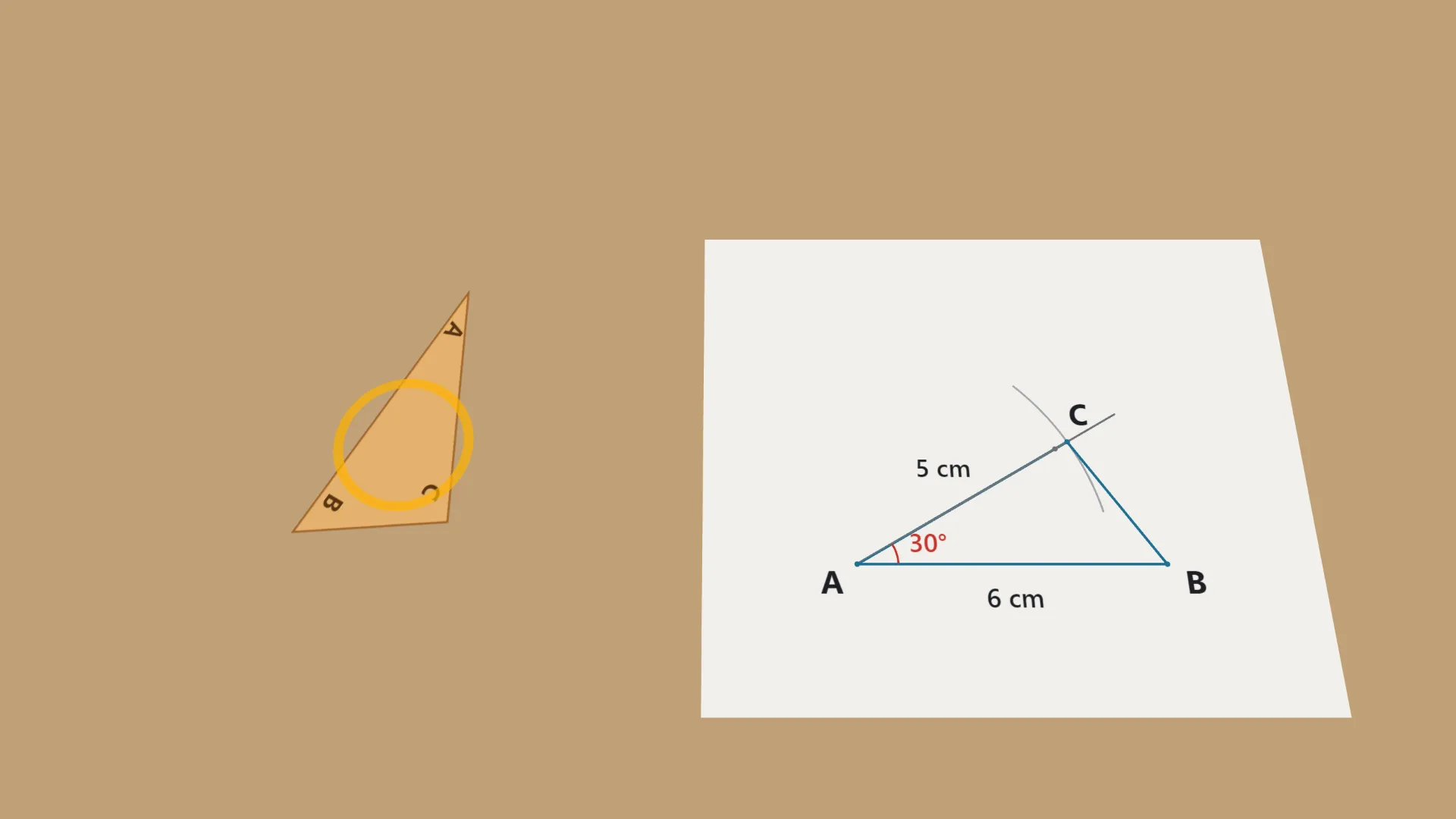
- SAS: construct a triangle with sides 6 cm and 5 cm and the angle 30° between them. Compare.
- ASA: construct a triangle with a 5 cm side and angles 50° and 30° at its ends. Compare.
- AAS (∠A = 50°, ∠B = 30°, BC = 5 cm): first find ∠C = 180° − 50° − 30°, then construct. Compare.
- RHS: construct a right triangle with one side 4 cm and hypotenuse 5 cm. Compare.
- SSA: base PQ = 6 cm, 30° at P, an arc of 4 cm from Q. It cuts the arm at R and at S.
- For each case, write in the table whether the triangles are always congruent.
Interactive 3D Experiment
Loading simulation…
What to observe
- With SSS, SAS, ASA, AAS and RHS the cut-out fits your triangle exactly.
- With SSA the arc meets the arm twice, so the same data gives two different triangles, PQR and PQS.
- SSS, SAS, ASA, AAS and RHS are conditions for congruence; SSA is not.
Notes
- A triangle cannot be pushed out of shape once its sides are fixed (SSS) — that is why bridges, cranes and roof trusses are built from triangles.
- The letters are a shorthand for the parts you measured: Side, Angle, and (in RHS) the Right angle and Hypotenuse.
- For SAS, construct the angle between the two given sides; an angle drawn elsewhere gives a different triangle.
- Label corresponding corners in the same order in both triangles before comparing them.
- Compare triangles by laying the cut-outs on each other, not by judging with the eye.
- Re-check the compass radius before drawing each arc, and keep the pencil sharp.
- Read the correct scale of the protractor when setting each angle.
- Cut the triangles out exactly along the drawn lines, so a poor cut is not mistaken for non-congruence.