
Comparing the Union and State Legislatures
Aim
To compare the parallel structures of the Union Government and your own State Government, and to find out what type of legislature your state has.
Apparatus
- Chart paper
- Ruler
- Coloured pencils
- Textbook table: Parallel Structure of Union and State Governments in India
- Internet access or reference books for facts about your state
Procedure
- Study the textbook table comparing the Union and State Governments.
- On chart paper, draw a two-column chart with the same features as rows.
- Fill in the Union Government column from the textbook.
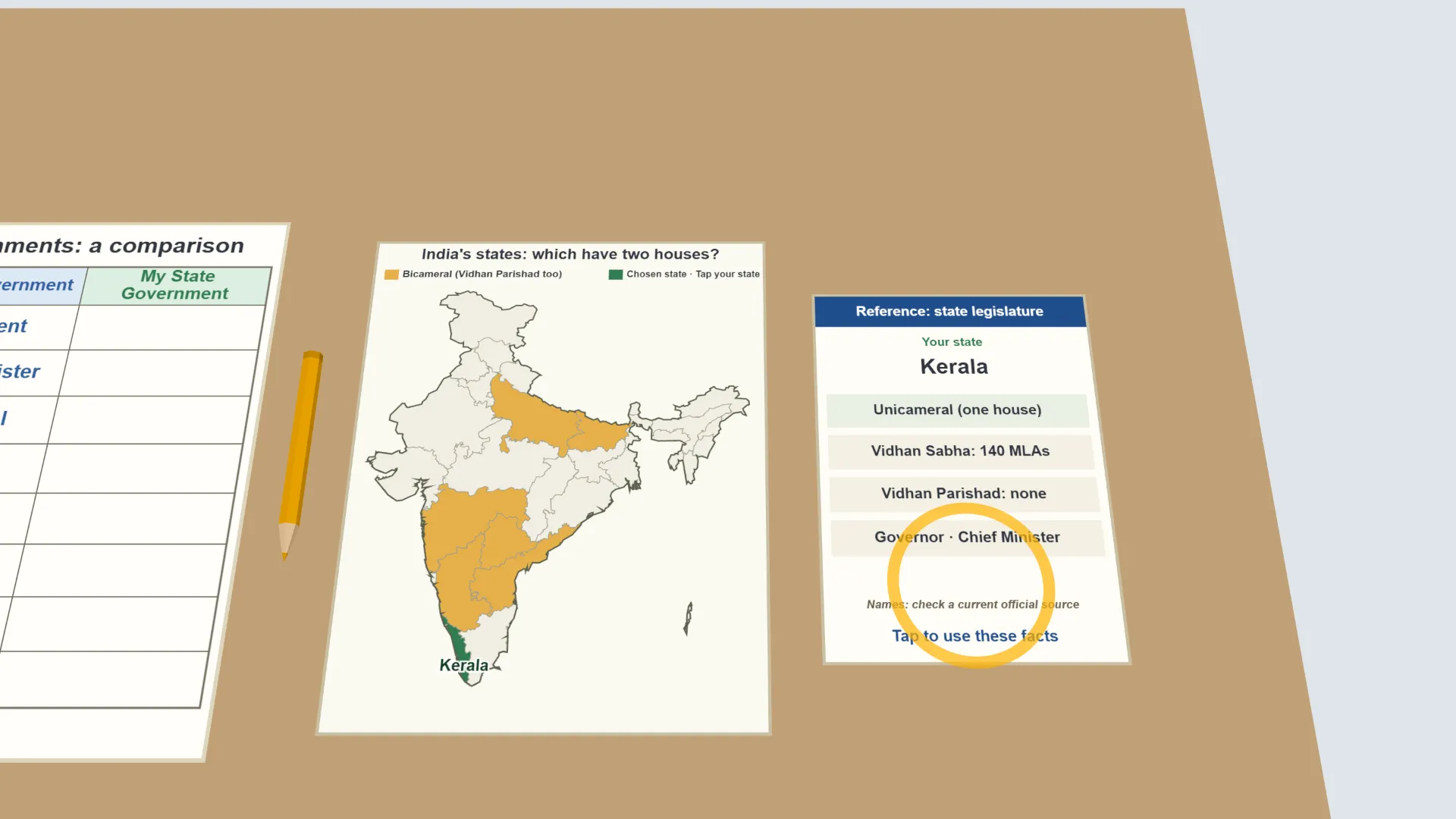
- Pick your state on the map (or keep the example) and find out its legislature.
- Fill in your state's column, including the number of MLAs and MLCs.
- Highlight in another colour every feature where your state is bicameral.
Interactive 3D Experiment
Loading simulation…
What to observe
- Each Union post has a state partner — President and Governor, Prime Minister and Chief Minister.
- Parliament always has two houses; most states have only one, the Vidhan Sabha.
- Only six states have a Vidhan Parishad as well.
Notes
- Maharashtra is shown as an example. Pick your own state on the map to see its legislature.
- Only six states — Andhra Pradesh, Bihar, Karnataka, Maharashtra, Telangana and Uttar Pradesh — have a bicameral legislature with a Vidhan Parishad. All other states have a Vidhan Sabha alone.
- Check your state's facts — the Governor, Chief Minister and number of MLAs — in a current, reliable source before you record them.