
Comparing Expressions Without Calculating
Aim
Build arithmetic expressions with tokens and compare them using =, < and > by seeing how the two sides differ, without working out each side in full.
Apparatus
- Counters, beads or bottle caps in two colours (about 60 of each)
- A few small paper cups or bowls to hold groups of tokens
- Dot grid or plain notebook and pencil
- Coloured sketch pens (at least 3 colours)
Procedure
- Show 13 + 2 with 13 tokens of one colour and 2 of another. Count them to get 15.
- Build expressions that equal 12, such as 10 + 2, 15 − 3, 3 × 4 and 24 ÷ 2.
- Build 10 + 2 and 7 + 1 and line them up. Without adding, find which side is larger and choose the sign.
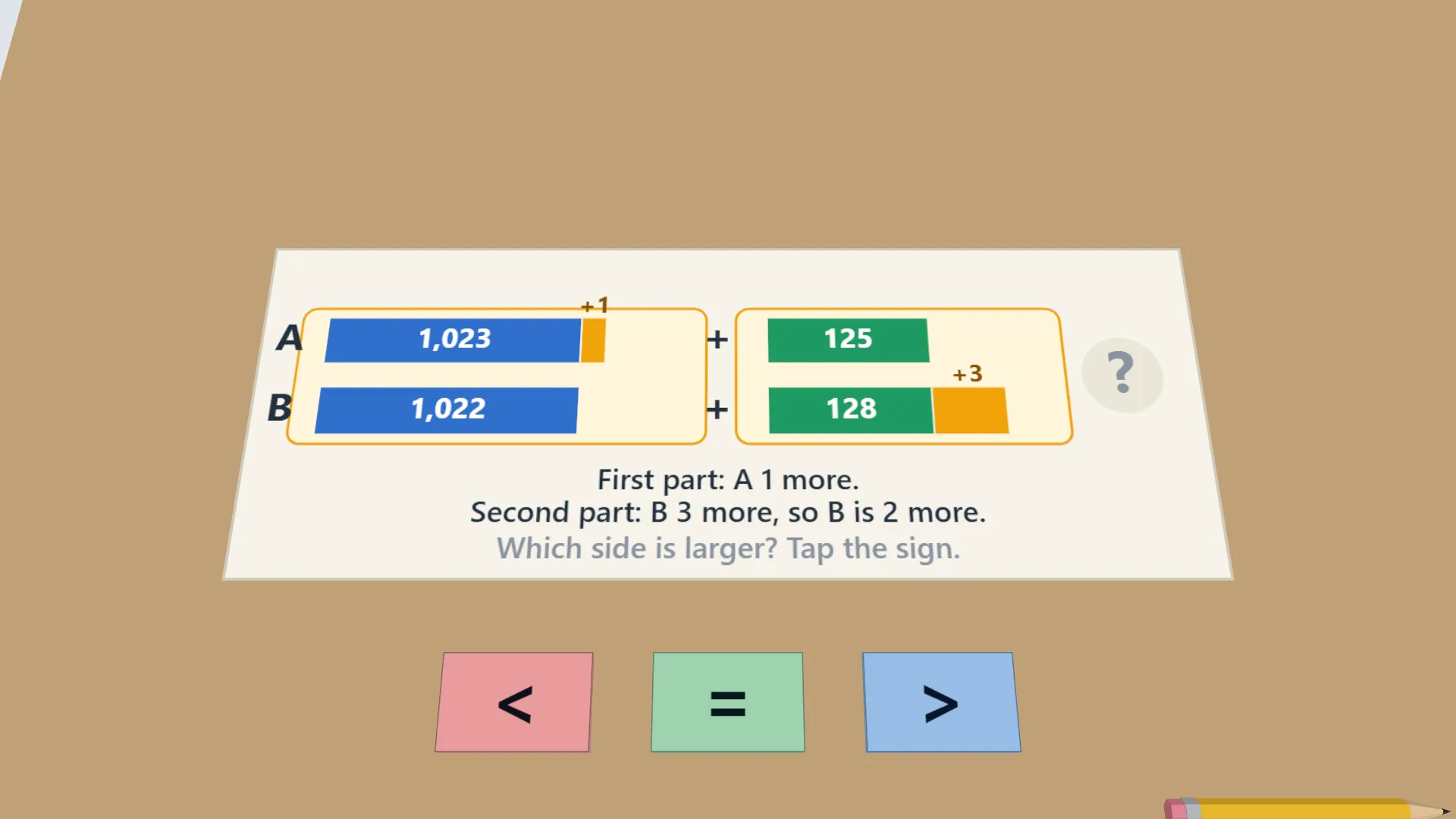
- Marble story. Compare 1023 + 125 and 1022 + 128. One side starts 1 more, the other gains 3 more.
- Compare 113 − 25 and 112 − 24. Look at the extra start and the extra amount taken away.
- Fill the table for the other pairs. For each one, write why your sign is correct.
Interactive 3D Experiment
Loading simulation…
What to observe
- Which parts of the two sides are the same, and by how much do the other parts differ?
- If one side has 1 more in the first part and the other has 3 more in the second, which side is larger?
- In a subtraction, what does a bigger start do, and what does a bigger amount taken away do?
- Do many different expressions have the same value?
Notes
- Math Spark: the = sign was invented by the Welsh mathematician Robert Recorde in 1557. He drew two equal parallel lines because no two things could be more equal. Comparing amounts without fully adding them is how mathematicians think about the structure of an expression instead of just its final number.
- Do not work out the two sides first. The aim is to compare by reasoning; use the values only to check.
- Line the two token piles up one against one, so the extra tokens are easy to see.
- Compare like parts with like parts. Match the shared portions before looking at the difference.
- The sign < or > always opens towards the larger amount. Check the direction before writing it.
- Use a different colour for each number in an expression so the parts stay distinguishable.