
Comparing Angles — Superimposition & the Transparent Circle
Aim
See an angle as an amount of turning about its vertex, and compare two angles by laying one on the other and with a transparent circle — without measuring them.
Apparatus
- Tracing paper or butter paper
- Two drinking straws and a paper clip (to make 'rotating arms')
- A small transparent circle cut from a plastic file cover or OHP sheet
- Sketch pens, ruler and scissors
- A piece of cardboard (to cut an angle-shaped slit)
Procedure
- Draw three pairs of angles of clearly different sizes and label them Angle 1 to Angle 6.
- Make rotating arms: push two straws onto the ends of a paper clip. The joint is the vertex.
- Open the arms to match ∠ABC. Without changing them, lay them on ∠PQR, vertex on vertex. Which is larger?
- Trace ∠ABC on tracing paper. Slide it over ∠PQR, vertex on vertex and one arm on an arm.
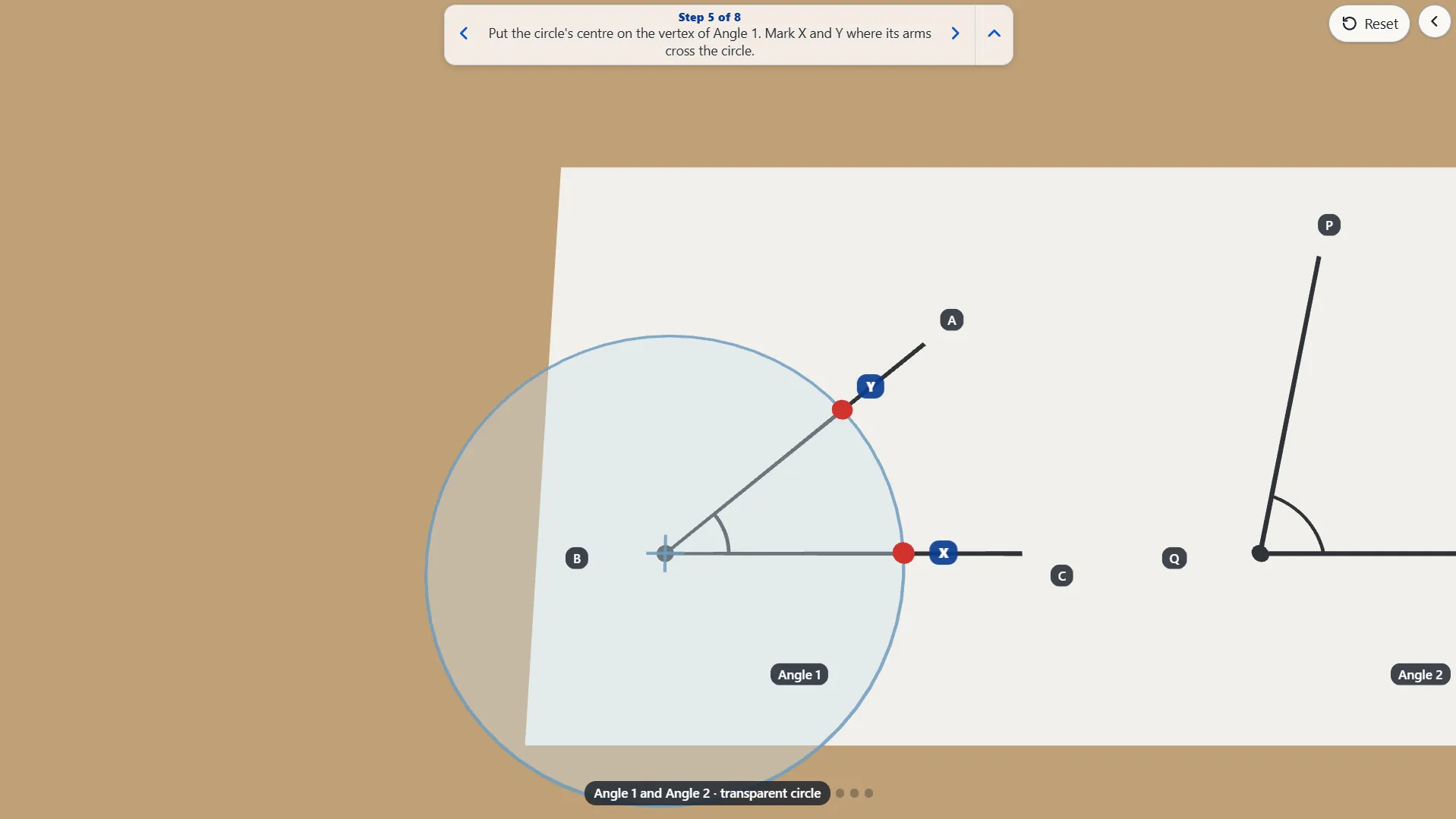
- Put the circle's centre on the vertex of Angle 1. Mark X and Y where its arms cross the circle.
- Move the circle onto Angle 2 with X on one arm. Does its other arm cross inside, on or outside Y?
- Cut a slit round the arms opened to Angle 3. Open them to Angle 4 and test them in the slit.
- Compare Angle 5 and Angle 6 with a method of your choice.
Interactive 3D Experiment
Loading simulation…
What to observe
- Which angle of each pair is larger, or are they equal?
- Do the arms, the tracing and the circle agree about ∠ABC and ∠PQR?
- When do the rotating arms pass through the slit?
- Angle 4 looks bigger than Angle 3. Is it?
Notes
- Whether an angle looks big has nothing to do with how long its arms are drawn. Two angles with arms of very different lengths can be exactly equal, because an angle measures turning, not length.
- A clock's short hour hand and long minute hand can point to the very same angle. What matters is the turn about the centre, not how far the hands reach.
- When laying one angle on another, put the two vertices together first, then bring one pair of arms exactly together.
- Do not change the opening of the rotating arms while carrying them from one angle to the other. Keep the paper clip joint firm.
- Put the centre of the transparent circle exactly on the vertex of the angle.
- Draw the arms long enough to cross the transparent circle, so that X and Y can be marked.
- Cut the slit neatly. A torn or widened slit lets a bigger angle pass and gives a wrong result.
- Handle the scissors carefully while cutting the circle and the slit.