
Constructing a Comparative Timeline of Colonial Powers in India
Aim
To make a colour-coded timeline of the Portuguese, Dutch, French and British in India, and to see the patterns in their rise and decline.
Apparatus
- A long strip of chart paper and a ruler
- Four coloured sketch pens (blue, green, orange, red)
- Twelve event notes with their years (in place of the chapter text)
- A notebook with the observation table
Procedure
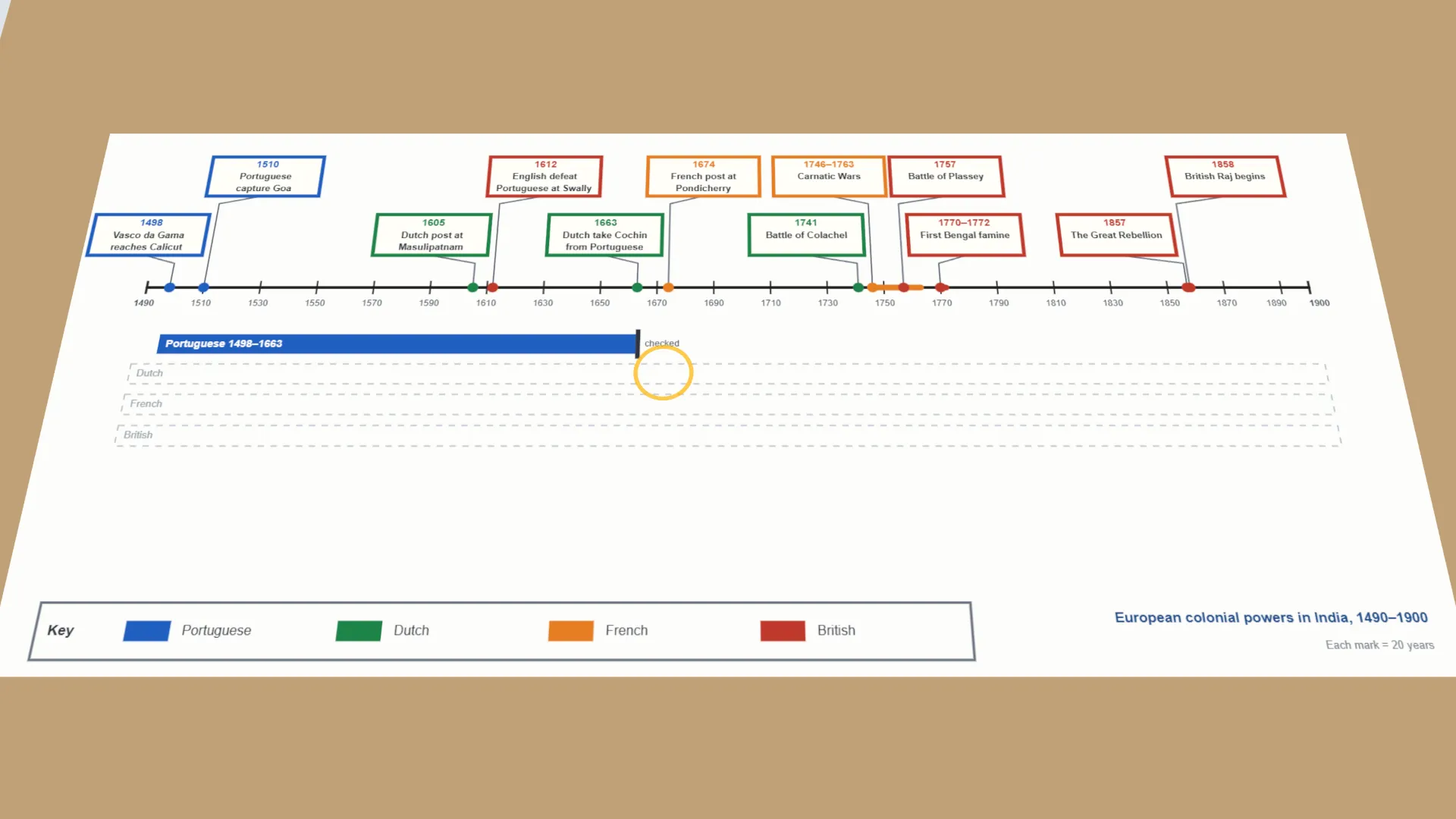
- Draw a timeline from 1490 to 1900, marked every 20 years. Tap the strip, then the ruler.
- Make the key — blue Portuguese, green Dutch, orange French, red British.
- Drag each event note to its year on the line. Its colour shows the power.
- Below the line, tap each power's lane to draw a bar of the years it was active.
- Tap each bar to write one sentence on why that power declined.
- Record six events and their significance in the table.
Interactive 3D Experiment
Loading simulation…
What to observe
- The Portuguese came first (1498), then the Dutch (1605), the French (1674) and the British trading companies.
- Each rival was checked in turn — the Portuguese by 1663, the Dutch at Colachel (1741), the French by 1763.
- The Carnatic Wars and the Battle of Colachel came within a few years of each other.
- Only the British bar runs on to 1900; after 1857 the Crown took over from the Company.
Notes
- A timeline does more than list dates — it shows how long each power was active and which events overlapped.
- Check every date before marking it, and keep the four colours the same all through the chart.
- The twelve events and years are standard dates from history books, chosen in place of the chapter's figure.