
Combining Two Different Squares
Aim
Combine two squares of different sizes into a single square by paper dissection, and so demonstrate and explain the Baudhayana-Pythagoras theorem, a² + b² = c².
Apparatus
- Coloured paper in two colours (red and yellow), one sheet each
- Ruler, pencil, scissors, glue stick and cellotape
- Graph paper (at least 20 × 20 cm)
- Set square or protractor to check right angles
- Sketch pens for labelling a, b and c
Procedure
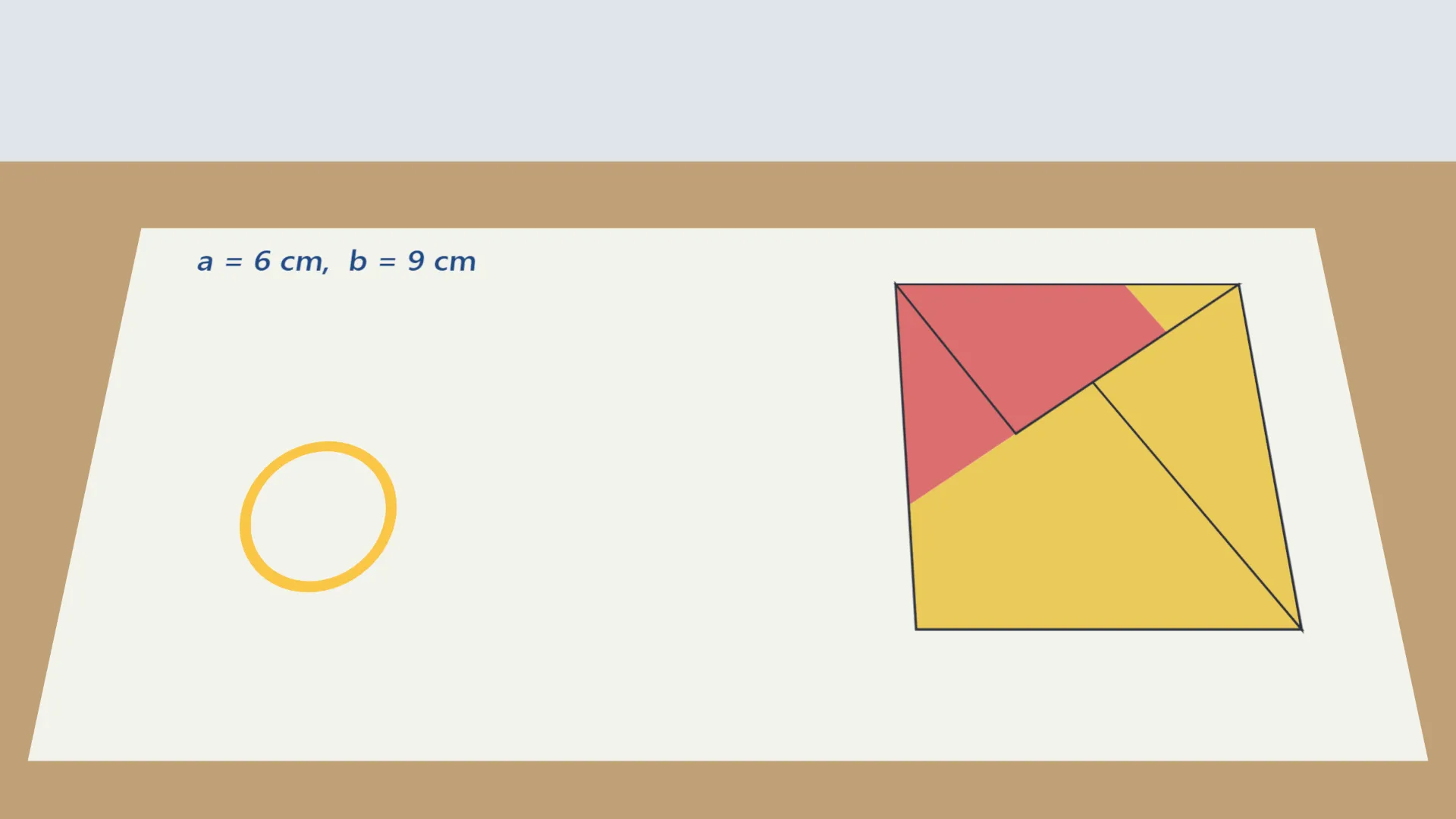
- Cut a red square of side a = 6 cm and a yellow square of side b = 9 cm.
- Join the two squares side by side so that their lower edges lie on the same straight line.
- On the larger square mark a rectangle of width a. Mark the point M on the base line at distance b from the left end.
- From M draw two lines, one to the far top-left corner of the small square and one to the far top-right corner of the large one. Each has length c.
- Cut along the two lines to get three pieces. Check that the two cut edges are equal.
- Rearrange the three pieces so that the two equal cut edges are adjacent sides of a new square of side c. Paste it.
- Measure c, complete the observation table and compare a² + b² with c².
- On graph paper draw a right triangle with sides a and b and a square on each side. Check that your three pieces cover the square on the hypotenuse.
- Repeat the whole activity with a = 3 cm, b = 4 cm, and with a pair of your own choice.
Interactive 3D Experiment
Loading simulation…
What to observe
- The two cut lines are equal in length (c) and meet at a right angle at M.
- The three pieces make one square of side c, with no gap and no overlap.
- For a = 3 and b = 4 the new square has side 5 cm and area 25 cm², equal to 9 + 16.
- The area of the square on the hypotenuse equals the sum of the areas of the squares on the other two sides.
Notes
- Math Spark: verse 1.12 of the Sulba-Sutra states that the square produced by the diagonal equals the sum of the squares produced by the two sides. Baudhayana stated the theorem in this general form about 300 years before Pythagoras. More than 370 different proofs have been published, one of them by James A. Garfield, later the 20th President of the United States.
- Draw and cut the squares on graph paper so that their sides are exact whole numbers of centimetres.
- Make sure the angle between the cut lines is exactly 90°; check it with a set square before cutting.
- Cut precisely along the lines: a millimetre of error stops the pieces forming a perfect square.
- Arrange the pieces with no overlap and no gap; paste only after checking the fit.
- Verify by measuring the side of the new square and comparing c² with a² + b², not by eye alone.
- Keep the two colours distinct so that the pieces of each square can be traced afterwards.
- Use cellotape sparingly so that it does not hide the joins.
- Handle scissors safely and collect the paper scraps.