
Do Clean Hands Really Matter? — Modelling How Germs Spread and Stop
Aim
To model how germs (pathogens) spread on our hands, and to test why washing with soap helps stop the spread of communicable diseases.
Apparatus
- Science notebook and a pencil
- A wide, shallow bowl filled with clean water
- Ground black pepper (or a little dry flour or chalk dust) to stand for "germs"
- A bar of soap, or a few drops of liquid soap
- A clean finger (yours!) and a towel to dry your hands
- Optional: a little cooking oil and glitter for a second germ test
Procedure
- Set-up: fill the bowl nearly full with clean water and let the water become completely still.
- Observe: sprinkle a thin, even layer of pepper over the water. The flakes are germs on a surface.
- Question: what happens to the germs when a clean finger touches them, and when a soapy one does?
- Hypothesise: write your first guess, e.g. "The soap will push the germs away."
- Test A: dip a clean, dry finger into the middle of the water and lift it out. Note the pepper.
- Test B: wipe the finger, rub a little soap on it and touch the middle of the water again.
- Record what you found. If your guess was wrong, write a new guess and test it the same way.
- Analyse: write a one-line conclusion linking what you saw to real handwashing.
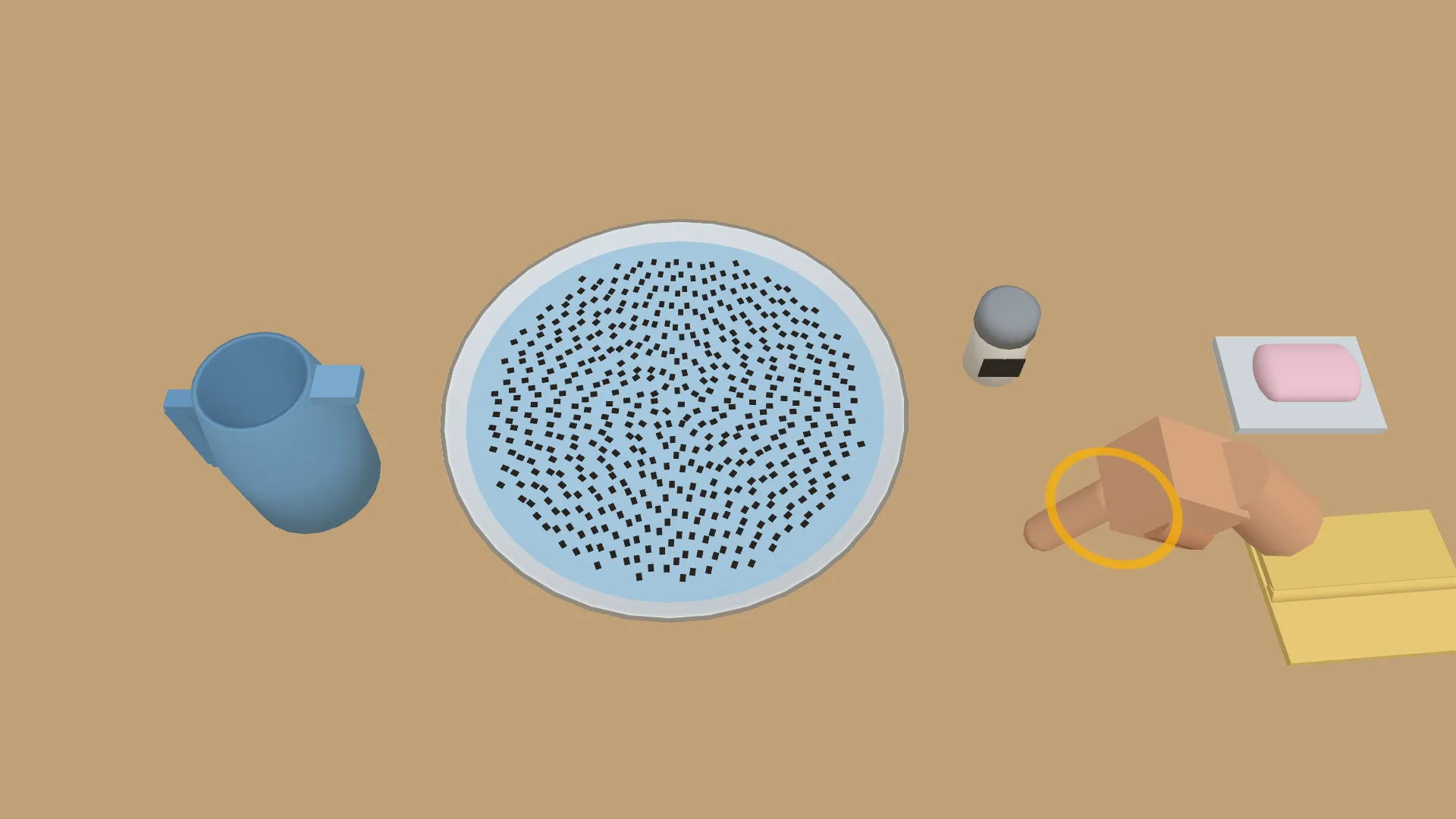
Interactive 3D Experiment
Loading simulation…
What to observe
- The plain, dry finger comes out with pepper clinging to it — like germs carried on an unwashed hand.
- The soapy finger makes the pepper dart away to the edges of the bowl, and almost none sticks to it.
- Soap loosens germs from the skin so that they can be washed off, which breaks the chain of infection.
Safety
- Let the water become completely still before sprinkling the pepper; even a slight ripple spoils the result.
- Sprinkle a thin, even layer of pepper — a thick layer will not spread out clearly.
- The first finger must be really clean and dry, with no soap, oil or lotion on it.
- Dip the finger straight down into the middle and lift it straight out; do not stir or swirl.
- Use only a little soap. Change the water and wash the bowl before repeating the test.
- Keep soap and soapy water away from your eyes and mouth, and wash your hands when you finish.
Notes
- Science Spark: in 1847 the doctor Ignaz Semmelweis showed that when doctors simply washed their hands, far fewer mothers fell ill in his hospital. Today the WHO reports that regular handwashing with soap can cut many infections by about half.
- Soap molecules have a water-loving end and an oil-loving end. They lift grease and germs off the skin, and the rinse water carries them away.