
Classifying and Analysing Sources of History
Aim
To identify and sort the sources of history into archaeological, literary, oral and artistic sources, and to say what information each source gives a historian.
Apparatus
- Pictures or printouts of historical sources (coins, inscriptions, manuscripts, sculptures, paintings, monuments)
- Chart paper
- Glue or tape
- Sketch pens
- Scissors
Procedure
- Recall the four kinds of sources of history. They are archaeological, literary, oral and artistic.
- Collect at least eight pictures of different sources, such as a coin, a manuscript or a piece of folklore.
- Draw a table on chart paper with four columns, one for each kind of source.
- Paste each picture under the column it belongs to.
- Below each picture, write one or two lines about what a historian can learn from it.
- Present your chart to the class. Discuss any source that could belong to more than one kind.
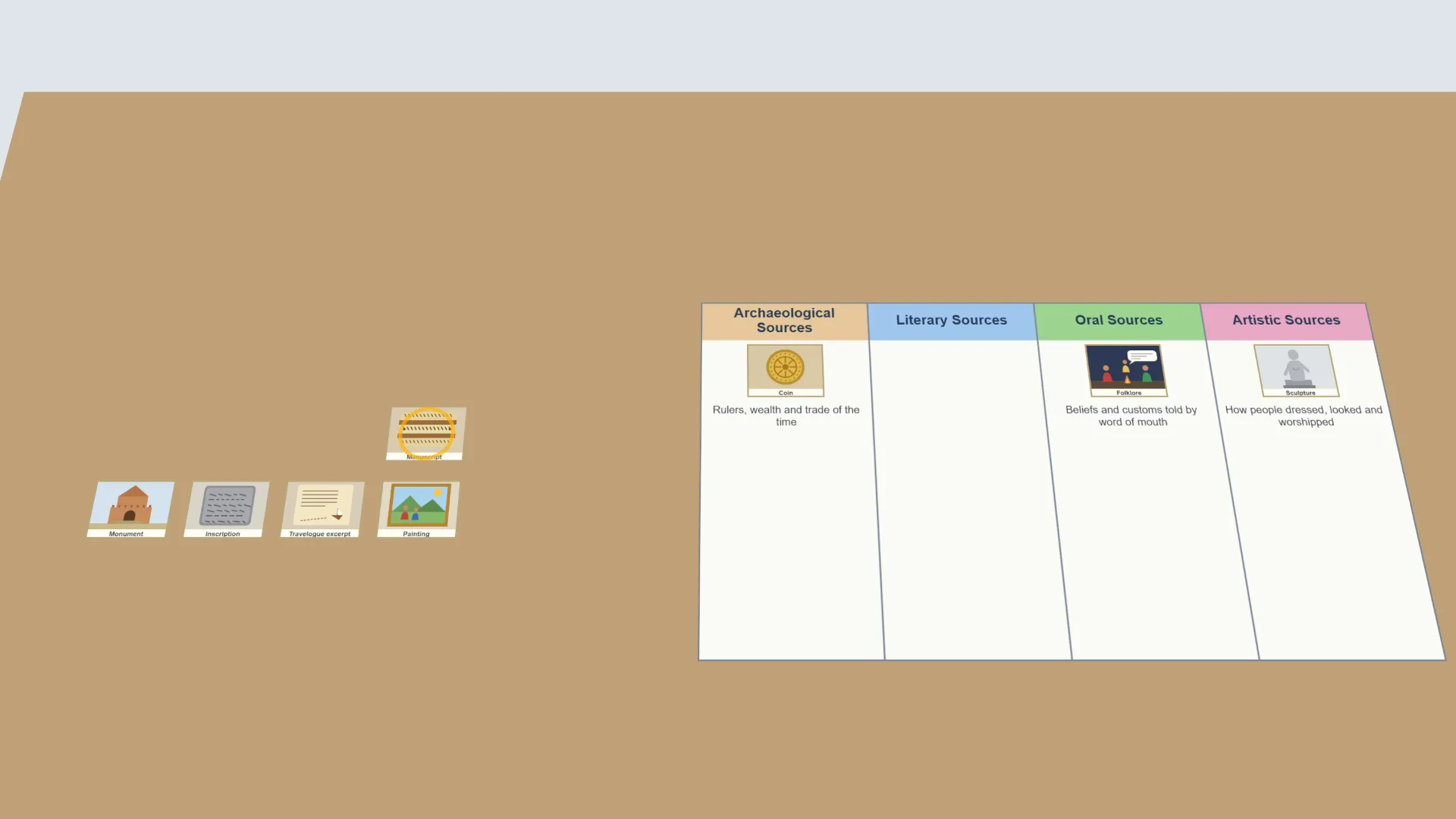
Interactive 3D Experiment
Loading simulation…
What to observe
- Each kind of source tells a historian something different about the past.
- Some sources, such as a monument, can fit more than one kind.
Notes
- Historians are sometimes compared to detectives. Just as a detective gathers clues from different places to solve a case, historians gather evidence from many different sources to reconstruct the past. When sources agree with each other, historians gain confidence in their conclusions. When sources disagree, historians must judge which one to trust more.
- Handle pictures and cut-outs carefully while pasting. Classify each source thoughtfully, keeping in mind that some sources may fit more than one category. Write information in your own words.