
Classifying Crops by Cropping Season: Kharif, Rabi, and Zaid
Aim
To classify a given set of crops into the kharif, rabi and zaid cropping seasons based on their sowing and harvesting months, and to relate each season to India's monsoon pattern.
Apparatus
- Crop picture cards (rice, maize, jowar, cotton, wheat, barley, mustard, gram, watermelon, cucumber, muskmelon, pumpkin)
- A blank calendar chart (Jan-Dec)
- Glue or tape
- Colour pencils
Procedure
- Draw a blank chart with 12 columns, January to December.
- Label three rows of the chart Rabi, Kharif and Zaid.
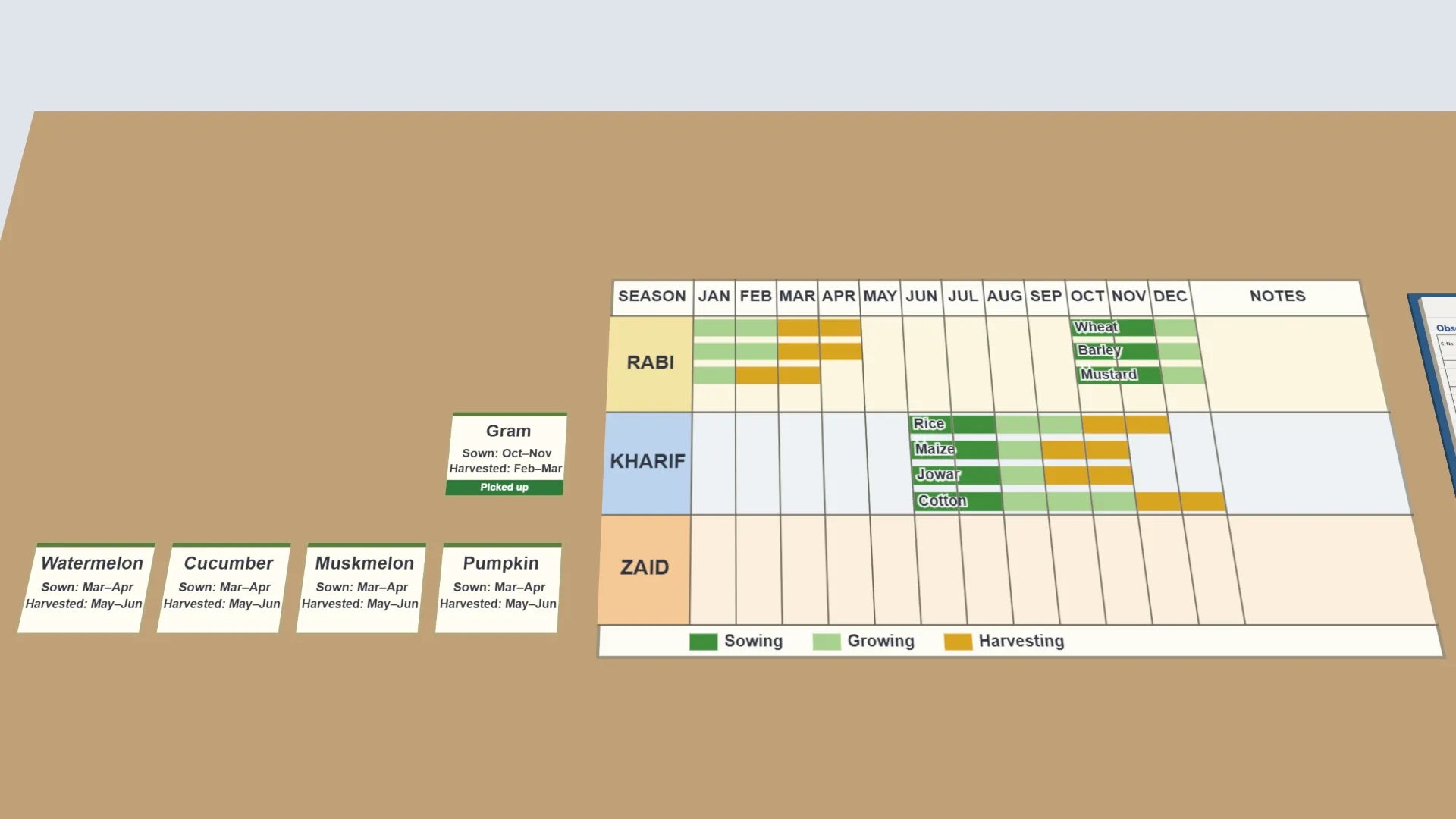
- Read each crop card's sowing and harvesting months and paste it in its season's row.
- Add a note to each row on how its season is linked to the monsoon.
- Complete the observation table for five crops, with each season at least once.
Interactive 3D Experiment
Loading simulation…
What to observe
- Kharif crops (rice, maize, jowar, cotton) are sown in June-July, when the southwest monsoon arrives.
- Rabi crops (wheat, barley, mustard, gram) are sown in October-November and grow in the cool, drier winter.
- Zaid crops (watermelon, cucumber, muskmelon, pumpkin) are short summer crops, between the rabi harvest and the kharif sowing.
Notes
- Social Science Spark: the words kharif, rabi and zaid come from Arabic and have been used since Mughal times. Before that, the three types of crops were called kedara (wet crops), haimana (winter crops) and graishmika (summer crops).
- Precaution: paste crop cards neatly within the correct season band; check the sowing and harvesting months before classifying an unfamiliar crop.
- The months of jowar, cotton, barley, mustard, cucumber, muskmelon and pumpkin follow standard NCERT facts; the other five follow the photo on the textbook page.