
Classifying Artefacts by School of Art
Aim
To sort art objects into the Gāndhāra or the Mathurā school of art by looking at their material, style and subject.
Apparatus
- Artefact picture-cards (six sculptures; in place of Fig. 6.27 of the textbook)
- A worksheet with columns for ‘Gāndhāra’ and ‘Mathurā’
- The Feature Comparison Chart
- A notebook with the observation table, a pencil, coloured pencils
Procedure
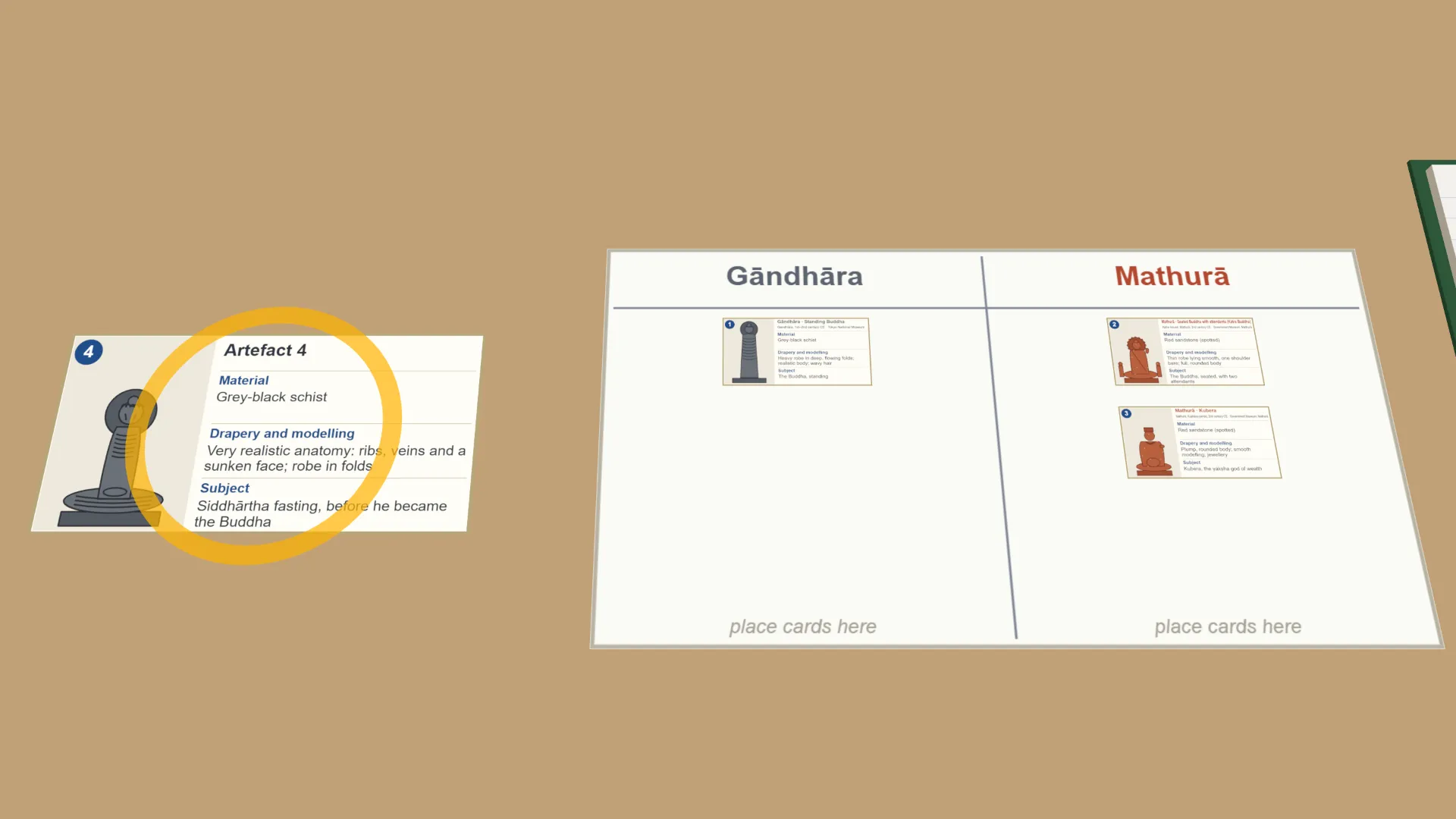
- Recall each school's features on the chart. Tap the Gāndhāra column, then the Mathurā column.
- Pick one of the six artefact cards to study.
- Note its material, its drapery and modelling, and its subject.
- Drag the card to the Gāndhāra or the Mathurā column of the worksheet.
- Write its row in the table, with your reason. Do steps 2–5 for all six cards.
- Discuss with a partner and write what decided each card.
Interactive 3D Experiment
Loading simulation…
What to observe
- Gāndhāra sculptures are grey-black schist, with realistic bodies and deep, flowing robes.
- Mathurā sculptures are red sandstone, with fuller, smoothly modelled figures.
- Both schools made images of the Buddha, so the subject alone cannot tell you the school.
- Mathurā also made Jain images and yakṣhas such as Kubera.
Notes
- Gāndhāra art is called ‘Greco-Buddhist’ art. It joined Greek ways of carving, brought by the Indo-Greeks, Śhakas and Kuṣhāṇas, with Buddhist subjects. Mathurā art grew from earlier Indian sculpture.
- Check each artefact's stone and figure style against the chart. Do not decide by the subject alone.
- Settle disagreements with your partner using the chart, not guesswork.
- The six sculptures are real museum pieces chosen to stand in for the textbook's Fig. 6.27.