
Constructing a Classified Timeline of Indian Architecture
Aim
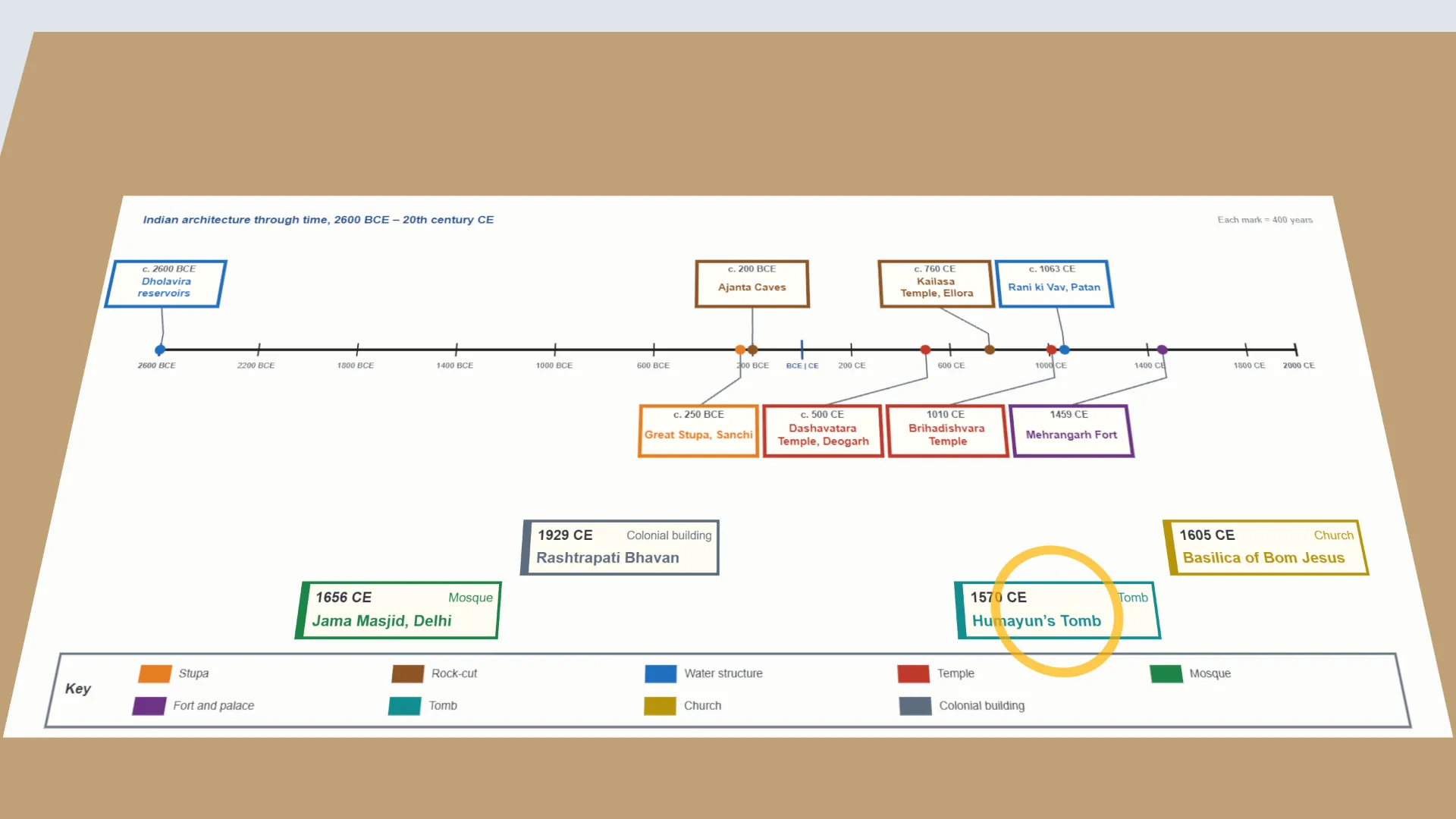
To make a colour-coded timeline of India's buildings and monuments, sorted by kind, and to see the patterns in how they spread across time.
Apparatus
- A long strip of chart paper, a ruler and a pencil
- Nine coloured sketch pens, one for each kind of building
- Twelve structure cards with their dates (in place of the textbook's Fig. 3.2)
- A notebook with the observation table
Procedure
- Draw a timeline from 2600 BCE to the 20th century CE, marked every 400 years.
- Make the colour key — one colour for each kind of building.
- Drag each structure card to its date. Its name is written in its kind's colour.
- Underline the three oldest and the three most recent names in pink.
- Record six structures, their kind, date and state in the table.
Interactive 3D Experiment
Loading simulation…
What to observe
- After the Harappan water works of Dholavira (c. 2600 BCE) there is a long gap on this timeline.
- Stupas, rock-cut caves and temples fill the years from about 250 BCE to 1100 CE.
- Forts, tombs, a church and a mosque were all built within about 200 years (1459–1656) — traditions side by side.
- Most of the structures crowd into the last 1 000 years; colonial buildings come last.
Notes
- Keep one scale all along the line, and check each date before marking it.
- The twelve structures and dates are standard dates from history books, chosen in place of the textbook's figure.