
Calculating Compound Interest — How Savings Grow
Aim
To calculate the compound interest earned on a savings deposit over several years, and to compare how money grows at different interest rates.
Apparatus
- Calculator
- Deposit Scenario Cards (each with a principal, a rate and a number of years)
- Worksheet with a year-by-year growth table
Procedure
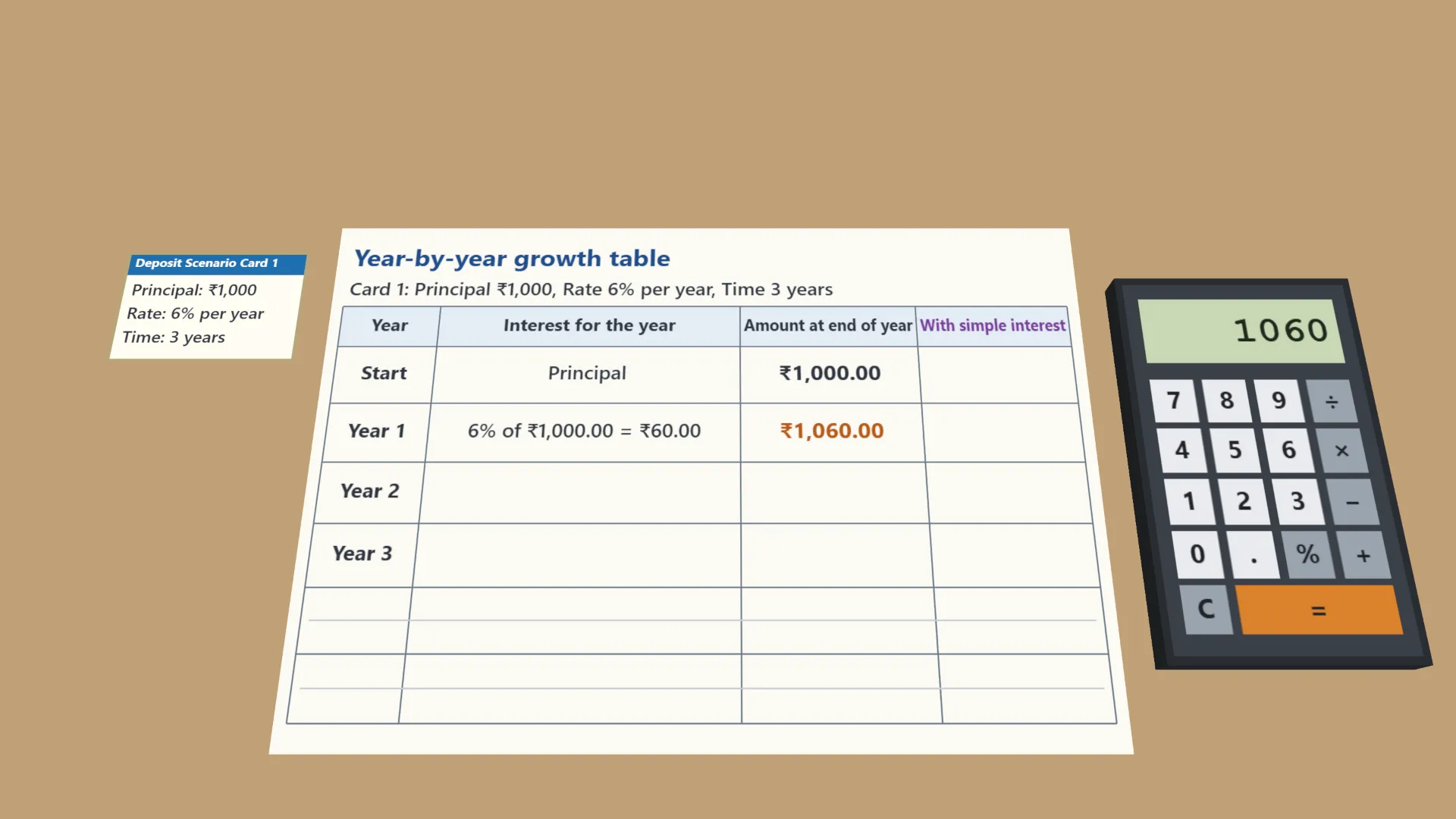
- Read a Deposit Scenario Card: for example, Principal ₹1000, Rate 6% per year, Time 3 years.
- Year 1: the interest is Rate% of the principal. Add it to get the new amount.
- Year 2: the interest is Rate% of the Year 1 amount, not the principal. Add it.
- Repeat for each remaining year, always on the previous year's total.
- Record the Year 1 and final amounts in the table, for three different cards.
- For one card, work out the amount with simple interest and compare the two.
Interactive 3D Experiment
Loading simulation…
What to observe
- With compound interest, each year's interest is bigger than the year before.
- A higher rate makes the same money grow much faster.
- Compound interest ends with more money than simple interest, and the gap grows every year.
Notes
- Social Science Spark: doubling one grain of rice on each of 64 chessboard squares gives an unimaginably large number. Savings left to grow compound in the same way.
- Always work out each year's interest on the previous year's total, not on the original principal.
- Check each step with the calculator before moving to the next year.