
Building Squares from Odd Numbers
Aim
To show with pictures that the sum of the first n odd numbers, starting from 1, is always the square number n². To use repeated subtraction of odd numbers as a test for perfect squares. To find the link between triangular numbers and square numbers.
Apparatus
- Graph paper or dot-grid paper (at least an 8 × 8 grid per student)
- Six different coloured sketch pens or highlighters
- 36 counters, beads or bottle caps per group
- Ruler and pencil
Procedure
- Mark a single dot in one corner of the grid and colour it. It stands for the first odd number, 1.
- Around it add an L-shaped border (a gnomon) of 3 dots in a second colour. Count the total – it is 4.
- Keep adding borders of 5, 7, 9 and 11 dots, a fresh colour each. Record every running total.
- Complete the n = 10 row by the pattern. Then find 36² as 1225 + 71 and check by multiplying.
- Test 25, 36, 38, 49 and 60. Take away 1, 3, 5, 7, … in turn until you land on 0 or go below it.
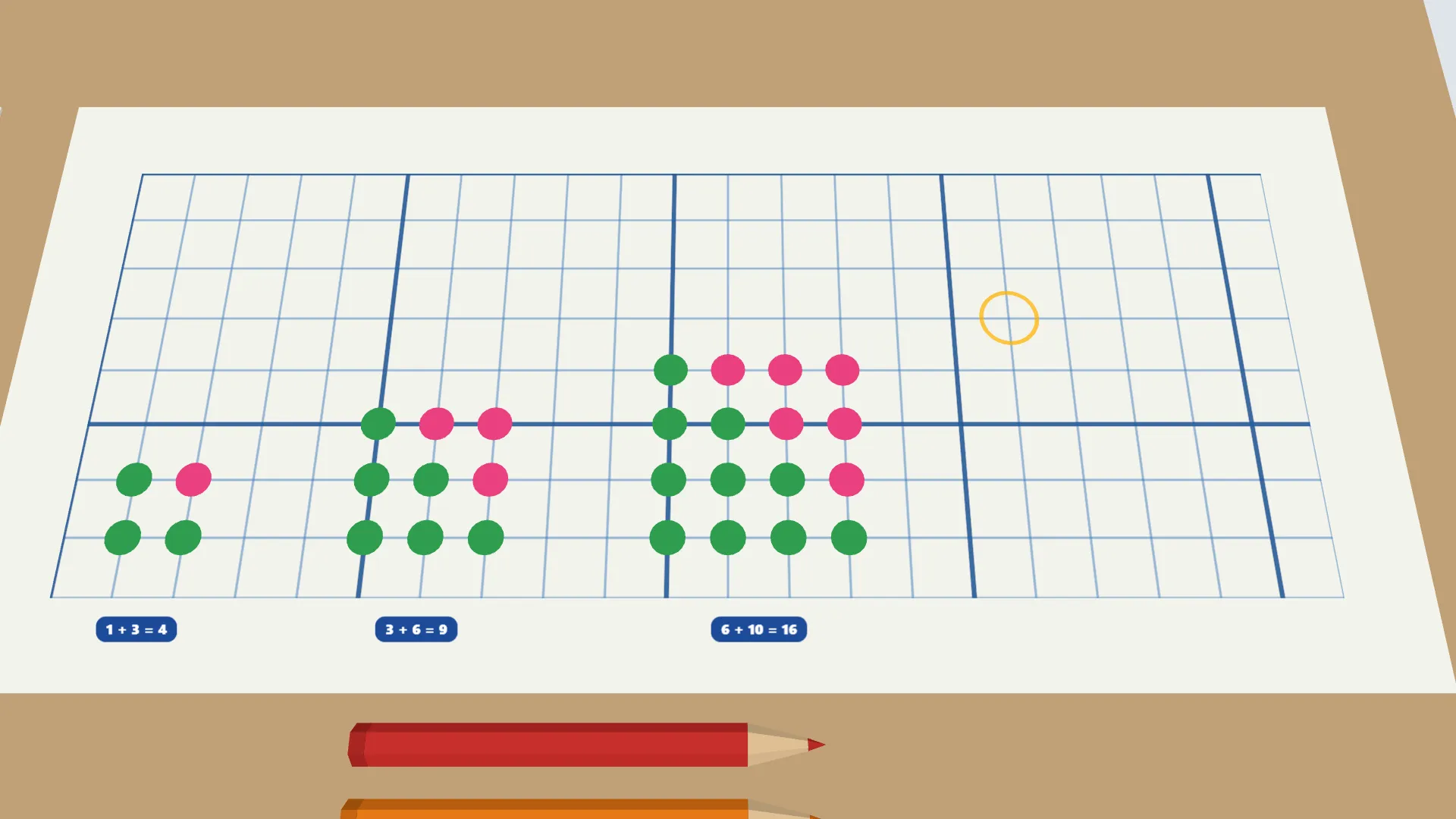
- Build squares of counters and split each along the diagonal into two triangular numbers.
Interactive 3D Experiment
Loading simulation…
What to observe
- Why does each new border hold exactly 2 more dots? Explain it with the picture.
- What does subtracting odd numbers show for 36, and for 38?
- What do the two parts of each split square add up to?
Notes
- Math Spark: the ancient Greeks called the L-shaped strip a gnomon, the shadow-arm of a sundial. The picture alone proves 1 + 3 + 5 + … + (2n − 1) = n² for every n. The difference between consecutive squares is always odd, and the differences grow by 2 each time.
- Always start the sum with 1 and take the odd numbers in order – skipping one destroys the pattern.
- Draw each border so that it wraps two sides of the previous square and shares its corner – not as a separate strip.
- Use a different colour for every border so the layers can be counted afterwards.
- Draw along the grid lines and keep the figure a true square at every stage.
- In the subtraction test keep going, even if the remainder is small, and stop only at 0 or below.
- Count the number of subtractions accurately – that count, not the last odd number used, is the square root.