
Building Fractions by Folding Paper
Aim
Make, name and measure the fractional units 1/2, 1/3, 1/4, 1/6 and 1/8 by folding paper strips, build fractions such as 3/4 from these units, and mark fraction lengths on a number line.
Apparatus
- 3–4 rectangular paper strips of equal length (about 20 cm each)
- Ruler and pencil
- Coloured pencils or sketch pens (at least 3 colours)
- A pair of scissors
- Plain or dot-grid notebook page
Procedure
- Take one strip. Its whole length is 1 unit. Label it '1 whole'.
- Fold a second strip in half and open it. Label both parts 1/2. Does 1/2 + 1/2 make 1 whole?
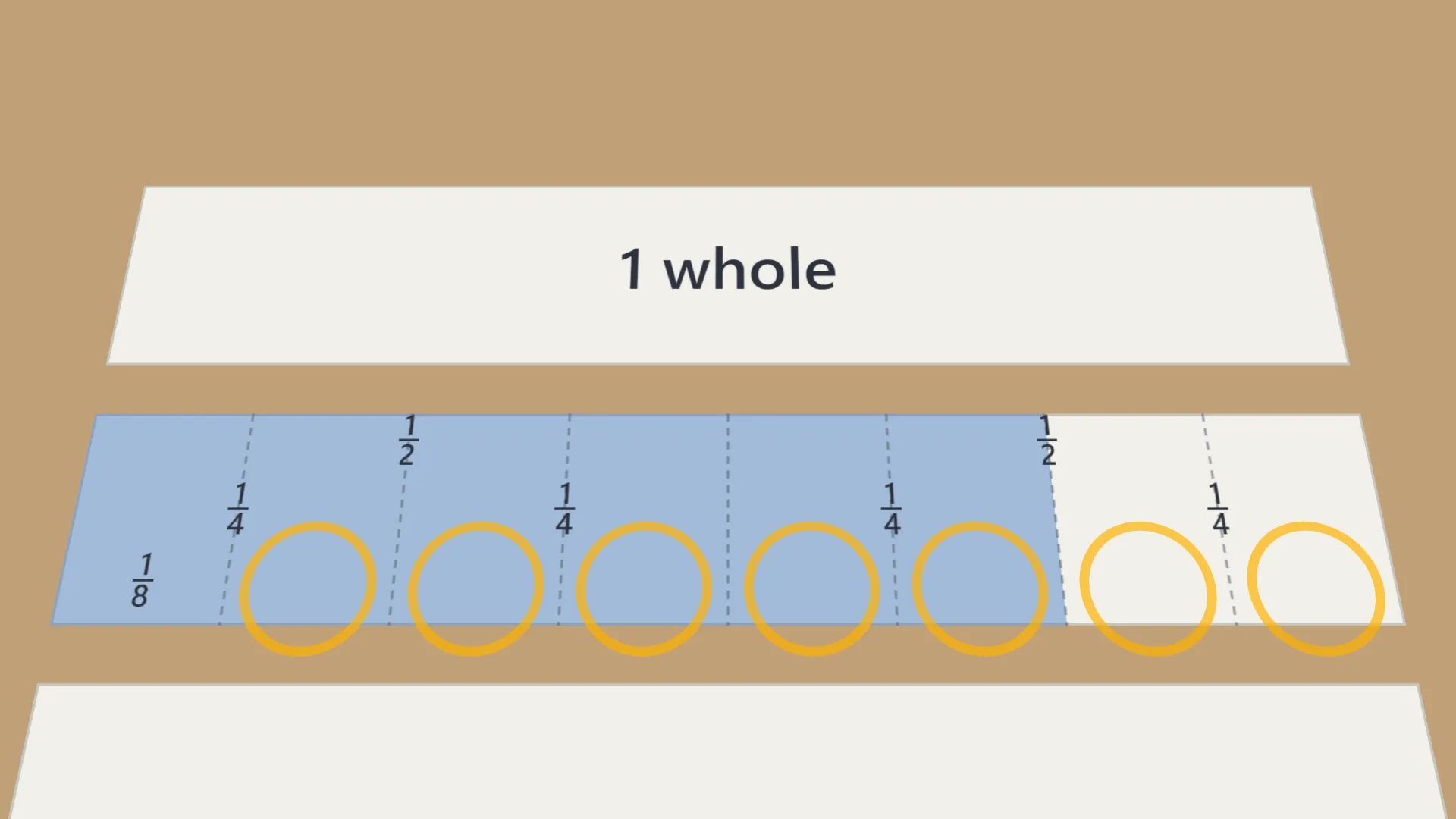
- Fold it again to get four equal parts. Label each 1/4. Shade three parts. 3/4 means 3 times 1/4.
- Fold once more to get eight equal parts. Label each 1/8. How many eighths make one half?
- Mark a fresh strip at 8 cm and 16 cm with a ruler. Fold it into three equal parts. Label each 1/3.
- Fold the thirds in half to make sixths. Label each 1/6.
- Draw a number line from 0 to 1 in 8 equal parts. Mark the lengths of the shaded strips.
- For each strip, write how many fractional units it has and which fraction they make.
Interactive 3D Experiment
Loading simulation…
What to observe
- Two halves, four quarters or eight eighths cover exactly one whole strip.
- 3/4 is three pieces of 1/4. The same length is six pieces of 1/8.
- Four 1/8 pieces cover the same length as one 1/2 piece.
- A 1/3 piece folded into two equal parts gives 1/6.
- 3/8 and 6/8 are both less than 1 on the number line.
Notes
- The way we write fractions today, one number above another, first appeared in India, in the Bakshali manuscript.
- In Sanskrit a fraction was called bhinna ('broken'). The Rig Veda called 3/4 tri-pada, like 'teen paav' in Hindi.
- Take strips of exactly equal length. Strips of different lengths cannot be compared.
- Fold so that the edges and corners meet exactly. Unequal parts are not fractional units at all.
- Crease each fold firmly and open the strip out flat before labelling.
- Label every part of the strip, including the parts that are not shaded.
- Keep all divisions on the number line equal, and always begin counting the lengths from 0.
- Use a ruler when a strip has to be divided into 3 parts, as this is hard to do by folding alone.