
Building an Electromagnet
Aim
To make an electromagnet using a coil of wire and an iron nail, to find its poles, and to explore what makes it stronger.
Apparatus
- Science notebook / lab record and pencil
- About 100 cm of flexible insulated wire
- An iron nail and a piece of chart paper
- One or two electric cells (and a cell holder)
- A magnetic compass
- A few iron / steel paper clips
- Adhesive tape
Procedure
- Wind the insulated wire tightly around the iron nail in many turns. Tape the ends.
- Put the cell in its holder. Connect the coil's ends to the cell — for a few seconds only.
- Bring the nail close to the paper clips and lift. Do the clips cling to its ends?
- Disconnect the wire from the cell. Do the clips fall off?
- Connect again. Bring the compass near end A, then end B. Note which pole of the needle each attracts.
- Take the nail out and test the coil alone. Count the clips and watch the needle.
- Put the nail back and use two cells. Count the clips and watch the needle.
- Use one cell again and wind more turns. Count the clips and watch the needle.
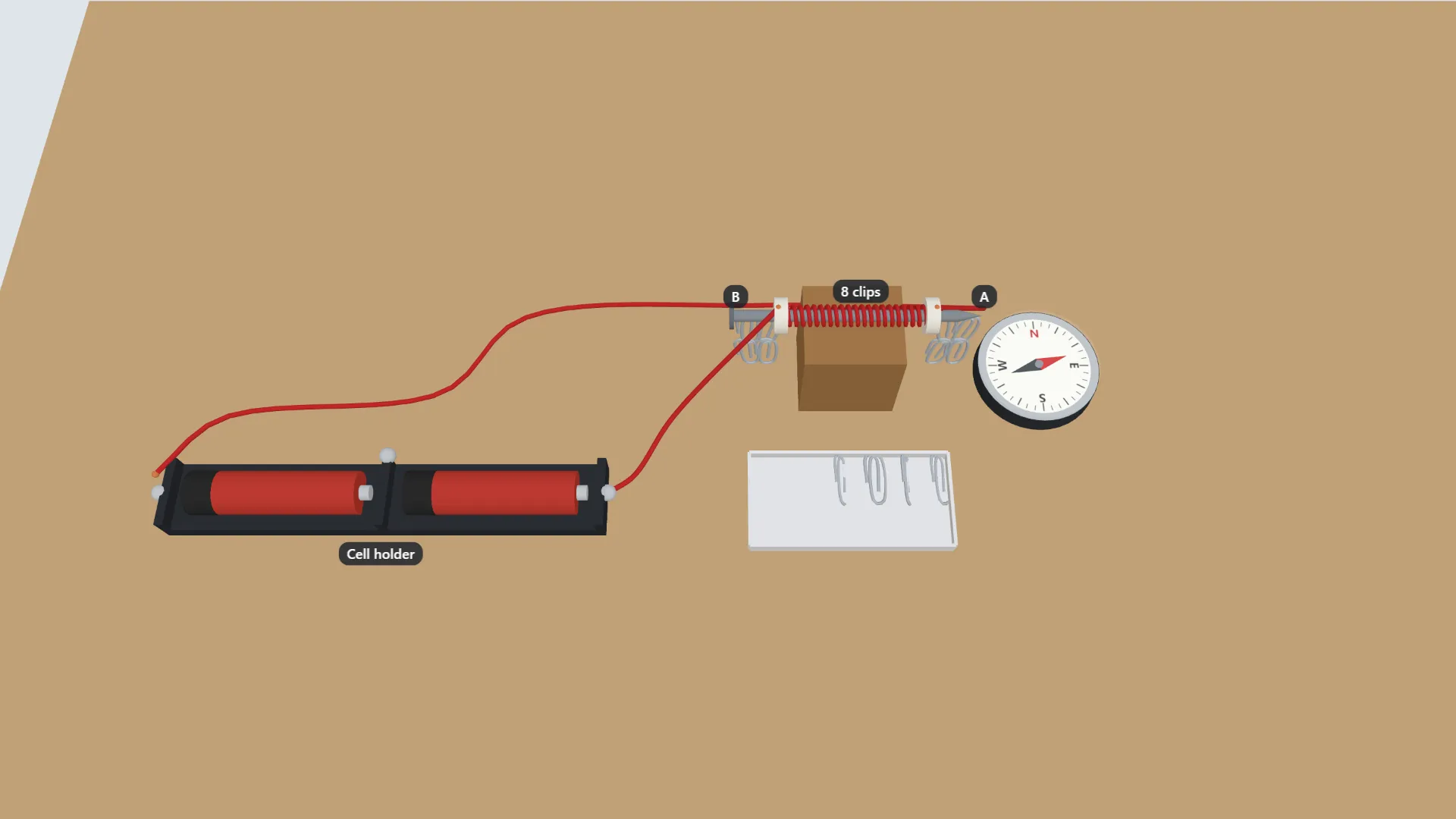
Interactive 3D Experiment
Loading simulation…
What to observe
- The clips cling only while the current flows. They fall off the moment the circuit is broken.
- One end attracts one pole of the compass needle, the other end the other pole. It has two poles, like a bar magnet.
- Two cells (more current) lift more clips. So do more turns of wire.
- With the iron nail inside, the coil is far stronger than the coil alone.
Safety
- Wind the wire tightly, in the same direction all the way, with the turns close together.
- Use insulated wire. Scrape off the insulation only at the two ends that are connected.
- Connect the coil to the cell for a few seconds at a time. A long time heats the coil and drains the cell.
- The coil and nail may get warm. Let them cool before handling; disconnect if the wire gets hot.
- Change only one thing at a time — the number of cells or the number of turns, never both.
- Use paper clips of the same size, and pick them up the same way each time.
- Keep the compass away from the coil except while testing the poles.
- Keep the electromagnet away from phones, watches, ATM cards and computers.
Notes
- The first electromagnet was made in 1824 by the English scientist William Sturgeon. It could lift about nine times its own weight! Today, giant electromagnets on cranes lift tonnes of scrap iron and drop it when switched off.
- In the simulation the numbers of clips are examples that show the page's results; your own counts may differ.