
How Do We Breathe In and Out? — Making a Working Model of the Chest
Aim
To make a simple model of the chest cavity and use it to explain how the movement of the diaphragm brings about inhalation and exhalation.
Apparatus
- A wide transparent plastic bottle with its lid, the bottom removed by the teacher
- A Y-shaped hollow tube (three drinking straws joined together will also do)
- Two deflated balloons of the same size
- A thin rubber sheet, cut from a large balloon
- Rubber bands, two small and one large
- Modelling clay to seal the lid, and scissors for the teacher's use
- Science notebook and pencil
Procedure
- Ask your teacher to remove the bottom of the bottle and make a hole in the centre of its lid.
- Fix one balloon to each forked end of the Y-tube and tie them with small rubber bands.
- Pass the straight end of the tube through the lid's hole, from the open base, and screw the lid on.
- Seal the gap around the tube with modelling clay, so that the bottle is completely airtight.
- Stretch the rubber sheet across the open base and hold it in place with the large rubber band.
- Hold the bottle steady and pull the sheet down from its centre. Watch the balloons and record.
- Now release the sheet, or push it gently upwards, and watch the balloons again.
- Repeat this three or four times, then decide which part of the model stands for which part of your body.
Interactive 3D Experiment
Loading simulation…
What to observe
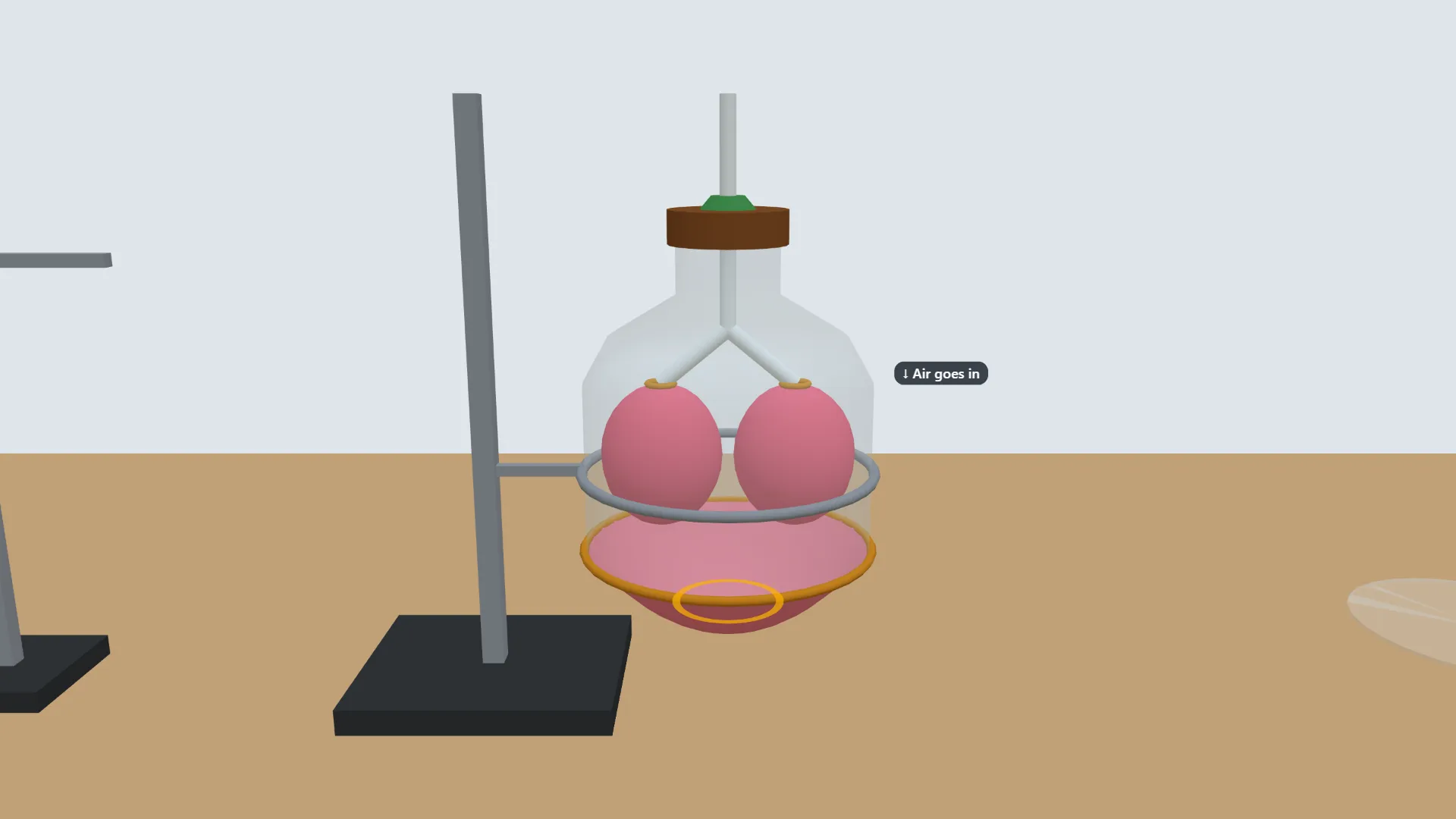
- Pulling the rubber sheet down makes the balloons inflate. Releasing it or pushing it up makes them deflate.
- The bottle stands for the chest cavity, the sheet for the diaphragm, the Y-tube for the windpipe and its two branches, the balloons for the lungs.
- When the diaphragm moves down, the space in the chest increases, air rushes in and the lungs expand. This is inhalation.
- When the diaphragm moves up, the space decreases, air is pushed out and the lungs return to their size. This is exhalation.
- Breathing is brought about by a change in the space within the chest, not by the lungs drawing in air by themselves. In the body the ribs also move up and outwards during inhalation.
Safety
- Only the teacher cuts the base and makes the hole. The cut rim must be smoothed or taped before the model is handled.
- Use a plastic bottle only, never a glass one.
- Use fresh balloons from the packet. Never use one another student has inflated by mouth, and keep the tube and straws out of your mouth.
- Secure the sheet with the large rubber band and keep it away from the face, as it can snap back sharply.
- Pull the sheet gently from its centre and stop if it begins to tear. Do not flick rubber bands at anyone. Wash your hands after using the clay.
Notes
- Science Spark: Your two lungs are a mass of about 300 million alveoli, air sacs with walls thinner than tissue paper. Opened out and spread flat, they would cover roughly half a tennis court.