
Is There a Limit to Breaking Matter? — Exploring the Constituent Particles of Matter
Aim
Break chalk and dissolve sugar to show that matter is made up of a very large number of tiny particles, with spaces between them.
Apparatus
- A stick of chalk
- A mortar and pestle
- A magnifying glass (hand lens)
- Sugar, a clean glass tumbler and drinking water
- A clean spoon, to taste water from the top layer only
- Science notebook and pencil
Procedure
- Break the chalk stick into two, and keep breaking it until it cannot be broken by hand.
- Grind the small pieces in the mortar and pestle into a fine powder.
- Look at the powder with the magnifying glass. Is each tiny speck still chalk?
- Decide whether grinding chalk is a physical or a chemical change, and why.
- Fill the tumbler with water, add two teaspoons of sugar and, without stirring, taste the top layer.
- Stir until the sugar dissolves completely, then taste the top layer again.
- Can you still see the sugar? Reason out where it has gone.
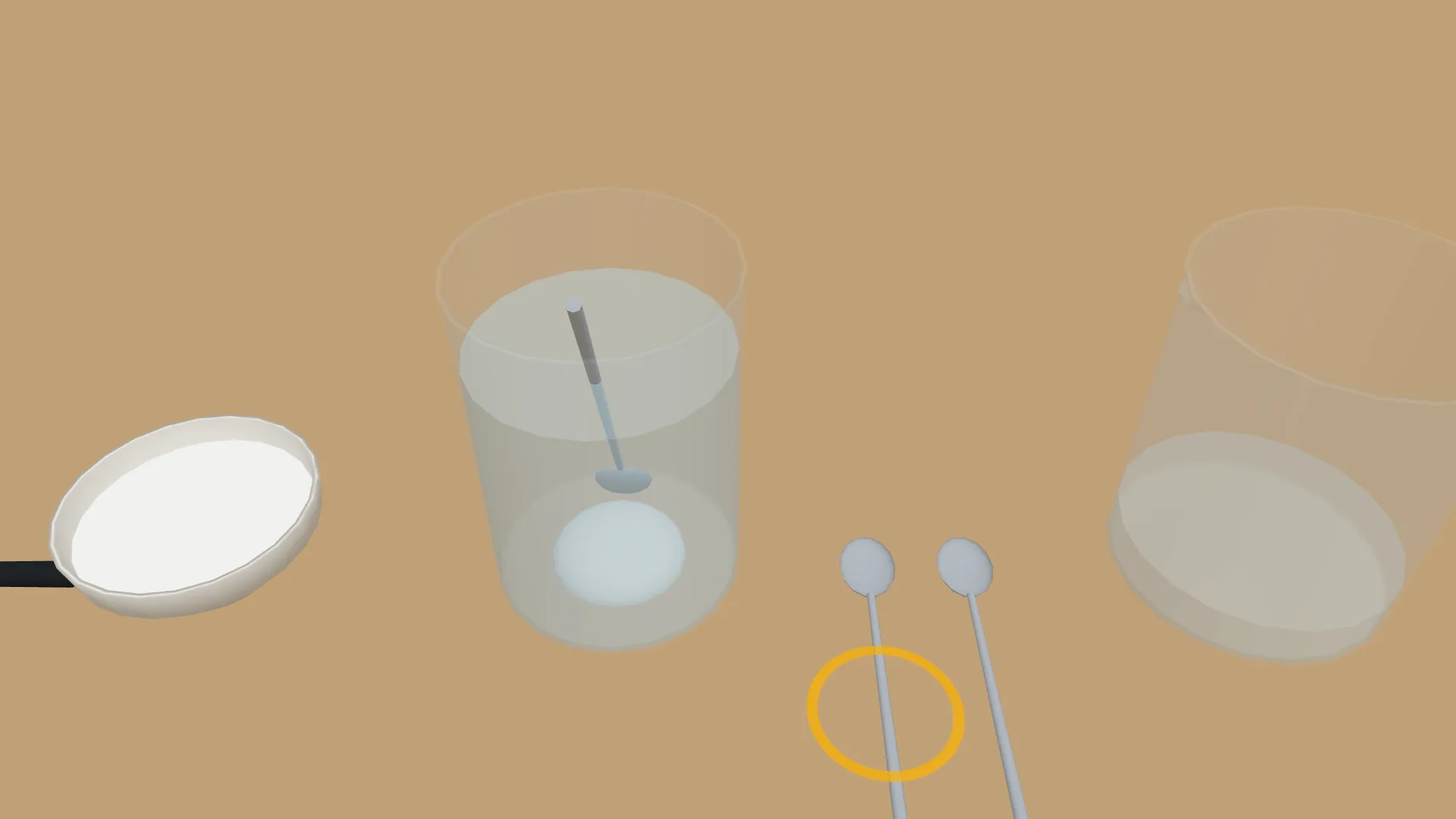
Interactive 3D Experiment
Loading simulation…
What to observe
- Is each tiny speck of powder still chalk — same colour, same nature?
- Does the top layer taste sweet before stirring? And after stirring?
- Can you see the sugar once it has dissolved? Where has it gone?
- Does the water level rise much when the sugar dissolves?
Safety
- Work under your teacher's supervision. Never eat or drink anything in the lab unless you are asked to.
- Taste only with clean drinking water, a clean tumbler, clean hands and a clean spoon each time.
- Taste only a very little water, and only from the top layer.
- Do not stir before the first tasting, or the comparison is lost.
- Grind the chalk gently so the powder does not fly into your eyes or nose. Do not breathe in the dust.
- Use plain white chalk, not coloured or dustless chalk, and wash your hands after grinding.
- Handle the magnifying glass carefully and never use it to focus sunlight.
Notes
- Around the 6th century BCE, the Indian philosopher Acharya Kanad described matter as built from tiny, eternal, indivisible units he called Parmanu, in his Vaisheshika Sutras, long before modern atomic theory.