
Tracing the Journey of a Bill: From Introduction to Act
Aim
To draw a flowchart of how a bill becomes an act, and to use it to follow a recent bill passed by Parliament.
Apparatus
- Chart paper or an A3 sheet, sketch pens or colour pencils, and a ruler
- Newspaper cuttings or printouts from government or PRS Legislative Research websites
- Textbook Fig. 6.8, From bill to act
Procedure
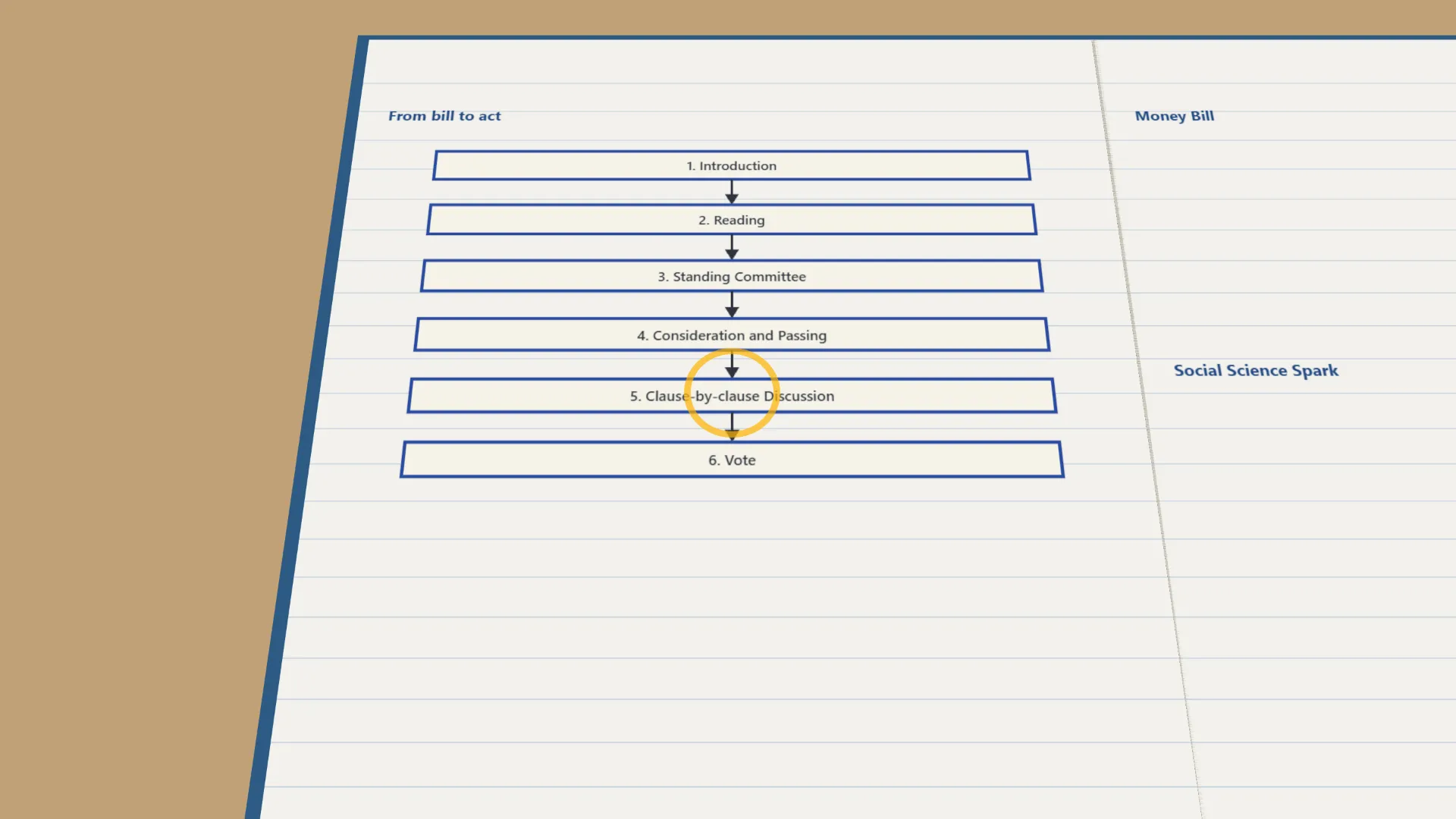
- Study the stages of lawmaking in Fig. 6.8. They run from Introduction to Gazette Notification.
- On chart paper, draw linked boxes for the stages and join them with arrows.
- In small groups, choose one recent bill passed by Parliament and research its journey.
- Fill each box with the dates, the House of introduction and any major amendments or debates for your bill.
- Note whether your bill went to a Standing Committee and whether it was a Money Bill.
- Present your flowchart and compare your bill's journey with the RTE Act in the textbook.
Interactive 3D Experiment
Loading simulation…
What to observe
- A bill goes through reading, committee, discussion and a vote in one House, and the process is repeated in the other House.
- It becomes an act only after Presidential assent and Gazette notification.
- A Money Bill can be introduced only in the Lok Sabha, and the Rajya Sabha can only suggest changes to it.
Notes
- Social Science Spark: a Money Bill can be introduced only in the Lok Sabha, and only with the prior recommendation of the President. The Rajya Sabha cannot reject or amend it. It can only suggest changes, which the Lok Sabha may accept or reject.
- The simulation shows the stages in order. Your own research on a chosen bill, with its dates and debates, is done in the notebook.