
Constructing a Timeline Using the BCE/CE System
Aim
To make a timeline of important events in early human history using the BCE/CE dating system, and to practise finding the number of years between two dates.
Apparatus
- A long sheet of chart paper or graph paper
- Ruler
- Pencil
- Coloured pencils or sketch pens
- The list of events and dates (Fig. 4.3 of the textbook)
Procedure
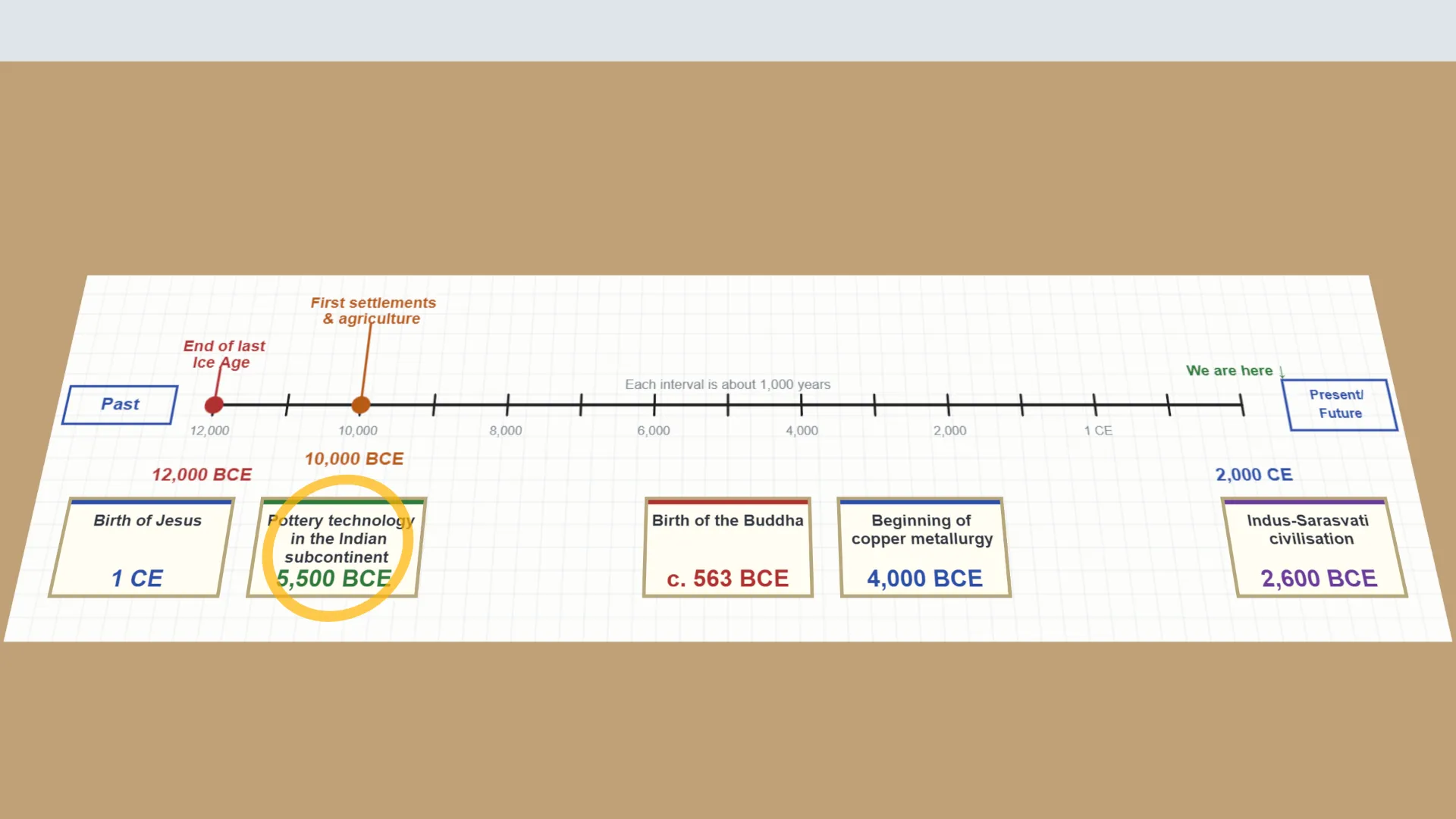
- Draw a long line across the sheet. Write Past at one end and Present/Future at the other.
- Mark 12,000 BCE near the left end and We are here (2000 CE) near the right end. Divide the line into equal intervals.
- Mark each event from the list at the correct point on the line.
- Remember that there is no year zero. The year 1 CE comes straight after 1 BCE.
- For a BCE date and a CE date, find the years between them: BCE year + CE year − 1.
- Write the events, dates and calculations in the observation table.
Interactive 3D Experiment
Loading simulation…
What to observe
- The events lie in time order along the line, and equal intervals mean equal numbers of years.
- The years from a BCE date to a CE date are BCE year + CE year − 1, because there is no year zero.
Notes
- In the Gregorian calendar there is no "year zero". The year 1 CE begins immediately after the year 1 BCE ends. This is why, to find the number of years between a BCE date and a CE date, we add the two numbers and subtract 1, instead of simply adding them.
- Use a ruler to keep the intervals on the timeline equal and accurate. Label all dates and events clearly. Remember that there is no year zero when you work out durations across BCE and CE.
- The dates of early events are approximate, from archaeological evidence.