
Balanced Diet Detective — Reading Labels, Planning Meals
Aim
Read the nutrition information on two food packets, tell the junk food from the healthier choice, and plan a balanced diet for one day.
Apparatus
- Two food packets with nutrition labels (potato wafers and roasted chana)
- Notebook and pencil
- Your food record for one week (made in advance)
- Chart paper and sketch pens
Procedure
- Compare your week's food record with a partner's. Note the same foods and the different ones.
- Turn over packet A (potato wafers) and read its nutrition label, per 100 g.
- Copy its energy, fats, carbohydrates, proteins and dietary fibre into the table, exactly as printed.
- Turn over packet B (roasted chana), read its label and copy its values too.
- Compare the two columns. Tap the packet that is closer to junk food.
- Write your finding under the table.
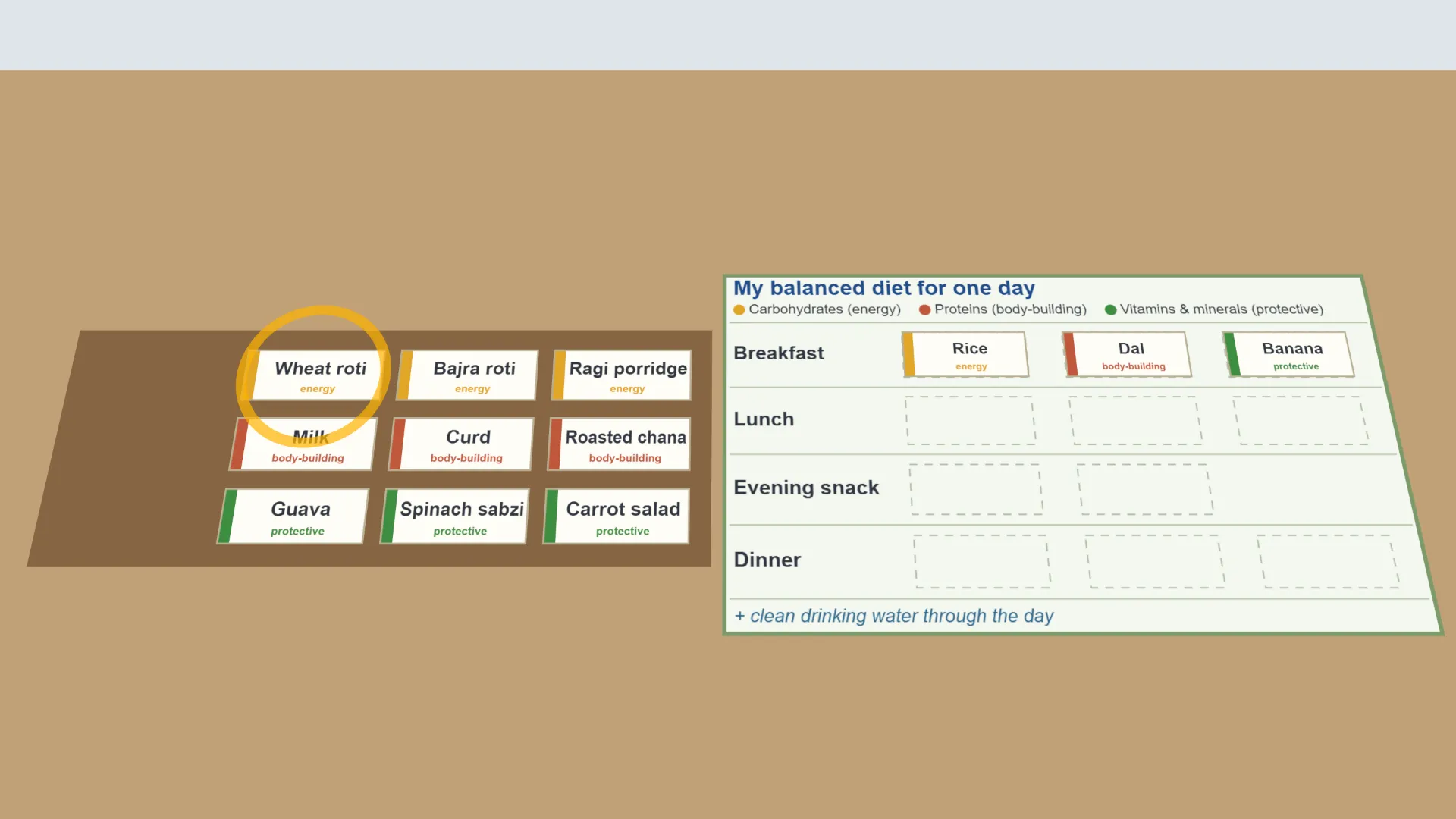
- Plan a day's meals on the chart. Give each meal foods from different nutrient groups.
- Write the conclusion. Which food would you choose more often? What one change would you make?
Interactive 3D Experiment
Loading simulation…
What to observe
- Which packet has more fat and more energy in 100 g? Which has more protein?
- Junk food gives a lot of energy from fat or sugar, but little protein, vitamins, minerals or fibre.
- Is dietary fibre printed on the labels? If a value is missing, write that it is missing. Never guess.
- Does each main meal on your chart have an energy food, a body-building food and a protective food?
Safety
- Bring clean, empty, dry packets. Cut edges of foil packets are sharp; ask the teacher to cut one open.
- Do not eat leftover food from the packets used in the activity.
- Copy the label values exactly as printed. Do not guess, round off or change a figure.
- Talk about foods and nutrients, never about people. Food choices differ with region, culture, religion and budget.
- The diet chart is a class exercise. Do not skip meals or cut out a food group; ask your parents or a doctor first.
Notes
- Millets such as jowar, bajra and ragi were India's staple grains for thousands of years. They need far less water to grow, so nutritionists and farmers now encourage these nutrient-rich "nutri-cereals" again.
- The packet labels in the simulation are example labels with typical values per 100 g. Real packets differ, so always read your own packet.