
Asking Questions & Finding the Average
Aim
To sort questions into statistical and non-statistical ones, collect data to answer them, and find the average (arithmetic mean) — both as a fair share and as a balancing value.
Apparatus
- Notebook or data-recording sheet and pencil
- Counters, beads or bottle caps (about 40 per group)
- Small identical cups or paper strips for the fair-share demonstration
- Coloured pencils and a ruler
Procedure
- Sort each question card into Statistical (its answer varies) or Non-statistical (one fixed answer).
- Collect data — tap each name card to count the letters in the first name. The row is recorded.
- Fig. 1.1 — tap each member A–E to build a tower of counters, one per guava (3, 8, 10, 5, 4).
- Level the towers — drag counters from taller towers to shorter ones until all are equal.
- Verify — add the values and divide by the number of members. Does it match the levelled height?
- Repeat with 7 ball bounces — tap the ball for each try. Mean = sum of values ÷ number of values.
- Discuss — is the average always a data value? Can it be a decimal? Why can totals mislead?
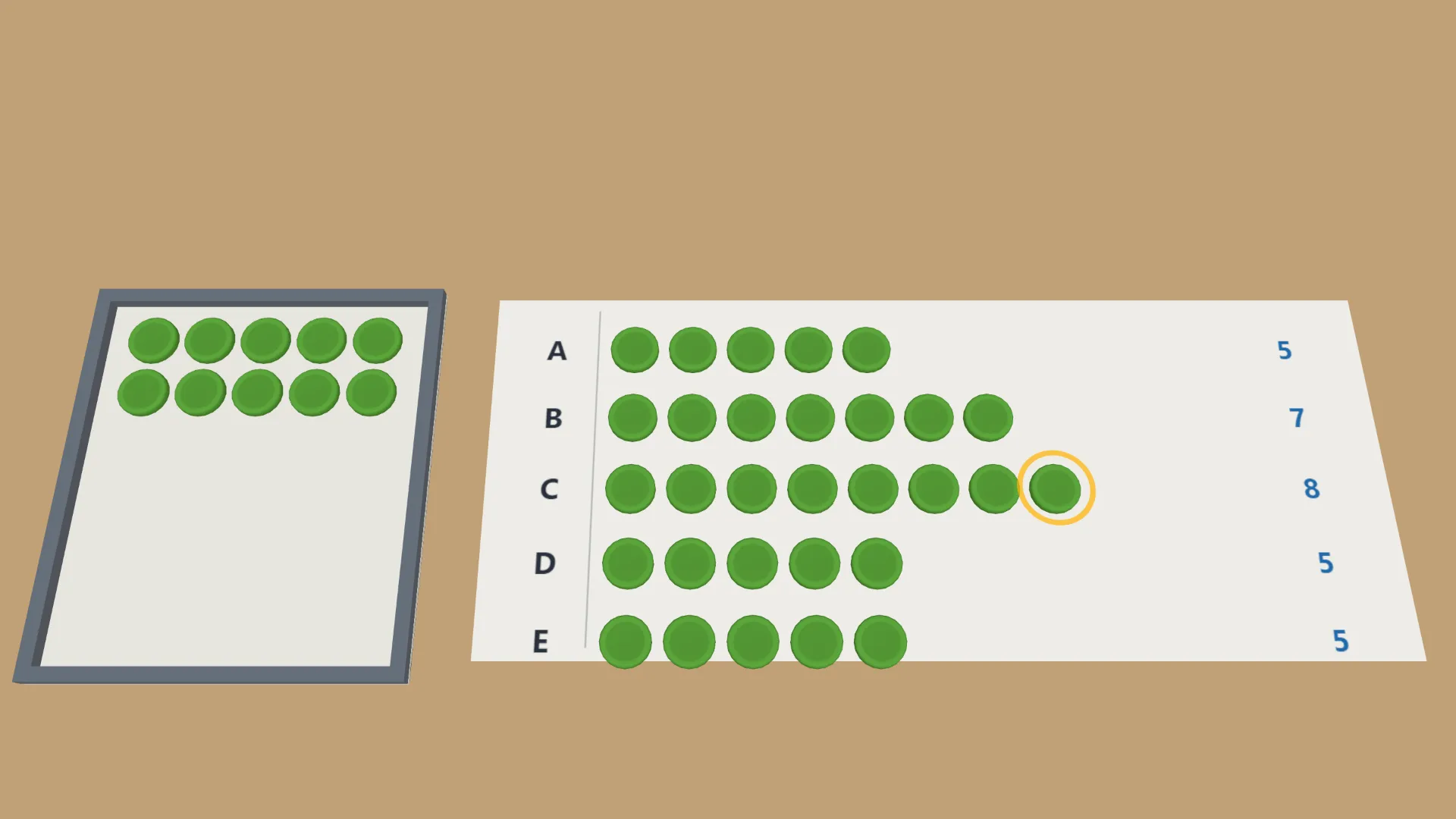
Interactive 3D Experiment
Loading simulation…
What to observe
- A statistical question has answers that vary; you need data to answer it.
- Levelling 3, 8, 10, 5, 4 gives 6 each, and 30 ÷ 5 = 6 too — the average is the fair share.
- The mean 4.8 letters is a decimal, and 6 is not one of the guava values.
- Every mean lies between the smallest and the largest value.
Notes
- The idea of the average is old. Brahmagupta (628 CE), Mahaviracharya (850 CE) and Bhaskaracharya (1150 CE) all used it — 'sama' means equal.
- In the 1500s, 16 men stood toe to heel; one sixteenth of that line became one 'foot' — a mean of 16 real feet.
- Record every value when you collect it; do not leave one out or enter one twice.
- Count the number of values carefully, and divide the complete total.
- Keep the unit with the average (letters, guavas, bounces).
- Check that the mean lies between the smallest and the largest value.
- Frame the question clearly before collecting data, so everyone measures the same thing.