
The Angle Sum of a Quadrilateral
Aim
Verify, by paper tearing and by the diagonal (two-triangle) method, that the four interior angles of any quadrilateral add up to 360°, and use this to explain why a quadrilateral cannot have exactly three right angles.
Apparatus
- Coloured paper or old chart paper
- A pair of scissors and a glue stick
- Ruler, protractor, and pencil
- A plain sheet to paste the torn corners
Procedure
- Draw an irregular quadrilateral. Shade its four corners in four different colours.
- Measure the four angles with a protractor, record them and find the sum.
- Cut out the quadrilateral and tear off its four coloured corners.
- Arrange the four corners tip-to-tip around one point, with no gaps and no overlaps.
- On a fresh quadrilateral SOME draw the diagonal SM, and add 180° + 180°.
- Try to draw a quadrilateral with three angles of 90° and a fourth angle not 90°.
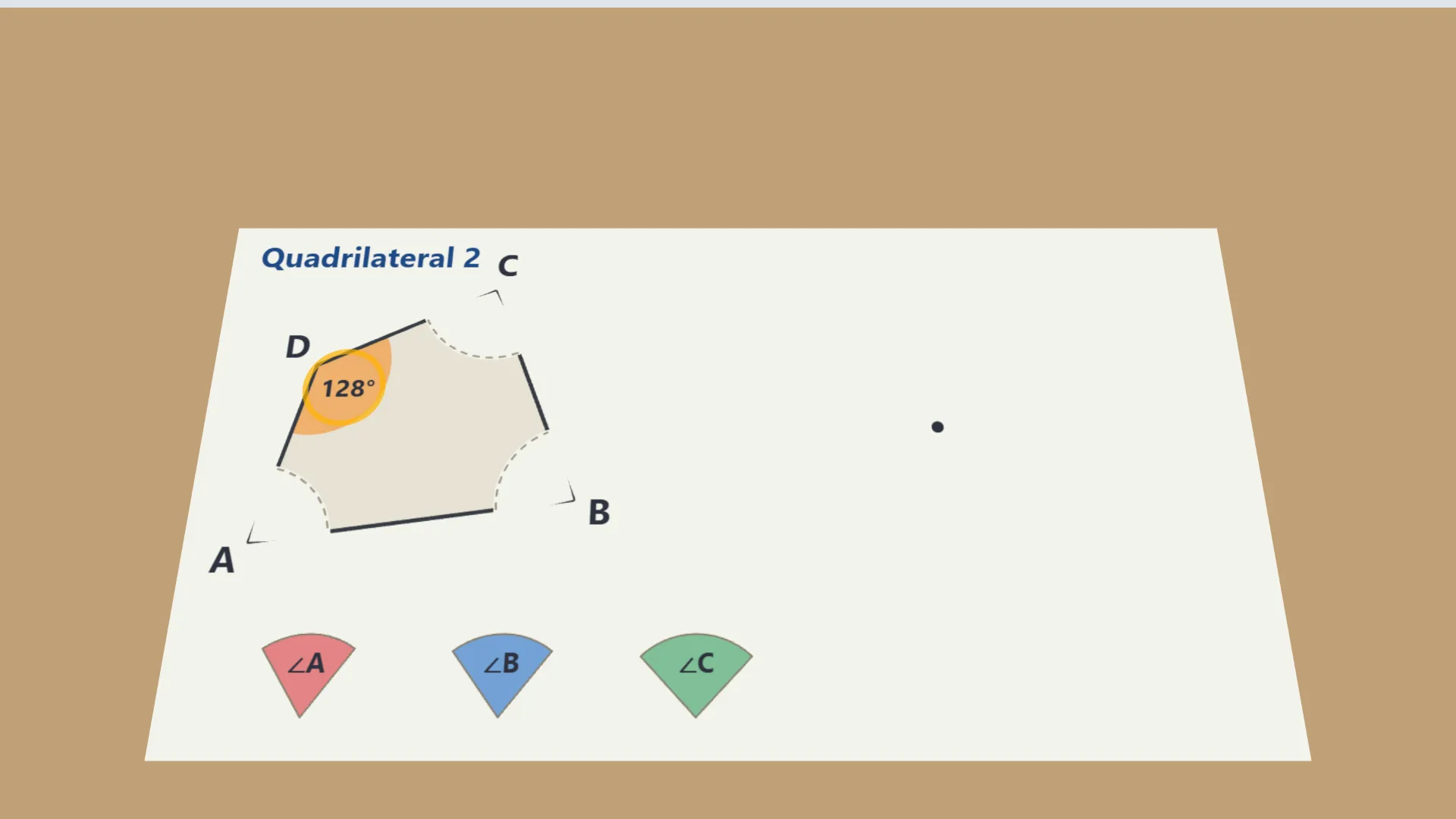
Interactive 3D Experiment
Loading simulation…
What to observe
- The four torn corners fit around the point exactly once, with no gap and no overlap — one full turn of 360°.
- The diagonal splits the quadrilateral into two triangles, and 180° + 180° = 360°.
- Three right angles use up 270°, which forces the fourth angle to be 90°, so a quadrilateral cannot have exactly three right angles.
Notes
- Math Spark: a triangle's angles make a straight angle (180°); a quadrilateral's make a full angle (360°). The angles of an n-sided polygon add up to (n − 2) × 180°. Square floor tiles fit around a point because four 90° corners make exactly 360°.
- Tear the corners rather than cutting them, so the torn edges show which angle belongs to the quadrilateral.
- Mark each angle with a coloured arc before tearing, so the vertex of each piece can be found afterwards.
- While arranging, keep all four vertices at one point and the pieces edge to edge, with no gap and no overlap.
- Repeat with quadrilaterals of different shapes, including a long thin one and a non-convex one, before generalising.
- When measuring, place the protractor's centre at the vertex and its base along one arm, and read the correct scale.
- A measured total may be 358° to 362°. Record the readings honestly and explain the difference as measurement error.
- Draw the diagonal from one vertex to the opposite vertex, so that exactly two triangles are formed.