
Analysing Primary Sources on Culture and Society
Aim
To read excerpts from historical chronicles and travellers' accounts, and to classify statements within them as fact, opinion or inference.
Apparatus
- The four primary-source excerpts (A to D)
- Notebook
- Pen
Procedure
- Read each of the four source excerpts carefully. Note who the author was and when they wrote.
- For each excerpt, find one fact, one opinion and one inference.
- Record your answers in the observation table.
- Discuss in pairs: does the author's background affect how reliable or biased the account is?
- Share your findings with the class and compare interpretations.
Interactive 3D Experiment
Loading simulation…
What to observe
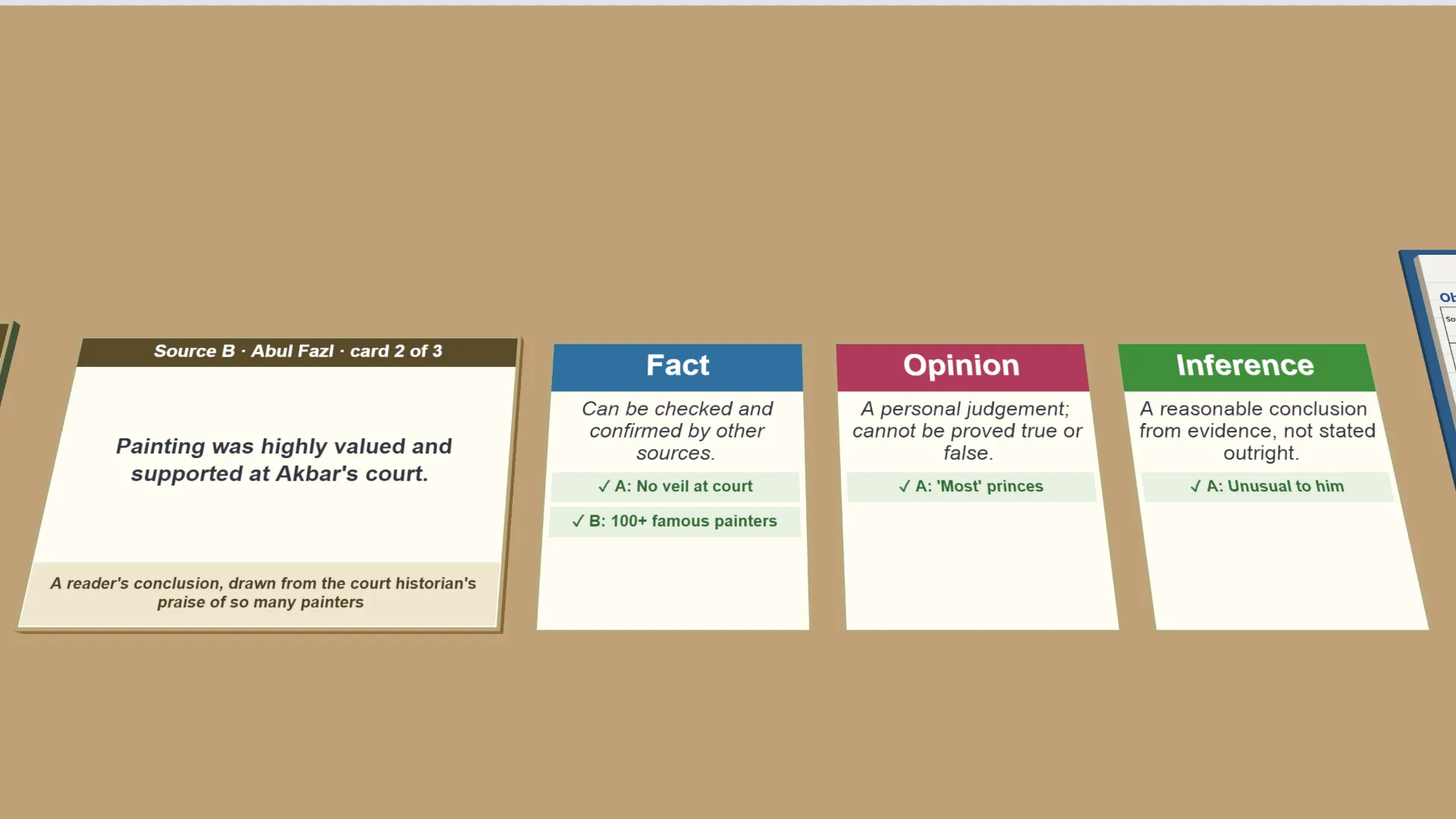
- A fact can be checked in other sources, like the women who kept the palace accounts at Vijayanagara.
- Words like "surpass our conceptions" and "well versed" show the author's own judgement.
- An inference is not written in the source; the reader concludes it from what is written.
- A court historian, a foreign visitor and a poet each write from their own point of view.
Notes
- Social Science Spark: a fact can be checked by other sources; an opinion is a personal judgement; an inference is a reasonable conclusion from evidence. Good historians tell these apart.
- Precautions: read each excerpt more than once; one sentence may hold more than one type of statement; do not assume a source is wholly reliable or wholly biased.
- The excerpts are from old public-domain English translations: Abu Zaid, in Elliot and Dowson, History of India, vol. I (1867); Abul Fazl, Ain-i-Akbari, tr. H. Blochmann (1873); Fernão Nunes, tr. R. Sewell, A Forgotten Empire (1900); Kabir, Songs of Kabir, tr. R. Tagore (1915).